

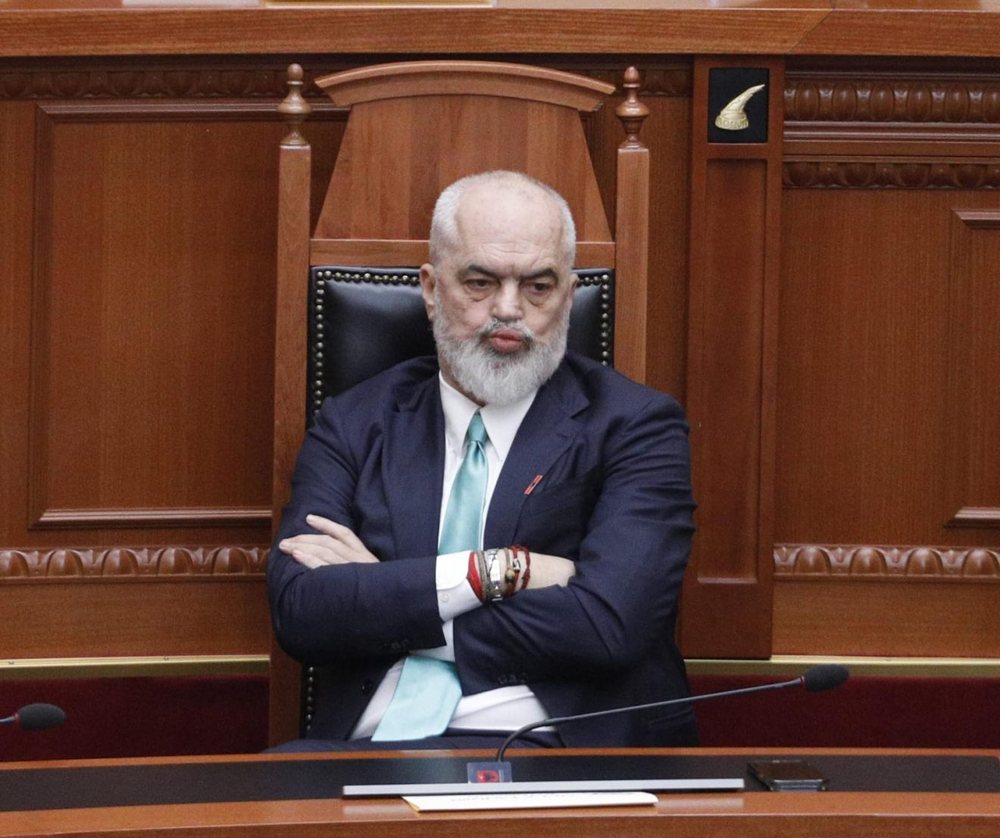
Prime Minister Edi Rama, in his attempt to campaign without an election and in the hope that he will be able to recover something of the image of the leader of a political force in which corruption is systemic, recently declared that he “rejects with disgust” the suggestion that he leads a corrupt party and government, and that the country, according to the suspicion or conviction of many people, is under the clutches of extortionate systemic corruption. He gave an unconvincing argument for this when he said that “if corruption had increased, the economy would not have grown.”
It is universally known that corruption, in the form of a lack of ethics or morality among the wider society, constitutes a major obstacle to human development and economic growth, because government corruption brings about “misallocation of resources”, while social corruption brings about a lack of correctness in the implementation of contracts or agreements, reducing work productivity. In short, corruption destroys the capital stock, whether in the form of physical assets or in the form of professional knowledge.
The problem is that, although corruption plays a significant role in hindering development, it is certainly not the only factor that enables or hinders economic development. Corruption, both in government and in the wider population, is not uniform.
If we accept the Prime Minister's logic, then we can say that between 1993 and 2008, Albania had an average economic growth of 6.5% per year, while from 2009 to 2025, the average economic growth was 3% (data from the International Monetary Fund). Does this mean that, in the 15-year period that followed the fall of communism in Albania, there was half as much corruption as there is today?! While, in the 16-year period from 2009 to today, there is twice as much corruption?!
Corruption is of course not something that can be measured, as the performance of the economy is measured (with a considerable dose of guesswork). We are not able to know exactly how much corruption there was during the democratic government (1992-1997) or the socialist government (1997-2005) or the PD+LSI or PS+LSI government, as well as after 2017, when the socialists have governed alone and no longer have an alibi for corruption.
We know that there was oil smuggling and crime and human trafficking and corruption with kiosk permits in the period immediately after the fall of communism. We know very well that there was corruption during the time of the subsequent socialist government or the democratic one. And we also know that, because the economy has grown, the budget that those in power can steal has also grown. We know that in 2002, at a well-known meeting among socialists, they accused each other of corruption over and over again, while one socialist was the one who declared that the party had taken on the features of “medieval principles” to describe corruption in the form of cells.
We also know that when Sali Berisha, who came to power in 2005 on an anti-corruption platform, was asked about corruption, he declared his opinion that “corruption is a lubricant”, a necessity to make a machine work. (Note the parable that imagines the state as a mechanical tool, a kind of somewhat rusty machine, which the citizen puts into operation by throwing a little bribe).
We also know that Rama declared not long ago that anti-corruption is “a cure worse than the disease.” (Here the parable goes to a grotesque level by comparing governance to a necessary body, which, if struck by SPAK, causes a tragedy for the rest of us, who cannot live without it.)
Economic growth is the natural state of humanity. The economy grows because humanity becomes more skilled. People learn and increase their knowledge of how to do more work, and consequently produce more goods or services, with less work. Economic growth is a collective effort of all humanity, while government corruption is a collective effort of a relatively small number of people, namely corrupt officials.
Corruption is a general term that does not always correspond to reality. For example, when Berisha spoke of corruption as a lubricant, almost twenty years ago, he was suggesting, incorrectly, that it was only about what is popularly called a tip. A tip is a sum of money given as a reward for getting things done quickly. So, if you need a state stamp or signature, and the state is a rusty machine that moves slowly, the citizen speeds it up a bit by giving it a tip for lubricant. This is different from bribery, in which the citizen pays to get something that is not his, for example, paying a traffic policeman to avoid a fine. But in Berisha's time there was another phenomenon that did not fall into any of these categories. It was the widely known phenomenon of traffic policemen who, in a pyramidal corruption system, paid to secure a job and then lay in wait to extort any possible passerby to recover the bribe money they had paid for the job. This does not fall under tipping, it does not even fall under bribery but has another name, it is called extortion. And of course the parable of the lubricant does not help much in explaining.
These types of corruption are child's play compared to some other types of corruption. One type, for example, is known in the language of the people as "customs' beam" despite the fact that it has nothing to do with customs and border crossings. The people have even created a joke about this, told in the Tirana mortgage, with a bey who collected taxes to build a bridge, imposed a tax for crossing the bridge and at a certain point, played a trick and ordered the rape of each of the villagers who crossed the bridge (in addition to paying the tax) to see how much the people keep. Customs beam differs from lubricant or extortion for the simple fact that each ruler builds and multiplies his beams. And while the beams multiply, as they have multiplied over the years in Albania, with concessions, monopolies, oligopolies, tenders, customs, mortgages, AZHBR, AKU, IKMT, APT, etc., the peasant who in the case of Berisha's parable had to pay for lubricant, is exhausted to the point that he runs away and flees to a more normal place like, say, Germany.
The issue with the current government is not that there is corruption because corruption is everywhere. The question is whether this corruption is individual or systemic. The AKSHI case and the “Balluku” case clearly show that corruption is systemic. And of course, systemic corruption does not allow the economy to flourish, as it can flourish, in the case of Albania. Albania is a country that can and should grow by 6 or 7% per year, grow for two or three decades at this rate to reach the economic level of a country like Croatia, Romania or Poland. With 3% economic growth, the country lags behind. The graph below shows why.
The data is from the International Monetary Fund and is in dollars. Currently, Poland's GDP per capita is 32 thousand international dollars higher than Albania's. In 2030, it is predicted to be 38 thousand more. The so-called economic growth that Rama boasts about and which he gives as an argument for why the country "has no corruption", seems to exist only in Rama's statements. / BIRN