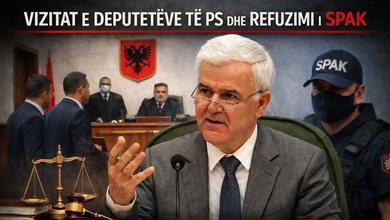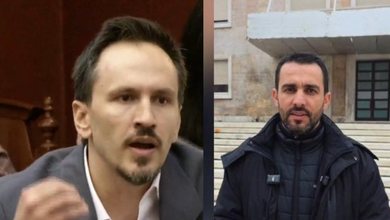



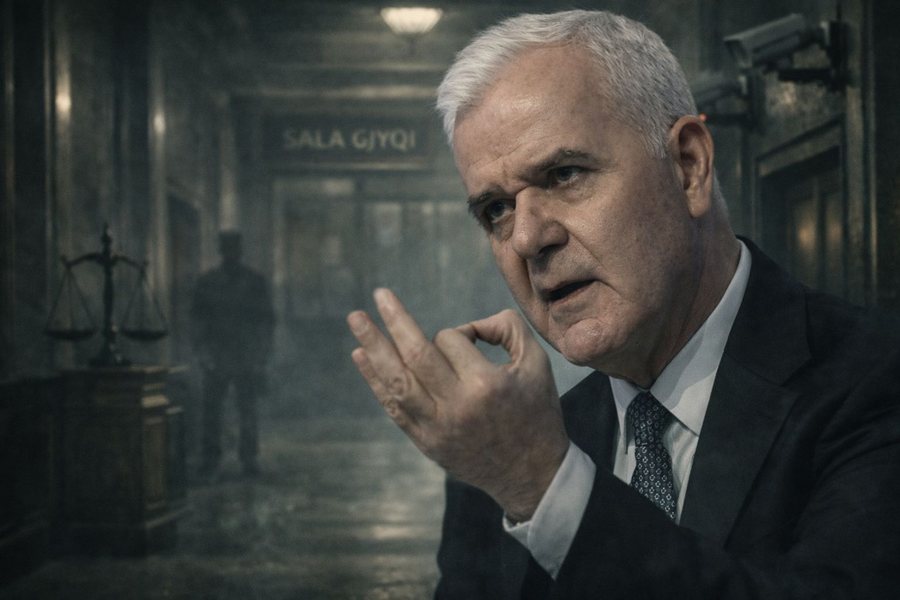
Fatmir Xhafaj would undoubtedly have liked to be in every court in the country to inspect and demand accountability, just as his parent party had taught him this craft before the 1990s. But this is impossible. And precisely for this reason, in open violation of the law and the Rules of Procedure of the Assembly, the "scoundrels" who have been sent to several courts as deputies of the "father of reform" have not been chosen at all by chance.
In the best case scenario, they are MPs with no connection to justice. In the most problematic scenario, they are MPs with problems with justice. The case of Saimir Hasalla is illustrative. Xhafaj sent him to "monitor" the Elbasan Court. Hasalla is the son-in-law of former MP Aqif Rakipi, who was removed from Parliament with the decriminalization law and declared non grata by the US State Department. Together with Hasalla, MP Aulona Bylykbashi also went to Elbasan for "monitoring".
Bylykbashi, former deputy mayor of Elbasan Municipality, has signed quite a few tenders that are currently under investigation by the Elbasan Prosecutor's Office and SPAK. Her presence as a "monitor" in this court is at the very least an open conflict of interest and in reality a form of pressure on justice.
For the Fier Court, Xhafaj has chosen a 31-year-old deputy, Erjo Mile, whose main merit seems to be his involvement in the socialist youth forum and a degree in psychology. Bledi Çomo, a lawyer by profession but with limited experience mainly in local positions, deputy mayor of Pogradec Municipality and secretary of the Korça District Council, has also gone to Fier. What can these two deputies inspect in a court like the one in Fier? What questions can they ask the judges and staff? The answer remains unclear.
Xhafaj has also sent Onid Bejleri, a young MP with a civil engineering background, to the Shkodra Court. His only contact with justice seems to be related to the period when he was the deputy mayor of Shkodra, perhaps when he was "crying troubles" with Benet Beci while the latter was a defendant by SPAK.
Meanwhile, in the Tirana Court, the new SP MP, the son of actor Petrit Malaj, appeared as Xhafaj's deputy. It is difficult to imagine what he might have discussed with the judges of the capital. Perhaps nostalgia for the positive heroes of socialist realism was the only topic worth discussing in those environments.
All this seems like a big joke. But the problem is that the seriousness with which this issue should be treated is nowhere in sight. The only clear element in this story is Fatmir Xhafaj himself who, violating every law and every procedure, has started "inspecting" the courts through his dummies, even though the latter probably don't even understand what they are doing.
The fact remains that the institutions that should have shown the way to this illegal act have become part of the problem: the courts that open their doors in violation of the law to deputies without an inspection mandate, the ILD and the KLGJ who choose to remain silent.
The attempt to put justice under control is neither new nor unknown in the Albanian reality of recent years. What makes the difference is the reaction. And so far the only institution that seems to still hold on to the old and long tentacles of the former State Security, softly and sweetly merged into the politics of the Renaissance, remains SPAK.