


By Desada Metaj
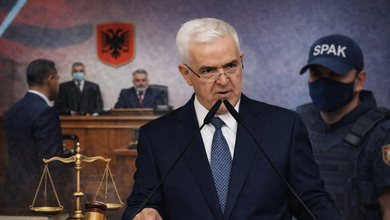
During the 7-hour meeting at the Prime Minister's Office between Edi Rama and Belinda Balluku, who had just been informed of the decision to suspend her from office by SPAK and GJKKO, Ulsi Manja himself was called in – apparently as a “confidant” for justice issues. It is not known what advice Manja gave in that closed room. But the fact remains that Rama left there to have dinner with Marta Kos, clear in his decision: to openly attack justice.
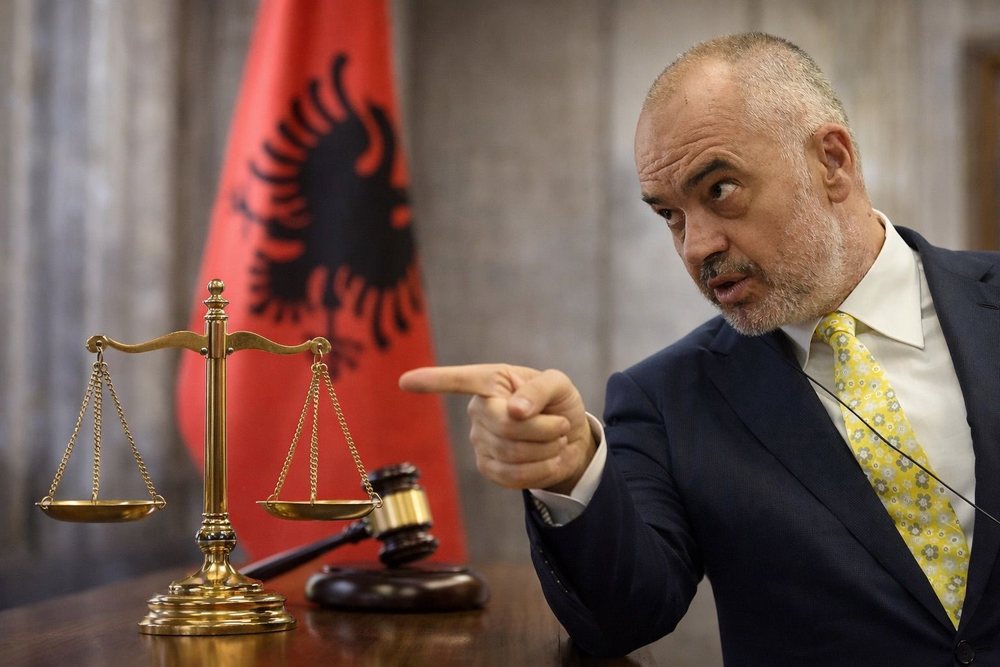
The first step was to take the clash to the Constitutional Court. A move that, despite the attempt to dress up in the guise of respecting official and apolitical tracks, essentially marked a completely new phase. A phase that freed Rama from the hypocrisy of the previous "defense of justice", of respecting and supporting the Socialist Party as a "guarantee of new reform", of the worn-out rhetoric of institutional trust. Most of us knew that these were simply political hypocrisy, produced by the deep embarrassment in which Rama was sinking more and more in the face of justice. Now he has thrown this mask aside.
Apparently, regardless of how this clash in the Constitutional Court will end, it is a small battle and without direct benefit for Rama and his people. Because it is, in essence, a battle of Rama but taking place in “foreign territory”, in the territory of justice itself. As such, it carries risks, uncertainty and portions with a lack of control. It is enough to see the delay of the Constitutional Court itself, after the initial haste and urgency, in issuing a final decision on the matter. Most likely, that court still does not give Rama the certainty beyond any doubt that he seeks. This path, therefore, does not offer solid and long-term guarantees.
Even Xhafaj's incursions, sending majority MPs to courts and prosecutors' offices to "monitor" them, do not constitute an effective strategy. The goal is not hidden, but the method is weak. SPAK's sharp opposing response to this control attempt has increased nervousness in the ranks of the majority, because it clearly showed that justice is not afraid.
Therefore, Rama's next step seems to be to shift the battle to his natural field: the Assembly. With 83 mandates or more, he has a cold political certainty: the fastest, most efficient and most concrete path is to change the justice laws. Precisely by setting the "red line" of the justice system towards the government.
For this new and more advanced phase of the clash, Rama once again chose Ulsi Manja. From the Top Channel studio, Manja made the message clear to prosecutors and judges: "wake up, because we are still far from the quality justice that Albanians expect". They, according to him, must "move away from the role of notary and rise to the height that the Constitution assigns to them".
This sounds like the last warning before a final intervention. It was clear to everyone that what Manja tried to camouflage – as much as she could and as much as she knows – was fundamentally simple: legal interventions in the justice system are now almost certain and imminent events.
As if untrained in these delicate moments, Manja forgot to say the "magic sentence" that Rama articulated in his speech on September 11 at the SP Assembly, when he declared that: "The baby is not thrown out with the bathwater, says a wise saying of our neighbors across the Adriatic, and in this case, heroic patience and ophthalmologist's care are needed so that the dirty water is cleaned slowly and by the institutions of judicial self-government themselves in the first place, because cleaning that dirty water is part of their public and legal mission. Our part is to support the improvement of the justice system with new laws, but there is another 'but', because no change in justice legislation, no matter how necessary it may seem to us here, will happen with our votes without getting the green light from the EC."
But patience seems to have run out. If judges and prosecutors "don't put their finger on the matter," then their heads will be cut off and their teeth pulled out. Not metaphorically, but through laws passed in the Assembly.
In fact, in the difficult position he finds himself in today in front of the justice system, Rama does not have much choice. This is the only card he has left. His fight with justice so far has made him look small and helpless rather than dominant. A prime minister who complains about Albania as a country with more detainees than convicted people - statistics that in fact do not speak of a failure of justice, but of its success. A prime minister who, even when he went to Paris, sought advice on how to change the article on abuse of office in the Criminal Code. A prime minister who "eavesdrops" on the Constitutional Court with bread in his hand to oppose the constitutional request for magistrates' salaries. A man who has gone from the absolute ruler of judges before the vetting, to the politician who is hit in the face by the strong reaction of the associations of judges and prosecutors, knocking him off the pedestal of greatness he had built in the eyes of the public. A prime minister who is now dragging his feet to "procedurally save" his deputy from SPAK's request to lift his immunity.
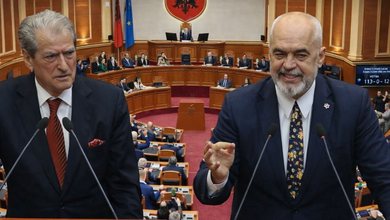
The only real strength he has left are those 83 mandates. There he can find, by building up, the formal justification of the “mandate given by the people”. There he also has the guaranteed consent of Berisha. Not coincidentally, the voices of analysts close to Berisha’s opposition have reinforced the strong blow of the thesis of “failure of justice”. It was no coincidence that, in parallel with Manja’s announcement, in other television studios these voices appeared in perfect synchronization: almost unanimously the narrative of the failure of the reform was articulated, camouflaged behind the increase in the number of files in the ordinary courts. Meanwhile, everyone knows that the “fear rabbit” is hiding elsewhere, in SPAK and GJKKO.
Most likely, Rama will now strongly invoke the thesis that Albania is a parliamentary republic and that his majority is mandated to undertake any initiative against what he calls the “republic of prosecutors.” The history of pressure on the Constitutional Court and the dragging out of Balluk’s immunity in the Assembly are nothing compared to what we have not yet seen: changes in the corpus of justice reform, aimed precisely at what Manja said bluntly from the Top Channel studio: “Put your finger on the mind, because we will intervene in the system.”
Of course, without the green light from Europe and America. At least the latter have already been warned by Ulsiu.