


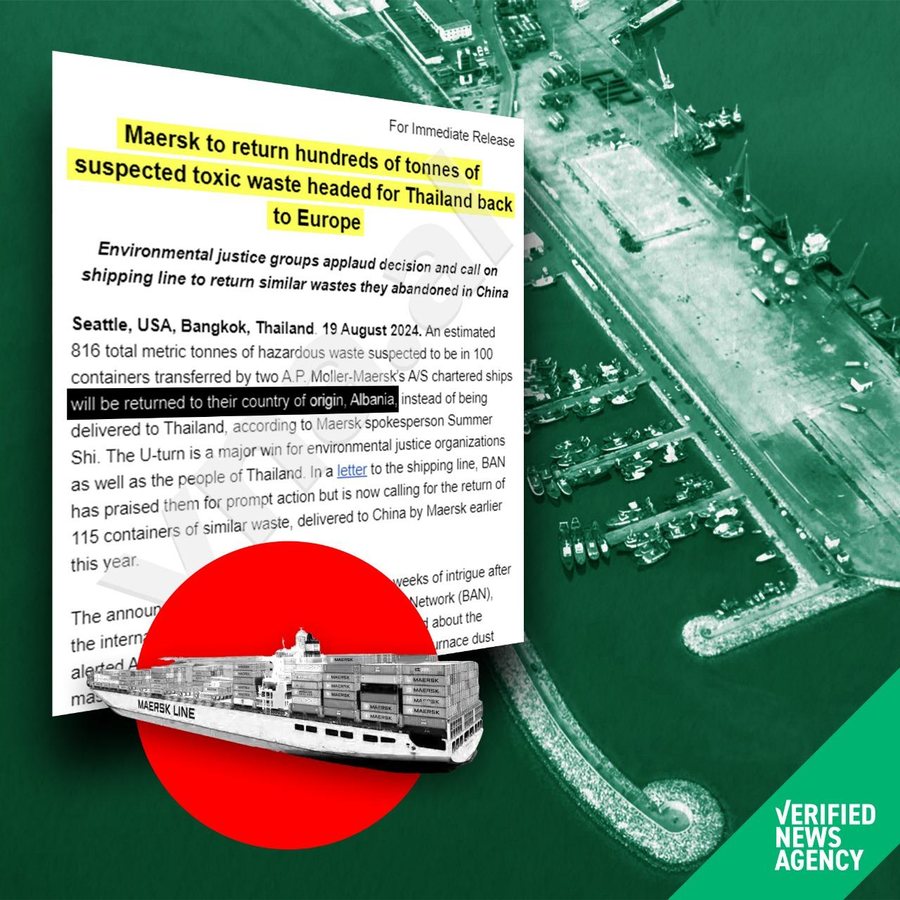
VNA learns that inside 102 containers of waste from the Turkish company KURUM, which were to be exported to Thailand through Gjovana Sokolaj's "Sokolaj" sh.pk company, it has already been verified that metallurgical furnace ash — a hazardous waste — was introduced, at a time when both companies appear to have carried out a series of actions to hide the true type of waste.
"Referring to the administered acts and the results of the expertise, it results that the entities Sokolaj sh.pk and Kurum International, fully aware of the danger of hazardous waste, which qualifies under code 10 02 07*, have carried out a series of actions to conceal the true type of waste, in collaboration with a third party, with the aim of exporting it outside Albania, avoiding all legal obligations provided for in Albanian and international legislation for the management of hazardous waste," the Prosecution document states.
The expert report to determine the type of waste inside the 102 containers that were returned to Albania, after the Basel network alert, was conducted in a specialized laboratory in Italy and constitutes the main document on which the Durrës Prosecutor's Office has filed charges and signed arrest or detention orders for the managers of the Kurum company, the Sokolaj company, as well as for senior state officials.
Results of the expert report
According to the Prosecutor's Office, the sending of the samples for expertise to the Advanced Analytical Services laboratory in Italy was accompanied by judicial police officers and experts who received them. On 24.12.2025, the expertise report of experts Selim Bregu, Sokol Abazi and Arjan Korpa was administered, from which it results that:
11 samples from 11 of the 102 containers seized
Based on the analysis of the total element content, the material is characterized by a very high content of zinc (Zn) and iron (Fe), accompanied by lead (Pb), copper (Cu), manganese (Mn), calcium (Ca), potassium (K), chlorine (Cl) and sulfur (S). The oxide composition is dominated by zinc oxide (ZnO – about 43%) and iron oxide (Fe₂O₃ – about 34%), with the presence of oxides typical of the metallurgical processes of steel production.
"In the case of the analyzed material, it is dust collected from the gas filtration systems of the electric steel furnace (EAF)," the document states.
Sample PROK-3 – Kurum International (28.08.2024)
This sample presents very high concentrations of zinc (about 262,000 mg/kg) and iron (about 140,000 mg/kg), associated with lead and copper. Expertise identifies it as zinc-rich (Zn-rich) EAF dust, the same as the material in the 11 seized containers.
Samples PROK-1 and PROK-2 – Sokolaj sh.pk (28.08.2024)
These samples do not match EAF dust. They have:
• very high copper content (12–14%),
• low zinc and lead content,
• increased presence of selenium (Se) and thallium (Tl),
• high release of copper and iron in the leaching test.
Experts describe them as Cu-rich non-ferrous smelter dust, associated with copper smelting or refining processes — that is, material other than that in the containers.
Sample PROK-5 – Alliance sh.pk (30.10.2024)
This sample results in Zn-rich EAF dust, comparable to the material from 11 containers and PROK-3. It also contains organic compounds PAH and PCB, typical of electric furnace filters.
Do the samples contain hazardous substances?
Yes. In all samples (1A–11A, PROK-3, PROK-1/PROK-2 and PROK-5) the presence of:
• zinc (Zn),
• lead (Pb),
• cadmium (Cd),
• arsenic (As),
which are associated with toxic risks to reproduction and aquatic ecosystems, requiring treatment as hazardous waste under the law.
Are the 11 container samples the same?
Yes. The variations are within normal limits for heterogeneous industrial materials. All are identified as EAF dust Zn-rich.
Do the 11 samples match PROK-3, PROK-1/2 and PROK-5?
• Yes to PROK-3 (Kurum) and PROK-5 (Alliance).
• No to PROK-1 and PROK-2 (Sokolaj).
Do the 11 samples match the analysis sheets submitted by Sokolaj/Kurum?
No.
The analysis sheets of:
• Kurum (11.10.2023)
• CEMTRA / GS MINERALS (07.04.2024) present materials dominated by iron oxides and with almost zero zinc, completely different from the real profiles found in the containers (ZnO ≈ 43%, Cl and S present).
Experts conclude that the analyses submitted by the entities do not reflect the actual material loaded into 102 containers.
VNA was also able to obtain the Prosecution's conclusion according to which:
The entities Sokolaj sh.pk and Kurum International, fully aware of the hazardous nature of the waste (code 10 02 07*), have taken actions to conceal its true type, in collaboration with a third party, with the aim of exporting it outside Albania, avoiding national and international legal obligations for the management of hazardous waste.