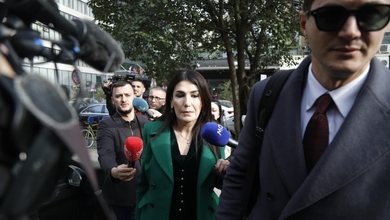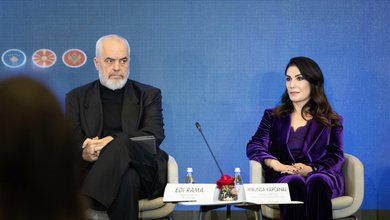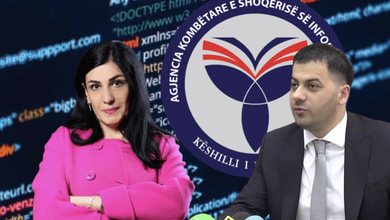


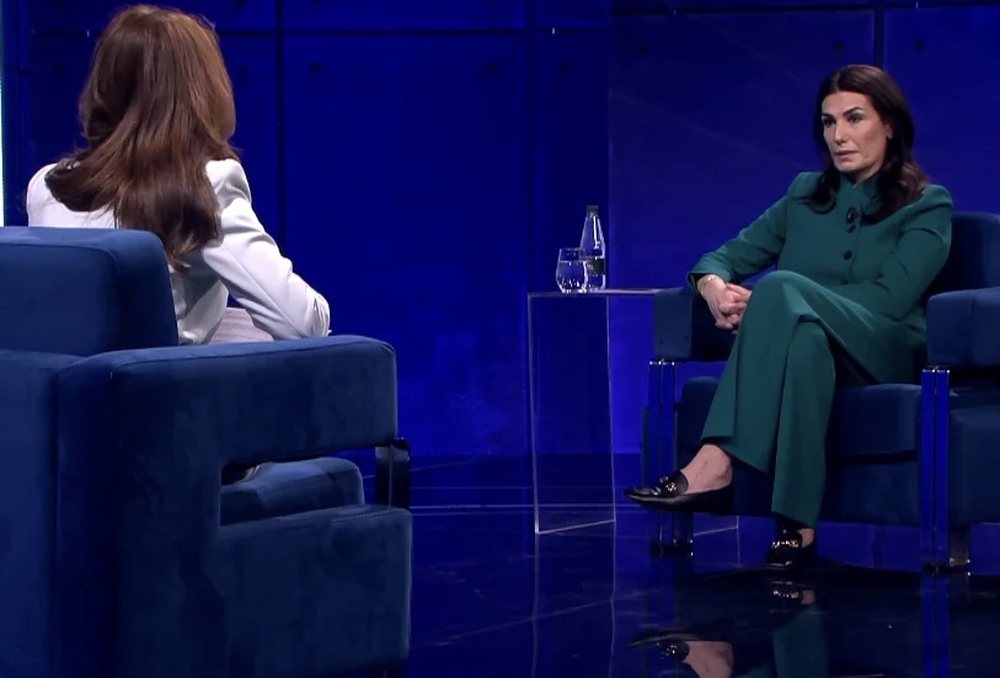
One of the most talked-about names of recent months suddenly appeared on prime time: former director of AKSHI, Mirlinda Karçanaj. Faced with serious accusations raised by SPAK for tender manipulation, organized criminal group and money laundering, the public expected an interview with real questions, a confrontation with the facts and accountability for the millions of public funds that have allegedly been wasted.
But what was broadcast on screen resembled more of an image-cleaning operation than journalism. A studio set up as an emotional refuge for a person accused by the justice system, with read questions, read answers, carefully dosed tears, and a television production that seemed to have taken it upon itself to erase the SPAK file from public memory.
Instead of questions about the connections with Ergys Agasi, about the allegedly manipulated tenders, about the villa in Qerret, the apartments, the meetings, favoritism or accusations about the scheme of distributing public money, the public saw a series of television skits where Karçanaj repeated that he had entered "the slaughterhouse of living things", that "AKSHI had made a revolution" and that he lived in a rented house near work out of institutional commitment.
Even, in an attempt to relativize the lifestyle and wealth that have raised so many public questions, she threw in the excuse that "they rented a house on the beach like all Albanians". As if Albanians spent their holidays en masse in rented villas by the sea and not counting the expenses for a few days of vacation. In fact, that was probably the only sentence that seemed to have come out of the script so carefully curated, because it was precisely there that it was realized how artificial the entire interview was and how far from reality the attempt to present herself as "just like everyone else" sounded.
The most scandalous thing was not only the way the charges were avoided, but the fact that a person under investigation for such serious crimes was treated as a victim of the media and not as an official who should answer to citizens for suspicions about the use of public money. Attacks on journalists were an integral part of this performance, as if the problem were not the SPAK charges, but those who report them.
Meanwhile, the SPAK file speaks of concrete charges: “Violation of equality of participants in tenders or public auctions”, committed in the form of a structured criminal group, “Structured criminal group”, “Commitment of criminal offenses by a criminal organization” and “Money laundering”. The investigations suspect manipulation and illegal favoritism in about 12 public tenders conducted by AKSHI, where according to the prosecution, Karçanaj is suspected of having acted in collaboration with businessmen Ergys Agasi and Ermal Beqiri.
But on screen, none of this existed. Only tears, servility to prosecutors, attacks on journalists, and meticulously crafted acting, where the interview seemed more like a television sweep to clear away the mud of accusations than a confrontation with the truth.