Opinion from Muriel
There are times when a court decision says more about the quality of a republic than an entire election campaign. The decision by federal judge Richard Leon in the United States, which temporarily halted Donald Trump's project for a ballroom in the White House, is one of them. The reasoning was clear: the president cannot change a symbolic national asset at will; private funding does not supersede the law; and the head of state is its custodian, not its owner.
This is, in essence, the standard of constitutional democracy: power is not measured by how far it can go, but by how quickly and clearly it stops when it crosses the line.
This is where the inevitable comparison with Albania begins.
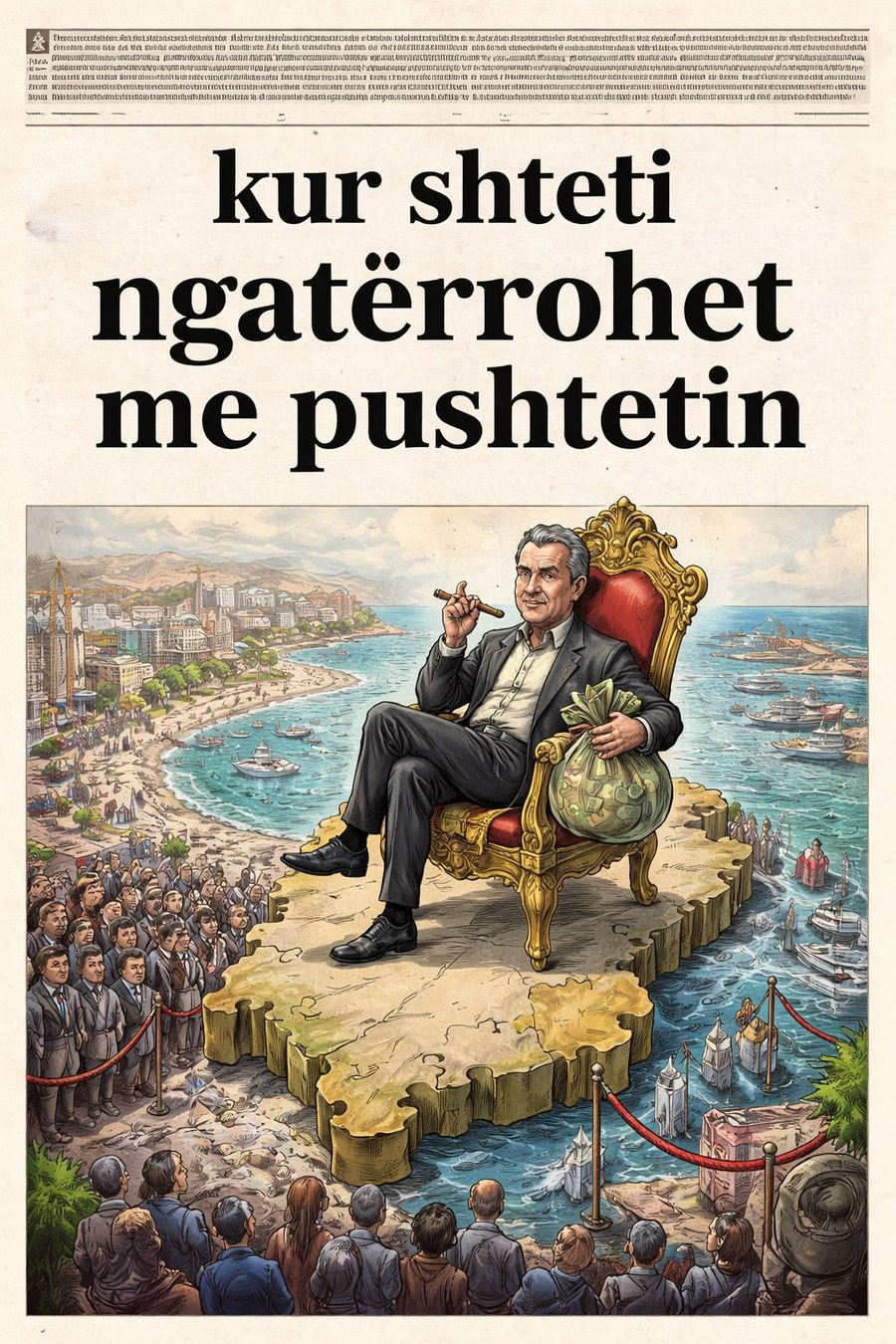
In the last 13 years, the big problem of Edi Rama's government has not only been the concentration of power. It has been something deeper and more harmful: the creation of a governing culture where the state, public property, the coast, ports, stadiums and even national heritage have often been treated not as assets of the republic, but as tools at the disposal of the executive will.
This is a fundamental change. Because when the state is seen as a trust, the government preserves. When the state is seen as an instrument, the government distributes.
The Law on Strategic Investments is perhaps the clearest expression of this philosophy. It gives the executive broad powers to make state lands, forests, agricultural lands and other assets available, as well as to treat certain projects as “public interest”, even with the possibility of expropriation for their purpose. In theory, this is a development tool. In practice, without strong institutional control, it risks becoming a mechanism for shifting public wealth towards interests favored by the government.
And this is precisely what has worried European institutions on more than one occasion. The European Commission has raised concerns about the extension of the law on strategic investments, about derogations in procurement and about policies that may conflict with European Union standards. When these remarks are repeated, we are no longer dealing with a party debate, but with a problem of the governance model.
The case of Sazan makes this pattern most dramatic. An island of historical, military and environmental significance was repurposed into a luxury resort after the government granted strategic investor status to a company linked to Jared Kushner for a project reportedly worth around 1.4 billion euros. The decision was made by the Strategic Investment Committee headed by the prime minister himself, with the state expected to get involved through the Albanian Investment Corporation.
The real question here is not whether the project brings in money. The question is more serious: can such a national asset be treated simply as an investment opportunity? In a state with constitutional reflex, this would have required a deep public debate, strong parliamentary oversight and much more rigorous institutional control. For republics are not measured only by the ability to attract capital, but also by the ability to maintain the limits of what should not be lightly put on the table.
The same logic is evident in the Port of Durres. The Constitutional Court describes in its decision that the “Durres Marina & Yachts” project received strategic investment status over an area of approximately 79 hectares and that the state property was transferred to the asset fund for supporting strategic investments, in order to implement the project. A national port asset, of public and economic importance, was thus put on the path of a luxury development with marinas, residences and elite services.
Here too, the problem is not just the project itself. The problem is the philosophy that produces it: the idea that public wealth can be redefined according to the vision of the next government, without a strong culture of institutional restraint. Instead of the question “what does the public lose?”, the question “how much does the investor gain?” has often been imposed.
Butrint represents another dimension of this deformation. The Constitutional Court found that the relevant foundation received the exclusive right and obligation to indirectly administer the cultural property, including possession, use, exploitation and enjoyment, but not ownership. Legally, the title of the property remained with the state. Politically and institutionally, however, a formula was accepted where exclusive control of the administration was moved outside the ordinary public administration.
This is a distinction that deserves attention. Public property today is not always given away by outright sale. Often the form is preserved, while the content changes. The property remains “state” on paper, but the use, management, and practical benefit pass into other hands. It is here that the gray area begins where the republic maintains the facade but loses substance.
One of the most tangible aspects of this policy is the coast. Official AIDA materials have promoted the “Albania 1 Euro” scheme as an instrument to provide investors with state-owned land for tourism projects for long periods. The state itself, in its official language, has presented public property as a competitive advantage to be offered at a symbolic price.
This is not just an economic issue. It is a sensitive issue of public morality. Because when the coast, land and state assets begin to be treated as promotional tools of the government, the belief is created that the public is no longer the owner of its wealth, but a spectator of the way it is redistributed. The case becomes even more serious when investigative reports have documented the transfer of public land for strategic investments or transactions far below market value.
Even stadiums and sports spaces have been introduced into this logic. The project for the “rejuvenation” of Selman Stërmasi and the use of sports properties as part of mixed-use development formulas show that even where urban, sports and civic interest should have dominated, the logic of rent has forcefully entered. Public space is no longer seen as a value to be preserved, but as a potential to be capitalized on.
This is the moment when the comparison with the American case becomes painful.
There, the court reminded the president that he cannot touch a national asset at will. Here, in Albania, the idea has been created for years that a “strategic” status, a government decision, a partnership formula or a state corporation is enough for public property to change direction according to political necessity.
There, it was said that private financing does not replace the law. Here, society is constantly invited to remain silent as soon as large investment figures are presented, as if private capital would automatically clear up any problem of public interest.
There, the court said that the president is a guardian, not an owner. Here lies the most serious political indictment against Edi Rama: during a good part of his government, he has often acted not as a temporary guardian of a republic that belongs to the citizens, but as an administrator of a state that can be reformatted according to the vision and interest of the government.
This is not just a matter of arrogance. It's a matter of boundaries.
A republic is not only damaged when the Constitution is openly violated. It is also damaged when the idea is normalized that public property is negotiable according to the needs of the government; that the coast, the port, the island, the stadium and the heritage can pass from public function to the logic of the project; that the citizen must be content with propaganda, while the state gradually loses its public substance.
The responsibility, of course, does not only lie with those who exercise power. It also lies with the institutions that have not always reacted with the necessary force, speed, and authority. Because the republic is not lost only when power crosses the line. It is also lost when no one shows it the line anymore.
And this is, in the end, the most bitter lesson for Albania: not only has power been prolonged, but it has been prolonged along with the belief that the state is disposable. That it can be packaged. That it can be given away. That it can be reused.
A society that gets used to this idea risks losing more than a port, an island, or a piece of coastline. It risks losing the very meaning of the republic.