

By Desada Metaj
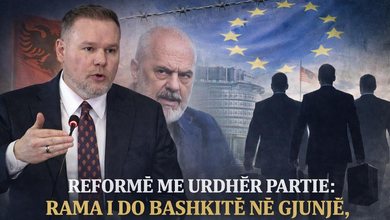
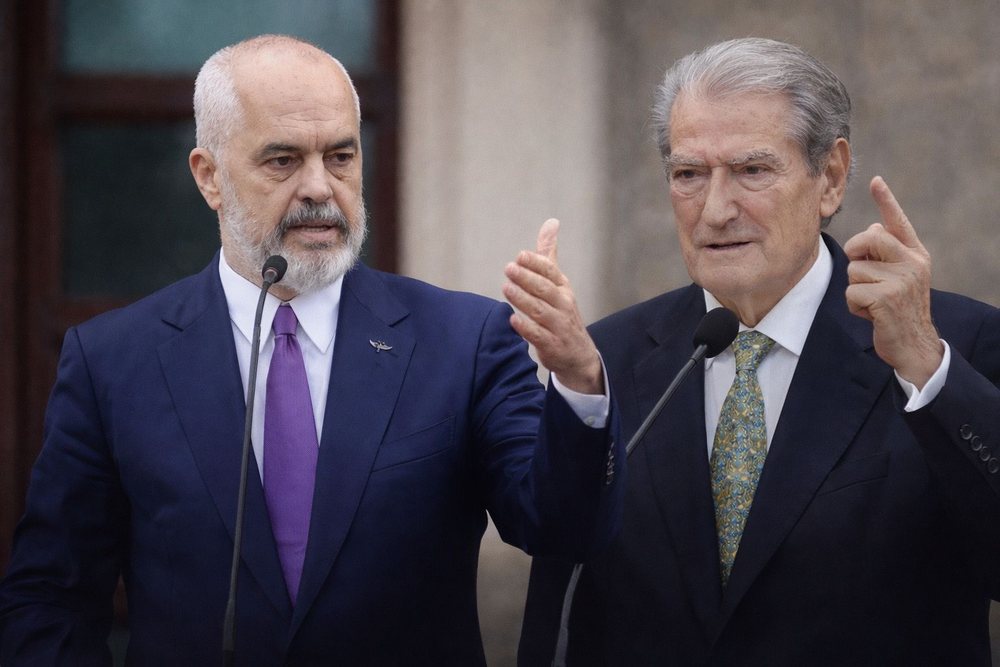
While the Balluku issue remains politically unresolved, while Berisha’s promises of a “final fight” against Rama continue to exhaust their energy only in press conferences without any substance, and while both leaders are up to their necks in the autocratic administration of their parties — one with exclusions from the government and screaming in closed meetings, the other with the dismissals and self-exclusions of a dozen local and central officials — it is precisely in this climate of political darkness and confusion that the SP and the DP have found the time and calm to agree on the next agreement. This time, the object of the bargain is one of the most important components of the electoral reform: the law on the financing of political parties. Gjiknuri and Bylykbashi made the agreed draft law public, presenting it as a joint achievement and as a fulfillment of international recommendations.
The financing of political parties is among the most delicate and heated topics throughout the democratic world, for a simple reason: it is the real nerve of the electoral process. Despite the official rhetoric that the vote is free and equal, the reality of contemporary democracies shows that the deepest deformation of the public will does not come from the manipulation of the vote on election day, but from the deep financial inequality between political forces and from the murky financing of electoral campaigns.
Albanian democracy, in its practical essence, is today largely a reflection of party democracy. It is enough to look at the internal structure of political parties — hermetic, vertical, autocratic like military units — to understand that the citizen's vote is often a mirage that increasingly departs from the principle of popular sovereignty. This democratic mutilation has its source and ferment in the totalitarian spirit that reigns within the political parties themselves. Precisely for this reason, the issue of internal party democracy and party financing should be the main axis of any serious electoral reform — especially when those proposing the reform systematically complain about electoral manipulation after every defeat.
The historical precedents are clear and instructive. The Italian Republic of the First Party was overthrown in 1992 precisely by the “Mani Pulite” operation — a legal movement (tangentopoli) that was based entirely on the issue of illegal financing of political parties, left and right. The corrupt financial system of parties was one that had infected every branch of the Italian state. Similar examples can be found in Germany, France and Spain, where party financing scandals have produced substantial reforms and criminal prosecutions of top political leaders.
The analysis of the draft law agreed between the SP and the DP reveals a clear logic: maintaining the status quo under the facade of reform. Specifically:
• Public financing remains concentrated. The two main parties will continue to receive over 70% of public funds from the state budget. This mechanism institutionalizes the financial dominance of the SP-DP duopoly and makes the entry of new political forces structurally difficult, thus hindering free competition and the opening of the political system.
• Channels of dark financing are preserved. For example, the draft law maintains the provision according to which “political groups abroad” can finance Albanian parties — an area with a well-known and controversial history. Suffice it to recall the six million dollar financing of the DP by “an Albanian-American political group”, as explained at the time by Sali Berisha. This legal window, carefully kept open, risks serving as a channel for the legalization of funds of unclear origin.
• Self-declaration as a control mechanism continues. The current system — where parties self-declare their sources of funding and where black money appears in the CEC books as fictitious membership “donations” — remains intact. The practice is widely known: members’ signatures are taken without their knowledge or real will, and this serves as a legalizing facade for money of illegal origin. This mechanism functions as a legal laundry within the party structures themselves.
• Real-time monitoring is missing. The draft law maintains the current control system only ex-post, i.e. after the end of the campaigns. This is a fundamental gap: when the campaign is over and the voting has taken place, the democratic damage has already been done. Everywhere in consolidated Western democracies, the collection and spending of electoral funds (fundraising) is carried out through exclusively banking channels — i.e. traceable — and is subject to real-time transparency, as in the United States, the United Kingdom and Germany. The same standard has been required for years by the OSCE/ODIHR recommendations. The SP and DP draft law has not even bothered to provide, for example, that every donation be made exclusively through banking channels. The sentence "follow the money" should have been the guiding star of such a reform if it were serious.
• Sanctions are absent or disproportionate. The law does not provide for sufficient and proportionate sanctions against political parties that finance election campaigns based on vote buying and abusive financial power — severely distorting the free will of the public. The phenomenon of buying seats in the Assembly with money is the main risk that is eroding the political and institutional system. And such seats should not be used to govern or change the constitutional system. Political parties that use them should be severely sanctioned in this regard, either by losing those seats or by criminal repercussions. In the absence of criminal fear, nothing changes behavior.
Financing electoral campaigns with criminal and corrupt money is, in essence, the highest form of political corruption — because it not only produces corrupt decision-making, but directly buys state power. This is the corruption that breeds all other corruption: governmental, judicial, prosecutorial. SPAK was established as a specialized institutional structure for governmental corruption. But for the political corruption of financing parties and electoral campaigns — which is a primary and not a secondary crime — this bargain between the SP and the DP is consciously and intentionally silent.
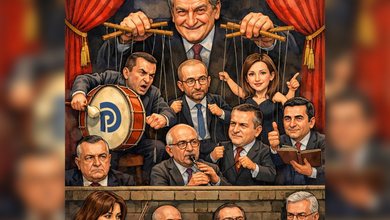
This is not a matter of technical incompetence on the part of Bylykbashi or Gjinuri. It is a matter of the pact — now open — between Berisha and Rama to keep the political system closed within their duopoly. It is a matter of converged interests: both parties know that winning elections is, above all, a reflection of financial strength. In a society increasingly distrustful of politics, where political morality has fallen sharply, the power of money is what dictates the electoral outcome and, ultimately, the governance of the country.
The law on the financing of political parties, in the current Albanian conditions, should have the dimensions of a true state-building revolution. It should be one of the hottest political topics, one of the main pillars of the parliamentary debate, and one of the areas where the judiciary would have expanded monitoring and supervision powers. It should guarantee full transparency, mandatory bank financing, criminal sanctions, independent real-time control and strict limitation of the influence of foreign funds.
But since Berisha and Rama are engaged in exclusions from the party and the government, with statutory changes to maintain personal dominance in their structures, with the asphyxiation of any new political movement outside them and with the installation of party totalitarianism within them — even this new season of SP-PD “love” seems to be giving the same offspring of political immorality. A change of form without changing the substance. An in no way refined way of public deception. What they offer is not a reform, but a simulation of it. A change in appearance, to guarantee continuity in essence. A compromise that does not aim to improve the system, but to protect it from any real threat of change.