


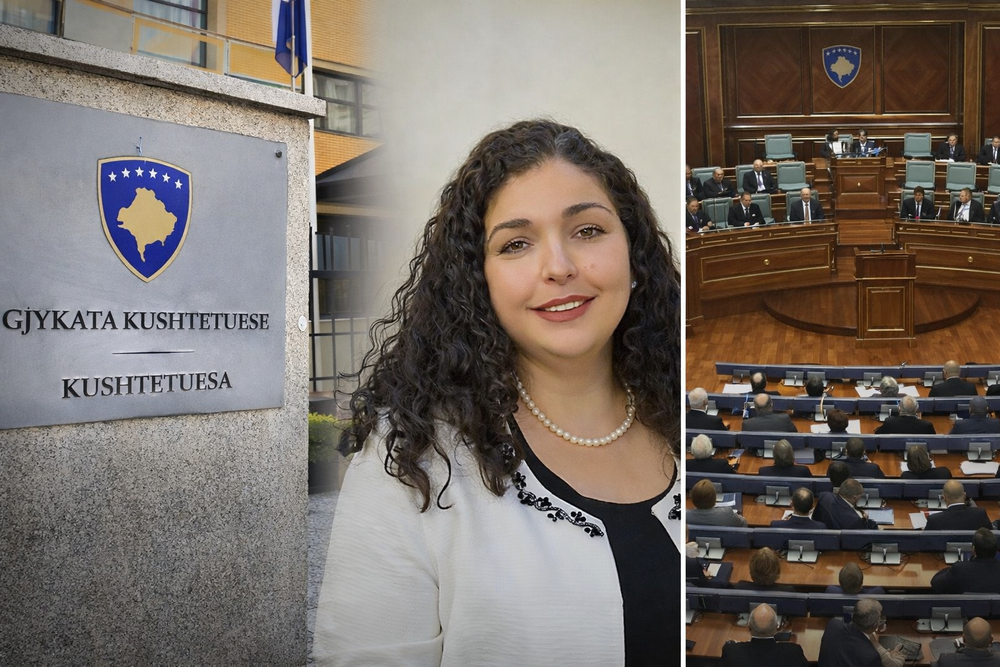
The decision of the Constitutional Court of Kosovo on the decree of President Mrs. Osmani to dissolve the Assembly of Kosovo was nothing more than an official institutional confirmation of the chain of Vjosa errors. Institutional errors that for the first time in Kosovo have compromised the institution of the President, but also political errors that have compromised the politician Vjosa Osmani. The chain of Vjosa errors has also revealed a larger problem, that of the political environment in Kosovo, which is increasingly, unfortunately, trying to resemble the toxic, anti-state, anti-development and corrupt politics of the Republic of Albania. The chain of Vjosa errors has encompassed a series of scandalous events that have occurred over the years in Albanian politics. Years later, any historian with a passion for politics will have to carefully analyze and examine this event, not only for cool-headed historical documentation, but above all to analyze all the problems that are a synthesis of the incompetence that Albanian politicians are displaying after the 90s.
The institutional mistake of the President, confirmed by the decisions of the Constitutional Court of Kosovo, was the dissolution of the Assembly in a hasty action, obviously emotional, but clearly also a game behind the scenes. The decisions (several such) of the Constitutional Court of Kosovo are exhaustive in the legal argumentation of a series of actions of the Assembly and the President.
The Court has argued that the presence of MPs in the sessions for the election of the president is a constitutional obligation, understood with the final objective of ensuring the functioning of the institutions, that is, of the state. In this context, every MP who chooses the option of “non-participation” practically positions himself against state consolidation and against the institutions, and invalidates the vote of the voters whose representative he is in the Assembly. The MP is voted for representation and the exercise of the function as a representative by participation and vote, he is not voted for non-representation. But non-participation is the MP’s mistake. It does not give the president the right to act as an “ordinary employer and dismiss MPs who do not go to work” by an act of dissolution of the Assembly. It is another matter that in order to enable the implementation of the Court’s interpretation, the institutions in Kosovo will have to think about developing the relevant mechanisms. Meanwhile, MPs and political forces who prefer to block the Assembly through non-participation should learn from the boycotting mistakes of the opposition in Albania, which has suffered considerable setbacks for this reason.
The court immediately after the referral of the case by the Assembly accepted it and blocked its implementation. The actions of both the Assembly and the Court were swift in time, as required by the seriousness of the situation and the highest institutions of a state. But Vjosa continued the mistake by not silently waiting for the court's decision. She rushed to organize the consultation on the election date, creating an environment that violates respect for the court's decision and aligning herself as a political party of that party that will at all costs overturn the election result from behind closed doors and tables. Here Vjosa lost the institutional integrity and political impartiality that the president should have.
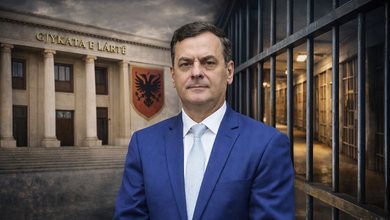
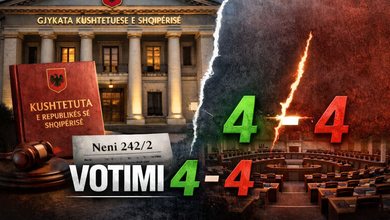
The court, without delay, unanimously ruled against the presidential decree, specifying in detail and deadlines the process leading to the election of the President or to early elections, for the specific case and for the future. These decisions, in the way they were taken in time and in their interpretation, seem to have been justified with a sound professional spirit and in the function of the consolidation and functioning of state institutions. A very strong contrast with the anemic and broken Constitutional Court of Albania, which to date has been distinguished for half-decisions, decisions without decisions and with justifications based on technicalities and not on the spirit, essence and constitutional principle.
Vjosa made the next mistake with the ridiculous reasoning that the Constitutional Court's decision does not find a violation in her decree. In fact, the Constitutional Court's decision, with a professional and elegant formulation, has nullified her decree, due to its unfoundedness. So the president, who should be the guarantor of the constitution, made a mistake in implementing it in his favor. Here Vjosa resembled Holta Zaçe, the former president of the Constitutional Court of Albania, who misinterpreted the constitution for her mandate.
Even earlier, Kosovo constitutionalists had publicly argued against the decree. Vjosa defended himself with the argument that he had consulted enough people about this decree. Here Vjosa resembles Bajram Begaj. She decreed the dissolution of the Assembly and began the process of decreeing the election date, contrary to the constitution. He decreed the date of the local elections contrary to the constitution, justifying himself by consulting others. The two presidents opposed to the constitution now have the obligation to show who the “professionals” are who consulted them in this action.
That Vjosa was wrong with the decree dissolving the Assembly was understood even before the process in the Constitutional Court began and most likely Ms. Osmani herself understood it, because the entire series of actions and public controversies that she undertook (together with her staff of advisors) was a typical situation led by emotion and not by cool-headed reasoning, by things getting out of control or by a contrived plan and not by assessments in the service of the state. The harsh and political confrontational language, the publicizing of discussions in the model of “a woman complaining in the neighborhood about her mother-in-law”, or of the details of the circulation of messages, and especially the use of a media outlet in Albania to send messages to Kosovo, were typical behavior and trajectory of a person who seeks to cover up the mistake and in a hurry falls into other even more revealing mistakes.
To put it bluntly, Vjosa erred in dissolving the parliament with an unprecedented act against the representative institution of the voter and the highest in the institutional hierarchy in a parliamentary republic. Even a president elected by the people does not override the parliament in a parliamentary republic.
Vjosa made a double mistake by starting a new institutional crisis in a country that needs to consolidate institutions and that had gone through a period of stalemates and frequent elections.
Vjosa, with her mistakes, violated the seriousness of the institution of the president, the guaranteeing and balancing role, and above all, she overthrew the principle of the president who is equally distant and who stands above the parties. This time, she acted as a party, firstly as a party of herself and secondly as a party of that part of Kosovo politics that is opposing the country's governance without logic and without principle through institutional deadlocks. Ilir Meta served us such a frivolous act against the constitution in Albania, when he canceled the date of the local elections, but of course an act with consequences of smaller proportions than the dissolution of parliament.
Why did Vjosa make a mistake? At this moment, no one can say for sure where such a big mistake is rooted. Someday, these too will come to light. A cold analysis of the entire course of Ms. Osmani's actions shows that someone left Vjosa in the lurch, after dragging her down the path of mistakes against the state. It seems clear that Ms. Osmani's strong ambition for a second presidential term has been very well exploited, the flattery with the dimension of a "politician" who can meet all political wings and with international weight, therefore who will receive support, and the abandonment on the first day of the presidential election process.
In Albania, we are not surprised by such schemes of abandonment. We have seen it before in the election of Bamir Topi as president and his immoral attempts to reach an agreement and understanding with Edi Rama to secure votes in parliament. The images of the two-faced smiles as they left the restaurants are indelible. But Rama never gave his votes to Bamir Topi. The voting sessions failed one after another and Mr. Topi was involved in strong accusatory emotions against his own party, without clearly understanding that the failure came from the luncher-promiser of votes, Rama. In the end, Bamir Topi managed to be elected president not by the promising Rama, but by the under-the-table agreement that Berisha was then forced to make with Nano to get 5 votes to the left, an agreement at a high cost for the Democratic Party. Albin Kurti is apparently not willing to create costs to the detriment of Vetëvendosje and is completely right not to take actions that weaken this political force.
We cannot predict what the next elections in Kosovo will produce. The institutional damage and the blow to stability were dealt, and it was not small. This situation is truly a treacherous blow to the state. From this moment on, Vjosa is no longer president, but a politician, which she is further proving with the campaign of shaking hands with individuals in front of cameras on the streets and in shopping malls. Vjosa has now entered the electoral campaign, but not with a blank face.