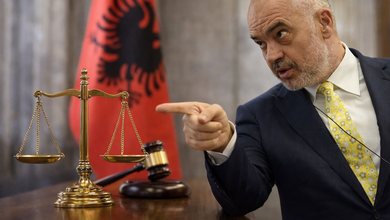



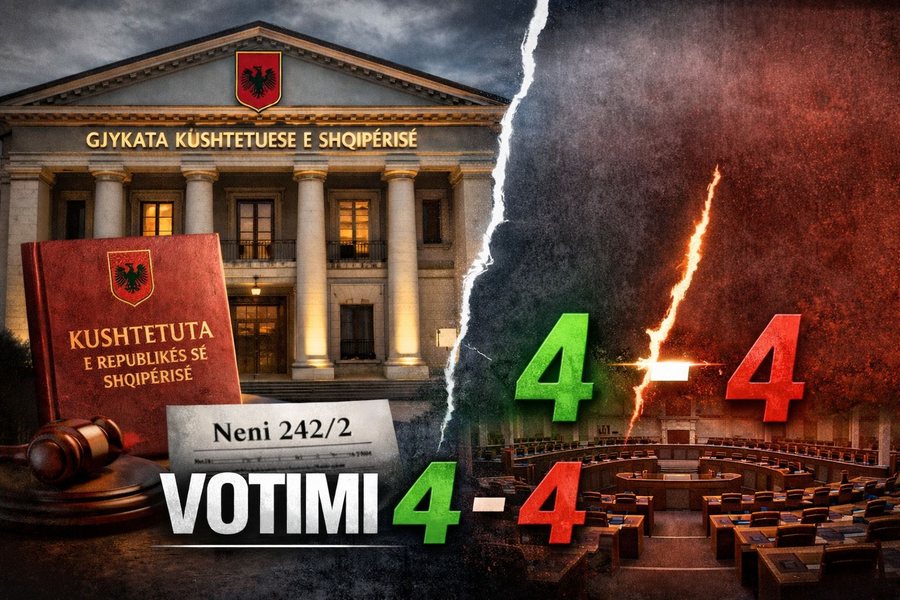
Finally, the decision of the Court of Justice regarding Edi Rama's request in defense of Balluku has been justified and published. The fate of the case and the public and political consequences it has brought are now known. But the reasoning behind the decision is not without interest, especially given the fact that this process was accompanied by great political pressure and tension from the government. Edi Rama himself, in his speech immediately after the decision, took the opportunity to initiate a draft law that seeks to supplement the famous article 242/2 of the Code of Criminal Procedure, which deals with the possibility of suspending a minister in office. He even announced that he took the opportunity from the court's decision (which at that time was only a press release), claiming that according to him, even the Constitutional Court has said that there is a need for legal supplementation.
In fact, today we have the answer. In a unanimous vote, the Constitutional Court analyzed Article 242/2 of the Code of Criminal Procedure and, after reasoning whether the “immunity of a deputy” is the same as the “immunity of a minister,” it also answered the question of whether the measure of suspension from office is included within the scope of the notion of immunity.
The answer is clear and concise:
56…. The Court considers it appropriate to analyze below whether the constitutional regime of ministerial immunities, as well as that of MPs, includes or not the guarantee provided for in Article 242, paragraph 2, of the CPC.
57…. The Court emphasizes that a legal norm cannot serve as a source to give content to or expand the meaning of a constitutional norm; on the contrary, it is the constitutional norm that determines the framework and limits within which ordinary legislation must be interpreted and applied. Consequently, the above provision cannot be considered part of the constitutional regime of immunity, which is exhaustively defined by the Constitution.
58…… the legal guarantee of Article 242, point 2, of the CPC cannot be interpreted as an extension of the immunity regime beyond constitutional limits, but must be understood in the function of guaranteeing the integrity of the representative mandate and the will of the voters.
So it is clear that the “suspension of a minister from office” as a court decision is not included in the notion of immunity. In other words, a member of the government is suspendable and, according to this constitutional logic, the procedure required in the case of lifting immunity (granting authorization) does not follow the procedure in question. We recall that in the case of lifting immunity, the procedure requires permission (authorization) from the Assembly. In other words, no kind of permission is required for suspension from office from the Assembly, the government, the Prime Minister or anyone else. The request of the prosecution to the court and the respective decision of the court approving this request are sufficient. The decision in question is executed immediately, as soon as it is notified to the interested party.
The Court, therefore, did not find this article to be unclear, nor to be in violation of the Constitution, nor to be necessary to be supplemented with other passages, as Edi Rama tried to argue and as he did by filing the legal initiative. Article 242/2 of the Criminal Procedure Code is applicable to every public official of the Republic of Albania, including ministers, the Prime Minister, the President of the Republic, the Ombudsman, the President of the High State Audit and the members of the Constitutional Court themselves. The only officials to whom it does not apply are: members of parliament, mayors and members of municipal councils. And there is an argument for this: they are directly elected by the sovereign through electoral processes. All others are appointed or appointed not by the sovereign. They are the result of either the Assembly, or the mayors, or the municipal councils. So there are two categories of public officials: those elected by vote – who cannot be suspended by court decision – and those appointed – who can be suspended.
Also interesting is the other part of the decision that talks about dividing the members of the court into two equal parts of 4 members, when it comes to the repeal or not of the decision of the GJKKO to suspend Ms. Balluku from duty.
4 members (Chairwoman Fiona Papajorgji and judges Sonila Bejtja, Sandër Beci and Marjana Semini voted according to this position) stated that:
65. That said, on the one hand, it is clear that imposing a measure of suspension from office on a member of the Council of Ministers (minister), which is not expressly provided for by the Constitution, by its nature and intensity constitutes a direct interference in the exercise of his duty. …
68. Similarly, although in the case of a deputy these guarantees are such as to prohibit his suspension, in our assessment, even in the case of a minister, as long as the measure of suspension is such as to bring consequences in the exercise of the constitutional functions of one of the powers, it is necessary to summon the Assembly, as the body that must assess and verify the measure requested by the prosecution. Therefore, in order to guarantee the balance between the constitutional interest in the effective exercise of criminal prosecution and the regular functioning of the executive power, even the restrictive measure of suspension will have to be conditioned by the prior authorization of the Assembly, as an institutional mechanism of control and balance.
69. Based on this analysis, although we have maintained the approach that the measure of suspension from office under Article 242, point 2, of the CPC is not included in the constitutional regime of immunity of the deputy/minister, this is not sufficient to exclude a priori the necessity of an assessment of this measure, which constitutes a guarantee for the public official during the exercise of his/her duty… On the other hand, the Constitution does not contain any prohibition or restriction on the possibility of exercising this form of control by the legislative branch, which also includes the verification of the implementation of the legal guarantees of the political function of the minister. Consequently, any measure that brings about the interruption/suspension, even temporary, of the exercise of the function of a minister directly affects the relationship of political accountability in the procedural aspect between the executive and the legislative branches.
According to this reasoning of the 4 members above, it is accepted that suspension is not included in immunity, but nevertheless they are of the opinion that authorization from the Assembly should be sought for this measure as well, even though the Constitution does not provide for such a procedure. The logical conclusion of the reasoning of these members is that they are with the idea of creating ex novo a new rule, which the Constitution does not contain, but through constitutional interpretation.
The other 4 members (judges Marsida Xhaferllari, Genti Ibrahimi, Asim Vokshi and Ilir Toska voted according to this position) held this position:
71…. the specific issue cannot be resolved either through an isolated interpretation of Article 73, point 2, of the Constitution or through its extended evolutionary interpretation, which creates a new constitutional norm. … In this context, the question arises whether the measure of suspension from the exercise of public office, according to Article 242 of the CPC, against a minister is such that it requires the prior authorization of the Assembly, as a guarantee to preserve the exercise of the powers of the executive branch.
72. Article 73, paragraph 2, of the Constitution provides for the prior authorization of the Assembly only for the measures expressly listed therein: arrest, deprivation of liberty in any form, personal search and search of the residence. Suspension from office is clearly not included in this list. …. The absence of the measure of suspension in the text of Article 73 constitutes a choice of the constitutional legislator and cannot be overcome by interpretation. The extension of immunity through interpretation would constitute the creation of a new constitutional norm, contrary to the competences of the Court and the principle of the primacy and direct application of the Constitution.
73. The measure of suspension under Article 242 of the CPC does not infringe personal freedom and does not affect fundamental rights within the meaning of Article 73, point 2, of the Constitution (personal integrity and home), therefore it cannot be compared with the immunity measures listed in the Constitution. It aims to protect the integrity of the criminal process, by preventing the risk that the exercise of the executive public function will hinder the investigation. The claim that this measure violates the separation of powers, as it affects the functioning of the Council of Ministers, is based on an incorrect premise, since the measure is directed at the individual and not at the institution. The powers of the institution remain unaffected and can be exercised according to the constitutional mechanisms of substitution, guaranteeing the continuity of the functioning of the executive power.
76. Constitutional immunity is not a general exemption from criminal jurisdiction, but a limited balancing mechanism, designed for specific and clearly defined cases. Any extension of it beyond the cases expressly provided for would violate equality before the law and would contradict the orientation of the constitutional reforms of 2012 and 2016.
Therefore, the above 4 members are of the opinion that the suspension of ministers from office is not included in their immunity. Consequently, if such a measure is decided, it does not require permission from the Assembly. The Constitutional Court cannot make an interpretation by which it adds a new rule, according to which “even for suspension from office, permission from the Assembly is required”. The rules of the Constitution cannot be added by interpretations of the Constitutional Court, but only if the Constitution is amended by the Assembly or by referendum.
The decision also contains a parallel opinion by judges Vokshi and Xhaferllari, who, unlike all 6 other members, have held the most radical position, according to which this issue should not even be considered, because there was practically no conflict of competence between the Prime Minister and the GJKKO.
They state that:
"The preventive measure of suspension from office cannot be equated with the dismissal of a minister and, consequently, it cannot be accepted that its effects reduce or interfere with the constitutional competence of the Prime Minister to propose the dismissal of a minister or that they reduce the functions of the Council of Ministers. Accepting the opposite is not consistent with the spirit of the principle of separation and balance of powers, as well as that of the independence of the judiciary.
In our assessment, the request is clearly inadmissible. Given the way its subject matter is formulated and its content, the request, in essence, does not aim to resolve any dispute of competences between the executive and judicial branches (because there is clearly no such dispute at the constitutional level), but rather to annul individual judicial decisions (including their suspension) issued against the Deputy Prime Minister and the Minister… .
Through the decisions of the special court, the subject of this constitutional request, the Prime Minister or the Council of Ministers have not been deprived, blocked, paralyzed or institutionally made difficult to exercise their constitutional powers. The requester has intact constitutional powers to resolve the situation when the individual appointed as a minister is objectively unable to exercise his/her duties. Here it should be borne in mind that Article 242 of the CPC does not block the powers of the minister as an institution, but prohibits the individual taken as a defendant from damaging the criminal process through the exercise of executive functions.”
Ultimately, this decision clarifies many things.
First, there is a decision by the Constitutional Court. We are not facing a “non-decision” or a failure of the Court to respond to the Prime Minister's request.
Secondly, that the suspension from office of a minister is not included in the scope of the minister's immunity and this decision was taken unanimously.
Third, there is no legal or constitutional gap in this matter.
Fourth, 4 members are of the opinion that even though “suspension from duty” is not included in immunity, permission from the Assembly should be sought, even though the Constitution does not provide for this rule. They apparently think that this rule can be added by interpretation made by the Court.
Fifth, 4 other members are of the opinion that “suspension from duty” is not included in immunity and therefore permission from the Assembly is not required. No such rule can be added by an interpretative decision of the Court. If required, this can only be done by amending the Constitution according to the normal rules (Assembly or people by referendum).
Sixth, 2 members are of the opinion that there is no conflict of powers between the executive branch and the judiciary. The judiciary is simply exercising its constitutional powers to investigate.
Finally, it is enough to read these positions and it is easy to understand the impact of political pressure and institutional resistance that the Constitutional Court faces in this chapter of political developments, which, apparently, is finally closed with this decision. To open the next chapter, that of the battle for the lifting or not of immunity for Ms. Balluku, now not by the hands of others, but by her own.