


By Desada Metaj
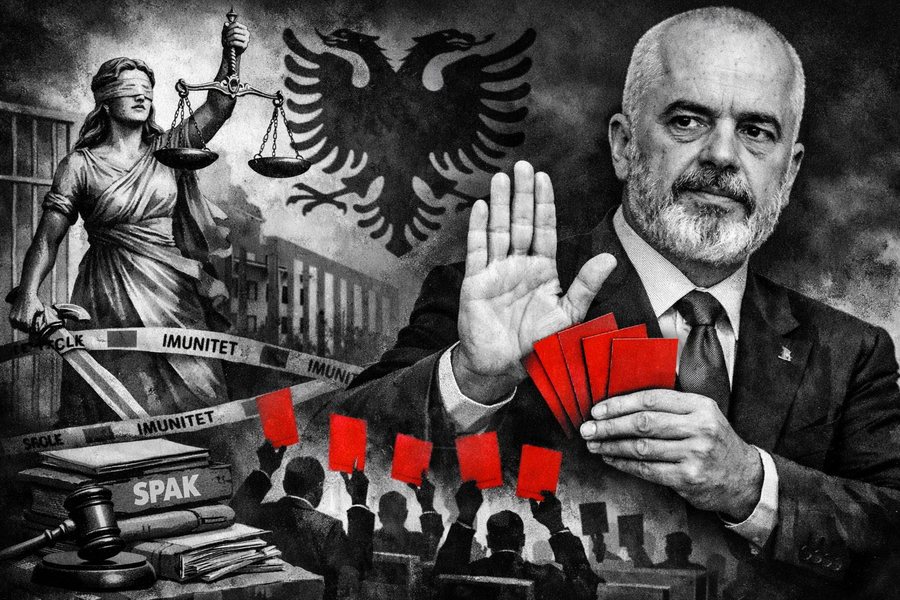
Cards against justice
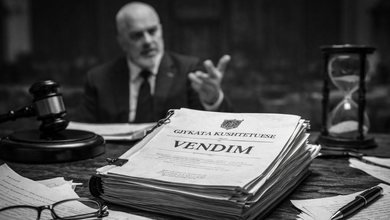
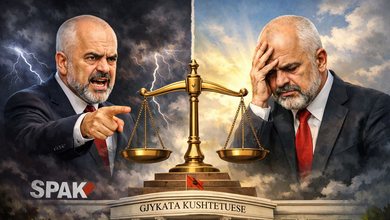
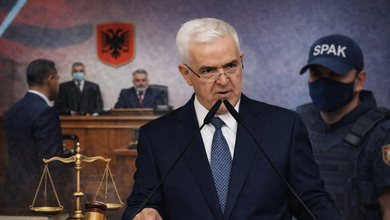
Edi Rama's latest move to amend the Criminal Procedure Code, openly motivated by the security measure "suspension from duty" imposed by the GJKKO against Deputy Prime Minister Belinda Balluku, is neither a reform, nor a technical clarification, nor a gap filling. To be clear, it has nothing to do with laws and jurisprudence, but is a pure political move to neutralize the effects of the SPAK investigations. And it is brutal in its simplicity: in the absence of a legal argument, the force of parliamentary cards is used.
The draft law provides that the security measure "suspension from duty" should not only be applied to elected officials (MPs, mayors, councilors, as the law has provided since 1995), but should now also be extended to non-elected officials such as the President, the Ombudsman, the Prime Minister, the Deputy Prime Minister, ministers and the Chairman of the Supreme Audit Office. It is clear that the real goal is to protect members of the government. The others are simply a decorative ornament, with the unmasked intention of seeking to adopt a principled rule. In fact, what has happened is simply the process of moving from a concrete individual issue (the Balluku issue) to the construction of a functional immunity zone for the top of the executive. As such, this is not a proportional correction. It is a transformation of a security measure into an institutional taboo.
The claim that Ms. Balluku has resigned, not once but three times and that Rama has refused her, presumably to protect the Constitution, the state, and the separation of powers, is legally false and betrays Rama's true intention. Resignation is in fact a unilateral act of will (legal and political); it does not require acceptance or consent from anyone else. On the other hand, if Ms. Balluku has indeed resigned (3 times in fact), this means that she has made the choice to face justice stripped of any legal and political shield. And this would truly be a behavior of a high level of political morality. But the question that arises is, if the resignation from the ministerial position was prevented by the Keyeminist, why doesn't she give up immunity, because no one can condition this? If an official gives a real resignation, he gives up both the function and, in the case of MPs, the immunity that stems from it. So Rama and his company have failed to find even a thin thread of political morality in their movements. The narrative of the three announced "resignations" is simply stale political rhetoric to avoid the essence: will justice be allowed to exercise its instruments? If there were a will to face justice, the path is clear and simple. Any other solution is a maneuver.
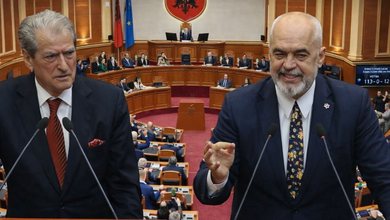
Meanwhile, the signing of the draft law by a minimum number of deputies and the rush to pass it quickly show more than a test or party discipline. They show fear of internal fluctuations. When a secure majority proceeds in a hurry and with limited signatories, the political message is clear: the internal consensus is not as monolithic as claimed. One deputy is enough to file a draft law. The involvement of the Group leader and the chairman of the Laws Committee, in addition to showing the latter as fighters against SPAK and justice, seems to hide some fear, for some internal current in the PS that perhaps does not agree with the path of confrontation with justice that Rama has chosen.
On the other hand, if Rama really had a concern of a principled level, regarding the separation and balancing of powers, with the spaces of the functions of each branch of power, then why is he in a hurry? Why does he not explore a consultation process? Why don't you ask the EU and US legal assistance missions that have been assisting all along in establishing the Justice Reform? Especially when such a bill, in its essence, really affects the separation and balance of powers, but in the direction of limiting the power of the justice system. In other words, the very constitutional essence. Laws of a constitutional-material nature, which affect the balance of powers, are not passed with a procedural sprint, except in the case when a concrete issue with justice is required to be closed there and then.
To make the logic clearer: The principle of equality before the law is not a slogan; it is the axis of the rule of law. The entire edifice of the Justice Reform is built on it. If an ordinary director or a senior official can be suspended from duty as a security measure, while a minister or prime minister cannot, an unacceptable criminal hierarchy is created: the higher in power, the more protected from effective investigation. And this is a flagrant distortion of the basic principle in democracy: everyone is equal before the law. The argument that “SPAK will investigate anyway” is flawed. A criminal investigation is not an abstract act; it is based on concrete procedural instruments. The removal of suspension from duty, and in parallel the practical limitation of other security measures such as prison arrest, house arrest or personal and home searches, strip the investigation of its essential tools. A prosecutor whose “procedural teeth” have been pulled out to bite the corrupt. And such an institution, without instruments, is simply a symbolic, non-functional institution.
The justification with the “separation of powers” is conceptually wrong. The separation of powers aims to guarantee that no power usurps the other and that each exercises its functions without arbitrary interference. The measure of suspension from office does not paralyze the executive function; it transfers the temporary exercise of powers to the deputy or another minister. Law 9000 itself, which deals with the functioning of the Council of Ministers, is very clear. It has resolved every unknown. The government does not stop.
On the contrary, the legal limitation of the investigative powers of the Special Prosecutor’s Office is a direct intervention of the legislative-executive power in the sphere of justice. So, instead of protecting the separation of powers, the draft law violates it.
The inclusion of the President, the Ombudsman and the Chairman of the Supreme Audit Office as a “package” is a weak alibi to create the appearance of a systemic regulation. There has been no finding of any constitutional gap by the Constitutional Court of Albania. Nor is there any jurisprudence that imposes such an intervention. So, the argument of institutional harmonization does not hold. It is simply a solution to the problem of the moment. Therefore, when a legal change arises as a reaction to a specific file, it is not a general norm; it is a disguised ad personam law.
Rama's previous statements that the European Union would be consulted for any change in justice laws remain rhetoric, if in practice real dialogue takes place only within the political circle of the majority with Ulsi Manjë and Taulant Balla. Besfort Lamallari also sits at the table on occasion. Justice reform has been the product of a broad consensus and strong international supervision. Any move that affects its architecture requires transparency, public debate and in-depth expertise - not political improvisation. Even less so this miserable move by Rama today.
This initiative is not just a technical procedural issue. It sends a dangerous social signal: the political elite is ready to change the rules of the game when danger approaches. In a society where trust in justice is still under construction, this message undermines the fragile institutional capital created after the reform. In the long term, the damage is greater than an individual issue. It is the relativization of the principle that no one is above the law.
Finally, this is the first direct and concrete move to test the limits of political power against the new justice system. If it passes without institutional and public resistance, it sets a precedent: every time an investigation touches the pinnacle of power, the rules can be rewritten. This is the path that Rama has chosen and no longer surprises anyone. The rule of law is not overthrown by a spectacular act; it is eroded by small interventions, justified as technical, but politically motivated. This draft law is not a legal fantasy. It is a banal act of political survival.
And for this very reason, it is dangerous.