


By Desada Metaj
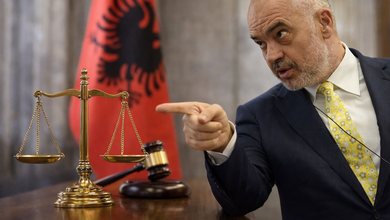
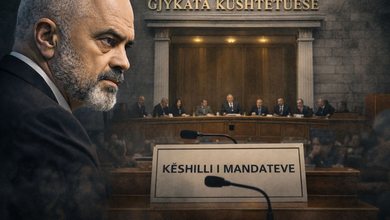
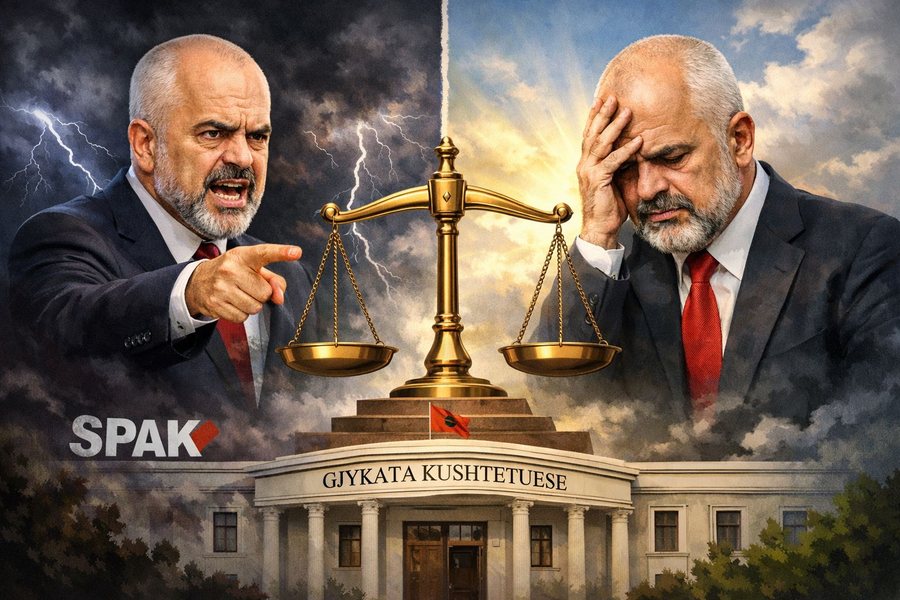
The Constitutional Court’s decision, let’s all admit, was unexpected. Rama’s intense pressure, coupled with its interim decision to suspend the GJKKO decision, had created the belief that SPAK had been broken in the face of one of the most powerful figures in power. Expectations were raised to the extreme: in the public, in politics, and in the media. The tension was clearly felt, both in Rama’s daily nervousness and in Berisha’s prejudiced attacks, who, in essence, wants a weakened SPAK. His alibi — that the Constitutional Court was controlled by Rama — serves the same fear that both share: a strong SPAK is not only a threat to Rama, but also to Berisha and anyone else who has an account with justice.
For this reason, the post-decision reaction was immediate: everyone rushed to curse the Constitutional Court for the 4-4 decision, labeling it a “decision without a decision”. In fact, this is not true. In fact, it is not at all like that. There is a clear verdict of the Constitutional Court: Rama’s request to annul the GJKKO decision has been rejected! Without appeal. Without equivocation. This was the real battle. Not what would be written in the legal reasoning, not the schools of thought or the constitutional doctrinal formulations, but whether Rama’s government would defeat justice to protect Balluk. And this is exactly where Rama lost.
However, beyond this, there is something even more valuable that the Constitutional Court’s decision has said. This point does not seem to have taken its rightful place in the political and media circles close to Rama and Berisha. There is a visible concern, a discomfort that is not openly articulated. The full reasoning of the decision has not yet been released, but the official announcement of the President of the Court distributed to the media contains an essential element, especially for those who claim that “there was no decision”. On the fundamental issue raised by Rama — namely whether Article 242/2 of the Code of Criminal Procedure, the one that provides for the security measure “suspension from duty”, applies or not to members of the government, including the Prime Minister — the Constitutional Court has ruled unanimously, 8 to 0. All its members have confirmed that “suspension from duty” is a security measure that applies to every member of the government, from the Prime Minister to the ministers.
We recall that the Prime Minister's claims before the Court were twofold. First, that the measure of suspension constitutes de facto dismissal and as such is his exclusive competence, with the President and the Assembly only ratifying it. According to this argument, the judicial suspension infringes the constitutional competences of the Prime Minister. The second claim, more subdued and partly contradictory, was that the suspension of a member of the government is permitted, but only with the authorization of the Assembly, just as in the case of the immunity of deputies.
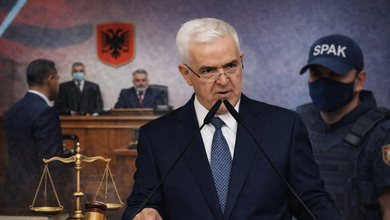
The first claim was unanimously rejected. The Constitutional Court confirmed that members of the government, including the Prime Minister, are subject to suspension from office by the judiciary and that Article 242/2 of the CPC is in accordance with the Constitution, without violating the separation of powers. Only the issue of the authorization of the Assembly divided the court into two camps: four judges thought that authorization was required, while four others thought that it was not, since immunity does not cover suspension from office. Immunity protects only from arrest and personal or home search — nothing more. This is clear from the official announcement. The full reasoning is awaited, but the essence is clear enough that the court itself made it part of the public communication.
That said, we must make it clear to everyone. Despite the fact that the public was naturally gripped by interest in what would happen to Balluk's personal criminal fate, given that it was a criminal blow to one of the most powerful people in the government, and a political blow to the entire government, essentially what was happening and is happening is something else, even more important and more dangerous than that. At stake was the fact of whether the justice system, at least in the last confrontation starting from November 2025 onwards, was, or would be, placed under the political control of the government. This confrontation, depending on the outcome, would give this verdict.
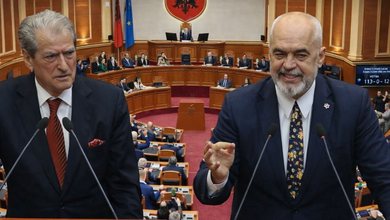
Rama has often alluded, in previous cases, up to the Veliaj case, that he had control over justice. Events so far, in a way, made this clear to the public. The Bllako, Koka, Beqja, Ahmetaj, and even Veliaj cases, as long as Rama, at least in appearance, did not oppose justice, created in the Balkan gossip of Tirana the idea that all of these were "Rama's games" to get rid of those he did not want. He himself reinforced these rumors, as he came out loudly to say that this justice was his and the SP's offspring, that he himself was its guarantor, and so on. Moreover, Berisha was also in harmony with this position, due to his concern with justice, treating SPAK's legal activity against him as a political attack by Rama (sometimes also by Taulant Balla), and presenting SPAK as a political tool of the SP, used to purge opponents outside and inside the SP. All the voices, therefore, were beautifully in harmony.
Until the Balluku case came.
In the Balluku case, this harmony and this diabolical intrigue were broken. Rama was no longer the controller of SPAK. He wouldn't use her as a knife to stab himself, would he?! Balluku was not only his deputy, but a loyal collaborator in Rama's own affairs. The Tirana Ring Road account or the lots are big issues, which befit the Prime Minister himself to deal with. Ministers are simply blind executors of his orders (by SMS or by word of mouth, it doesn't matter). And, precisely in November 2025, Rama's stance changed 180 degrees. He attacked the judge and the prosecutor who met face to face. He launched an attack against them by taking the case to the Constitutional Court. Rama, at that moment, was no longer the one who knew everything, or even who anticipated everything. He was caught, at the very least, unaware. The seven hours of the meeting at the Prime Minister's office prove this.
That event, in addition to its legal value and a request that had long been articulated in public since after Veliaj's arrest, it was Balluku's turn, gave a first answer to the other unknown: whether Rama controlled SPAK. It turned out that he did not control it at all. In fact, SPAK had the audacity to knock on the Prime Minister's office. Rama saw, at that moment, that this was the first victory of justice, which came dangerously close to him. Therefore, the Balluku case had this added value, compared to all the other previous cases.
The Constitutional Court's decision, in this light, in addition to rejecting his request, despite the vote ratio, also showed that Edi Rama does not control the Constitutional Court, at least not in the numbers that would guarantee his success. The interim decision, taken urgently and coming after an unscrupulous and nervous public pressure, truly created a discouraging effect on the public as well. But, it seems, the last word had not been said. The increased interest of internationals, beyond the courtesy visits to SPAK and the Constitutional Court, was only a sign. The passage of time, it seems, clarified a lot, not only in the underground diplomatic movements, but also in the legal clarification of the concrete situation.
Despite everything, the decision of the Constitutional Court, taken 8 to 0, overthrowing Rama, and the failure of the five members in favor to overthrow Balluku, is neither more nor less than the second cardinal victory of justice after that of SPAK. Two strong pieces of evidence, in a short time, that overturned a narrative carefully constructed by Rama, to which Berisha also did the same, not innocently. The “surprising” positions of Ibrahim of the SP, who votes against Rama, or the “Bejtja” of the DP, who votes for Rama, prove precisely the failed attempts to subjugate the Constitutional Court and the counter-reaction to not submit to the power of all sides of politics that are in conflict with justice.
The masks have now fallen. Rama's as the "knight with the angry face" in defense of justice, but also Berisha's, who insults justice by claiming that it has submitted to Rama, have received a severe blow. Justice - SPAK, GJKKO, High Courts and Constitutional Court - with these acts have raised their authority in the eyes of the public like never before and have left the political wings and media voices close to them, who are now seen to have gathered under a single front against justice, leaving aside the "old dasas".
The most affected is Edi Rama himself. He has lost his fascination as omnipotent and untouchable. As a political player of international rank. As an actor of the future, light years removed from the banality of the Albanian swamp, as he calls it. He has diminished. He has shrunk. He has put an end to Balluku's troubles and is now dealing with procedural trifles. He has engaged Xhafaj, Manja, and company in the crusade for justice. He has begun to move under instinct and without a clear picture ahead.
He did not say a word about the other test of fire that is already on the table of Parliament: that of the removal of immunity. He tried a little yesterday, in a muted voice, to anathematize the justice system and the Constitutional Court, but very timidly. He did not give any explanation for the "elephant in the room", the immunity of the deputy, even though the public interest is much greater than for the decision of the Constitutional Court of a few days ago.
He actually said something that speaks volumes: that he will “undo injustice” by law. In other words, he said what Ulsi Manja also announced a few days ago: he will intervene in the legal system to hinder the work of justice. And, in fact, this is the only move he has left. With 83 mandates, together with Berisha’s desire to attack justice, he is getting ready to change the codes and laws of justice. The nonsense, such as the high number of detainees, the extended terms of detention, the “disproportionate” salaries of magistrates, the abuse of office in the Criminal Code and, most recently, the suspension from office, are just excuses to undertake a punitive incursion into justice with votes in Parliament. There is no other way at this stage.
But even this path is not so simple. It is not elementary arithmetic: 83 mandates plus Berisha. Because, now in the eyes of the public and in the eyes of the international community, he himself is no longer the generator, the solution, the guarantee, or the stability of justice. He is the problem of justice. Perhaps, in his mind, he can bring dark ideas of political instability, the destruction of the idea of Albania's integration into the EU, or seek salvation in Israel or the Vatican, but one thing seems clear: he cannot touch the integrity of the justice system. More precisely, he will not be allowed to do so. Even God can take his mind and approve controversial laws, undo previously approved mechanisms, establish legal obstacles against suspension from office, against arrest, against the right to collect evidence and telephone calls by SPAK, and such stories, but he must not forget that all roads lead him back to the Constitutional Court. This is the first and least important.
But now, his relationship with the internationals in Brussels or Washington is not and will not be the first. The latter have not yet spoken publicly. It is not known what they will say in the meetings with Antonio Costa or what other officials have spoken or will speak, but one thing is clear: everything revolves around one issue - how not to allow Edi Rama to obstruct justice. And all this translates into political and public costs for Rama, if he takes anti-justice legal action.
Finally, what remains in this situation is that justice must understand that it has already won the first battles, both in SPAK and in the Constitutional Court. But this is a long battle. Only the first part has been consumed, with the victory of justice. Other battles will come very soon. Therefore, not simply for the sense of service to duty, but also for the public interest, the new justice, which is now more authoritative than before, must capture other quotas of authority and superiority in the battle. And it is not alone. It has the support of internationals and, above all, of Albanians.