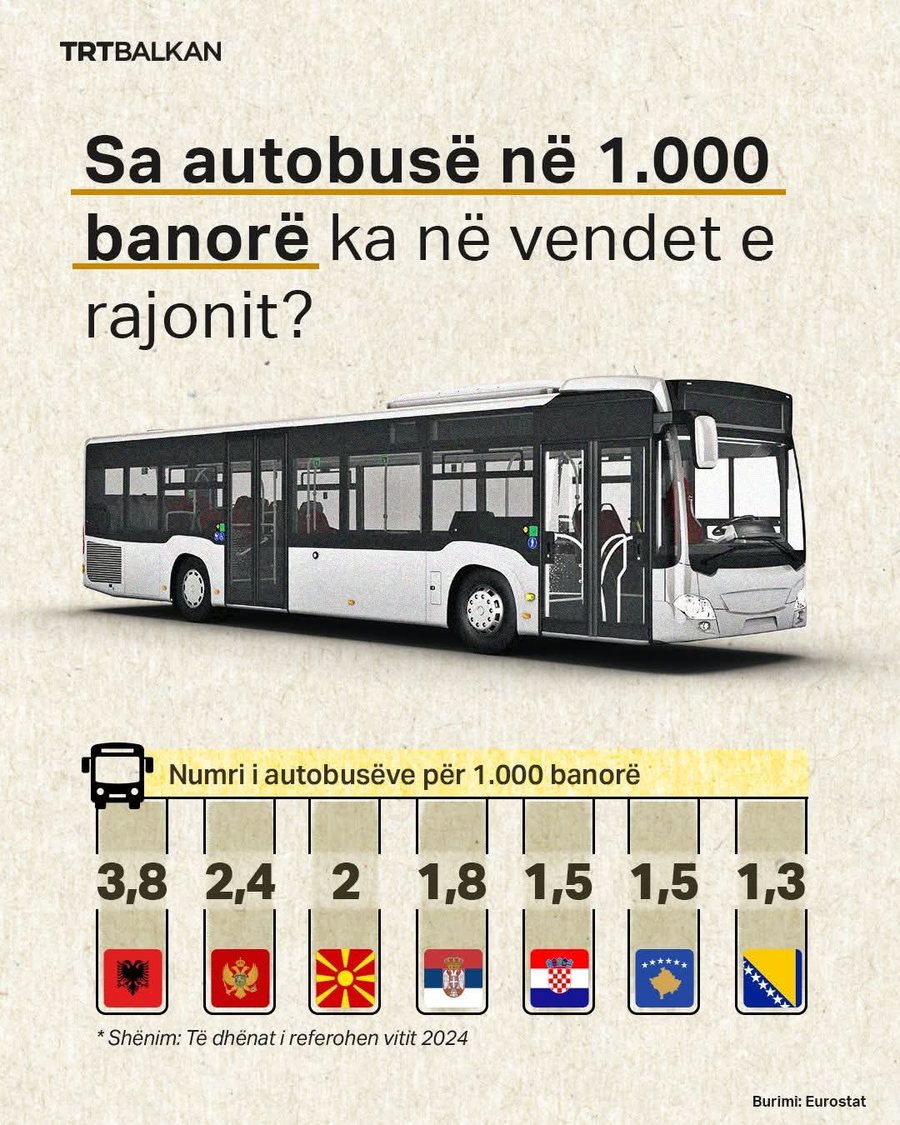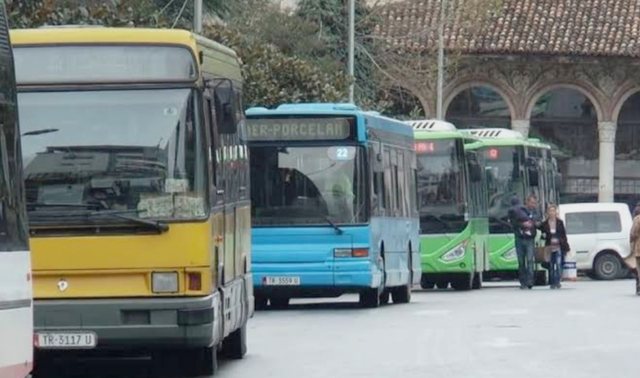



In 2024, there were a total of 737,142 buses and motor coaches (including trolleybuses and minibuses) in the EU, representing 1.6 buses per 1,000 inhabitants. North Macedonia, with 3,690 buses or 2 buses per 1,000 inhabitants, is slightly above the European average.
The highest number of buses and motor coaches per 1,000 people was recorded in Malta (4.6), followed by Luxembourg (4.0) and Estonia (3.7). On the other hand, the lowest rates were recorded in the Netherlands (0.5), Germany (1.0) and Austria (1.2), according to transport equipment data published by Eurostat.
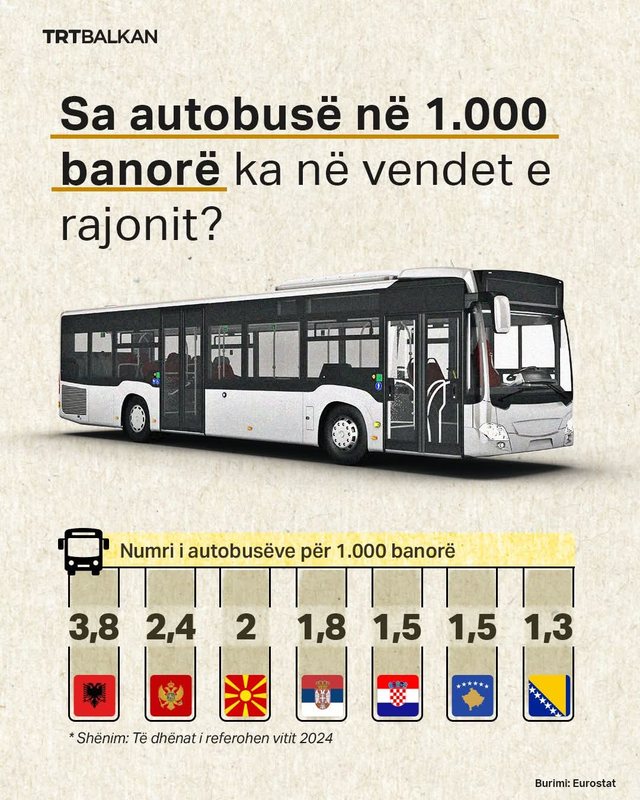
In the region, Albania (3.8), Romania (3) and Bulgaria (2.8) have the most buses per 1,000 inhabitants. They are followed by Montenegro (2.4), Greece (2.6), Serbia (1.8), Croatia (1.5) and Bosnia and Herzegovina.
This motorization rate has remained stable over the last 10 years, while the number of private cars per 1,000 inhabitants has increased significantly over this period (from 506 in 2014 to 578 in 2024). The Republic of North Macedonia, with 319 cars per 1,000 inhabitants, remains below the European average, however there has been a significant increase in the last 10 years, from 180 in 2014.
On average, 5.1 percent of the bus and motor coach fleet was renewed across the EU in 2024, while Macedonia, with 379 new buses in 2024, has a renewal rate of 10.2 percent.
The renewal rate represents the ratio of newly registered vehicles to the entire fleet, excluding used ones. In the EU, the highest renewal rate was in Luxembourg (11.6 percent), followed by the Netherlands (9.6 percent) and Austria (9.5 percent). On the other hand, only 0.7 percent of the fleet in 2024 was renewed in Bulgaria, 2.4 percent in Poland and 2.5 percent in Hungary.
Efforts to improve air quality, especially in urban areas, have had a positive impact on the share of zero-emission buses and motor coaches, representing a larger share of new vehicle registrations. At EU level, in 2024, this share was higher than that of new private vehicles (17.8% versus 13.5%), corresponding to 6,746 new zero-emission buses.
In our country, according to data from the Institute of Statistics, in 2024, out of 3,690 buses, 3,609 were with diesel engines (97.8 percent), 63 with gasoline-gas (1.7 percent) and only 15 were electric (0.4 percent).