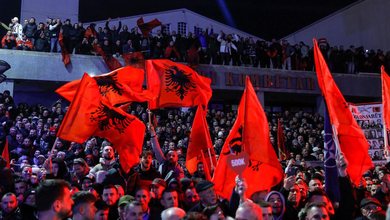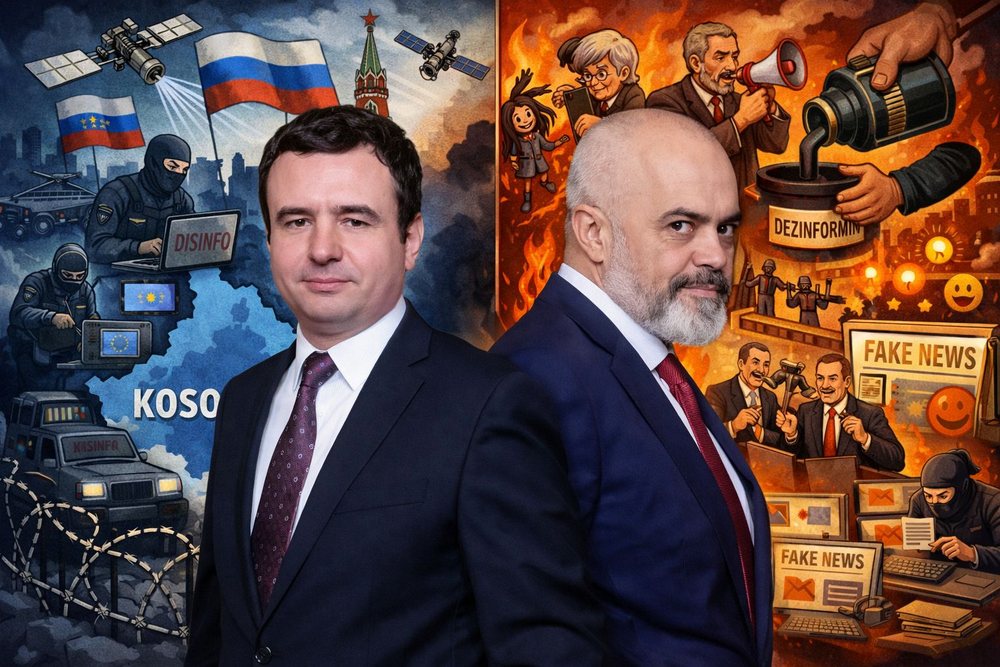
In the Balkan political landscape, the election campaign is not simply a program competition, but a sophisticated battlefield of disinformation. Monitoring reports for the 2025 elections show a fundamental divergence between Pristina and Tirana in the source of this propaganda. Kosovo faces attempts by foreign states to disrupt the elections through distorted information, while in Albania, in the absence of external influences, disinformation is produced internally, for political enemies.
Esiona Konomi & Xhemajl Rexha
In Albania, general parliamentary elections were held in May, while the citizens of Kosovo went to the ballot boxes 4 times during 2025, twice for the national elections and two more for the two rounds that elected the new mayors of its 38 municipalities.
Foreign influence
In Kosovo, the electoral process faces an informational aggression that comes mainly from outside the borders.
Kosovo continues to be a target of foreign interference, mainly from Serbia and Russia. A BIRN Kosovo investigation into the February 2025 elections, titled “Hate Speech and Disinformation during the 2025 Elections in Kosovo,” found disinformation interference from the Russian state and Kremlin-funded media.
The research found that in the two months before and after the local elections on October 12, Russian state-controlled media published 353 disinformation articles. Belgrade-based Sputnik published 193 articles about Kosovo during this period, while Russia Today Balkans, also based in Belgrade, published 125. The rest were published by Pravda, including in Albanian, and the TASS agency.
The Russian Foreign Ministry spokesperson, Maria Zakharova, as well as the Russian Foreign Minister himself, Sergey Lavrov, were also involved in the propaganda campaign against Kosovo during the election period.
Unlike Kosovo, Albania appears almost "immune" from foreign interference, much less direct Russian or Serbian influence on elections, but it suffers from an equally toxic phenomenon: indigenous propaganda. In Albania, the disinformation machinery "cooks" inside the offices of political parties.
The source of disinformation is not foreign centers, but domestic "troll farms" and portals funded by local political or economic actors.
The target is not citizenship, but the opponent. The comments come from profiles that have photos of landscapes, cars or flags, with few friends and recently created (usually before the campaigns). A news item that is quickly copied on hundreds of portals is promoted for a fee on social networks, but there is no transparent legal entity that is responsible for the advertisement.
While journalists in Kosovo must fact-check narratives coming from Belgrade or Moscow to protect the integrity of the state, in Albania the challenge remains filtering out orchestrated attacks within the genre, where the truth is often drowned out by the deliberate noise of domestic propaganda factories.
Ready-made materials
In Albania, the practice has been consolidated for years where political parties or candidates provide ready-made materials, filmed and edited by their electoral teams, which are broadcast in the media.
For the May 11 campaign, such materials dominated television broadcasts and in most cases, even in the news edition, they did not make any note to show voters that this was not an independent product of journalists.
"The use of ready-made footage prepared by political parties themselves, which was broadcast as news without being identified as such, was widespread. The Central Election Commission (CEC) did not take measures to address this practice," the ODIHR report on Albania said.
This phenomenon is limited to Kosovo and has not become the norm.
Journalists' access to events
The Association of Journalists of Albania called before the elections for parties and candidates to make their electoral agenda and meetings with the public transparent. However, despite this, the two main candidates for prime minister, Edi Rama and Sali Berisha, did not publish their agendas in advance, and thus journalists could not plan field trips to independently film and report on the electoral meetings.
"Journalists were forced to follow the campaign "live" through the leaders' social networks, while those who attempted to approach their rallies (mainly those of the incumbent prime minister) were not allowed by security forces to broadcast, with the argument that the activity offered a ready signal. The same thing happened with the main candidates," says AGSH.
Independent journalistic productions in Albania were almost non-existent.
In Kosovo, journalists had full access to all rallies of the competing political entities. While major television stations closely follow these rallies, especially those of the main parties, some media outlets do not have sufficient resources to do so. They then depended on live broadcasts of these events on the official party channels on Facebook or YouTube. Media outlets that closely followed the rallies brought behind-the-scenes coverage and more voices than media outlets that directly depended on party-directed broadcasts.
Coverage of the December 28 elections went smoothly, but in the February 2025 campaign, journalists were targeted by attacks and obstructions from the largest party, Vetëvendosje. Journalists and cameramen from the two media outlets, Klan Kosova and Nacionale, were physically obstructed and harassed in various cities, not only by Vetëvendosje supporters, but also by its officials. On election night, February 9, a series of incidents occurred, including an individual attempting to run over a Klan Kosova journalist with a car in the city of Istog.
Debates between candidates
No televised debates between candidates or leaders took place in Albania. Edi Rama and Sali Berisha, political rivals since 2005, have never debated in a media studio or other setting.
"Lack of competitive debate on political shows: Only 8% of television time on the three main political shows was dedicated to direct confrontations between political actors. The majority of programs included promotional interviews, personalized profiles or unbalanced panels," specifies the BIRN report on Albania.
Kosovo has developed a culture of debate and confrontation between candidates over the years, and especially for local elections. Even in 2025, candidates for municipal elections faced each other in several debates, including the confrontation between Përparim Rama (LDK) and Hajrullah Çeku (Vetëvendosje), in the second round of the race for Prishtina. Both had ample opportunity to present their program and vision for the capital of Kosovo, in a television program lasting over two hours. In the central level elections, there has never been a full confrontation of the candidates for prime minister.
Vetëvendosje reversed its February decision to boycott two major private television stations – T7 and TV Dukagjini – by sending high-level officials there. The boycott of Klan Kosova was partially lifted, with its representatives attending only one specific show. A major debate between the sub-speakers of the four main parties – VV, PDK, LDK and AAK – was also organized as a good opportunity for a confrontation of programs.
Ethics and online campaigns
The authorities in Albania, AMA or the CEC have not punished any electoral entity or media operator for using hate speech, sexist or discriminatory language up to this stage.
However, independent reports raise concerns about the language used by politicians and broadcast through the media.
“Most media outlets relied mainly on copying and pasting party messages and social media posts, rather than producing original, voter-oriented reporting,” said the BIRN report in Tirana.
The ODIHR report on Albania notes the lack of regulation: “The campaign on social media was not expressly regulated by law, and no authority was responsible for monitoring disinformation or manipulative content.”
Representatives of political parties in Kosovo used harsh and offensive language towards each other. The leader of Vetëvendosje, Albin Kurti, was a champion of this behavior. In his victory speech on February 9, he called opposition leaders “hajvanë,” a Turkish word for “animal.” Vetëvendosje engaged in denigrating campaigns against the media and journalists throughout the year. Its representative on the CEC, Sami Kurteshi, called the Alliance of Criminal Groups (AGK) the Association of Kosovo Journalists (AGK), the only organization in the country that advocates for the safety of journalists and media freedom.
Opposition representatives, on the other hand, accused Prime Minister Kurti and Vetëvendosje ministers of “thieving,” corruption, and nepotism. In some cases, Kurti was called “anti-American,” and in the most serious case, his mental health was questioned.
There were also complaints about hate speech in 2025 to the Electoral Panel for Complaints and Submissions, the complaints body of the CEC. This institution made decisions against the Coalition for Families in the February elections, following complaints from the LGBT community.
The largest party of the Serbian community in Kosovo, the Serbian List, was sentenced several times during the year for broadcasting video clips with content against the constitutional order of the Republic of Kosovo.
Women in the media
Birn and ODIHR note that, although women candidates were in high numbers, almost equal to men, in the May 11 elections in Albania, a low number of them received media coverage, whether on television or in portals. They were also victims of denigrating comments on online platforms.
Kosovo has a female president for the second time in its young history, but women's representation at the local level continues to remain minimal. No women were elected mayor in any of the 27 Albanian-majority municipalities.
Campaign monitors noted that women were underrepresented at all political party rallies, with negligible numbers of them giving speeches. A similar situation was observed in political debates in the media, where there was a disproportionately higher number of male parliamentary candidates taking part in the discussions.