


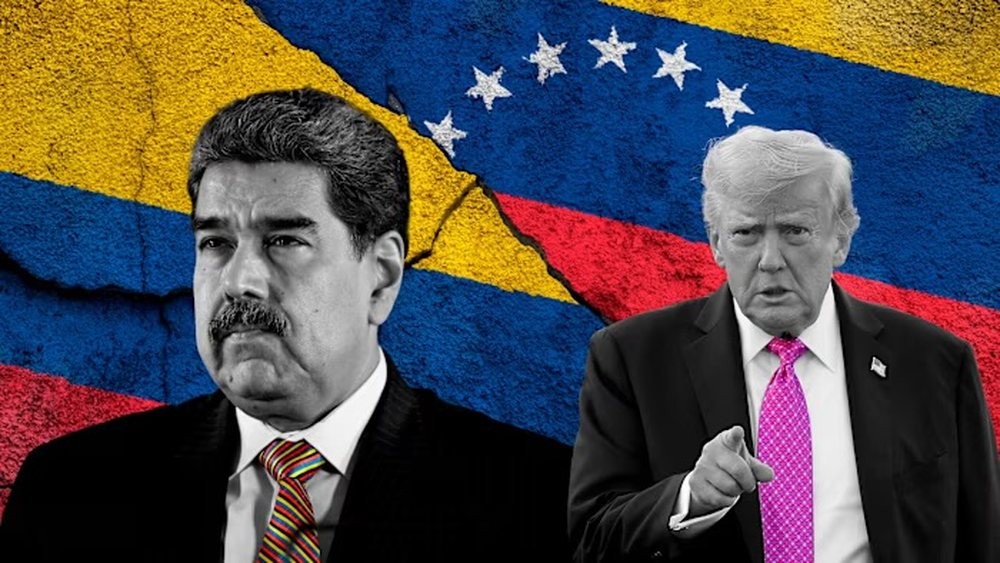
On Saturday morning, the US military invaded Venezuela. After bombing Venezuelan infrastructure, a small US force landed in Caracas and kidnapped Venezuelan President Nicolas Maduro and his wife. Trump has called the attack a "law enforcement" action, although Secretary of State Marco Rubio could not say what legal authority authorized the invasion or what jurisdiction the US government has to do so.
Although the claim of “law enforcement” may be the official stance, the administration and its supporters have used a wide range of justifications for bombing and occupation, ranging from democratization to human rights.
The latest US military operation reminds us that very little has changed in US foreign policy since 1989, when George HW Bush set the stage for today’s policy of endless intervention. The only difference, perhaps, is that Trump’s MAGA coalition, after years of denouncing regime change and state-building, has now wholeheartedly embraced it.
However, regardless of who supports it, the US bombing of Caracas exposes three key foundations of American foreign policy. One could say that the operation in Venezuela "revealed" the true nature of US foreign policy, but for anyone who has been paying attention, there is nothing new.
One: The American Constitution has no value.
As with all military operations since 1945, the bombing of Venezuela, a clear act of war to anyone who is not a regime apologist, occurred without any declaration of war by Congress. In this case, as in the case of the Libya War under Obama, there was not even a debate in Congress. Trump now says that he informed the oil companies of the operation before informing Congress.
Countless conservatives who have long claimed to care about the “rule of law” or a “strict constructionist” view of the U.S. Constitution are now divided over whether bombing a foreign country and kidnapping the head of state counts as “war” or not, and are claiming to be unclear about why anyone would think a simple bombing operation would constitute war. This is the same tactic used by the left: pretend to be unclear about simple words spoken in Albanian, which are clear to honest people but are constantly being redefined to suit a political agenda.
The result of their fabricated ambiguity is also evident in this claim: Since we can never be sure what the word "war" actually means, bombing other countries, at taxpayer expense, by the way, requires no congressional involvement. Or so we are told.
So much for Article I of the U.S. Constitution, which gives the legislature the right to veto military action. The veto, by the way, is an American invention, but it is a principle shaped by centuries of resistance and sacrifice to absolutism in Europe, when Stuart kings and other despots tried to impose wars on taxpayers without a vote in parliament. Unfortunately, thanks to decades of disregard for the rule of law in modern times, something now embraced by MAGA, this cornerstone of limiting state power has been completely abandoned.
Two: International law only applies to other countries (but not to Israel)
Just as the denial of the Constitution shows that the rule of law is meaningless in American domestic politics, we also know that the rule of law means nothing to American politics in the international sphere. After the Russian invasion of Ukraine in 2022, the US regime spent years lecturing Americans on the so-called “rules-based international order.” Despite the fact that the US regime had spent years invading Afghanistan, Iraq, and parts of Syria, the US regime then tried to claim that the Russians should respect the sovereignty of other states because of a supposed rules-based order.
This only applies to other countries that are not called “the United States” or “Israel.” For example, the Russian state claims the right to intervene in its “neighboring country” or sphere of influence. Many American foreign policy “experts” deny that such a concept exists. Many even scoff at the idea of a sphere of influence. However, the United States of America consistently uses an almost identical claim regarding Latin America. The “Monroe Doctrine” or something similar to a statement that Latin America is within the US sphere of influence.
The reality is that American policy is nothing more than an exercise of direct power, and any reference to international law is used only to justify U.S. intervention. The American regime, and its parasite state, the State of Israel, are simply doing what the ruling oligarchs of each regime determine is in the best interest of the ruling class. International law or “court decisions” may be used to provide some sort of pretext for policy, but neither the Constitution nor any principle of sovereignty has any value in the context of American policy.
Three: Democracy doesn't matter
Some defenders of U.S. foreign policy still try to claim that it is U.S. policy to defend democracy. Some defenders of intervention in Venezuela continue to claim that U.S. action is justified because Maduro was not “regularly elected.” Presumably, Maduro’s removal means that some other politician, someone favored by the regime, such as María Korina Machado or Edmundo Gonzalez, will become president with the approval of the majority.
First, it is important to remember that American policy has never prioritized the “democratization” of foreign regimes. What matters is that foreign regimes act as puppet states, in accordance with American policy. Whether or not these regimes are democratic is irrelevant. To make this concrete, we need not go beyond the fact that the US is closely allied with the Kingdom of Saudi Arabia, a bloody dictatorship where women have virtually no legal rights and Christianity is illegal. Similarly, the US regime has now allied itself with ISIS and Al-Qaeda militants who rule over Syria, where religious minorities are regularly targeted and churches are bombed.
And then there is the current Ukrainian president, Volodymyr Zelensky, whose term ended in 2024, and who now rules as Ukraine's unelected strongman, with American approval. Indeed, the list of dictators historically supported by the US is very long.
It is now clear that free elections are hardly a priority for the US regime in Venezuela. For example, Donald Trump has already ruled out the idea of a Machado presidency, even though the US has for years claimed that its opposition party enjoyed strong support in Venezuela. Washington also claims that Gonzalez won two-thirds of the vote in Venezuela's 2024 elections. However, Trump has not even hinted at a Gonzalez presidency. On the contrary, he has declared that a Machado presidency is out of the question because she lacks the necessary "respect" in her country.
If there is so much public demand for Machado and her party, why not let her take power? Perhaps sensing that the opposition party in Venezuela has long been pumped up by the American propaganda machine, Trump has declared that the United States government will “run” Venezuela indefinitely. In other words, the de facto government of Venezuela is in Washington, D.C., where, of course, no one has been elected by Venezuelan voters.
Moreover, the de facto US puppet regime in Venezuela is now the same socialist party that led Maduro. Maduro has simply been replaced by another socialist, Delcy Rodriguez, who was sworn in on Monday. Past experience shows why the ruling party is staying put: the US regime’s problem with the Maduro regime was never its socialism. The only problem was that the Maduro regime was anti-Washington. This is not surprising given the many collectivist despots who have been close US allies throughout history. The US regime loves socialist dictators as long as they are our socialist dictators.
If Rodriguez agrees to take orders from Washington, she may well remain in power, despite years of Washington propaganda telling us that the current ruling party lost the election.
But, if new elections are held and the new president "elected according to a regular process" takes office, we can be 100% sure that the new president has received Washington's approval. No "democratically" elected president in Venezuela will be allowed to take office without the approval of the US regime. In other words, the decision of the "people" is subject to decisions made in Washington.
This is how it works when America “spreads democracy.” If a majority of Venezuelans elect a president deemed unsuitable by the king’s viceroys in Washington, that candidate will be declared illegitimate, deported, imprisoned, or killed. What really matters is whether a “democratically” elected leader is willing to take orders from Washington. Whether or not that person won the election fairly is irrelevant.
This is a well-established pattern in American history, and, as John Mearsheimer notes, “The United States has a rich history of overthrowing democracies around the world, and we have a rich history of supporting some of the world’s greatest dictators. So this idea that we’re there defending freedom and democracy doesn’t match reality.”