


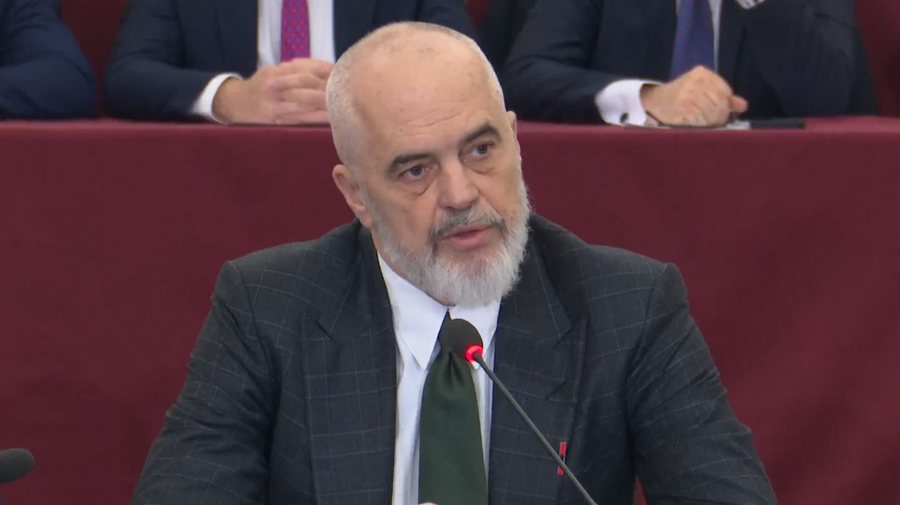
Prime Minister Edi Rama has publicly responded to the statement of the Association of Prosecutors of the Republic of Albania on the constitutional debate on magistrates' salaries, but has chosen to shift the focus from the issue of salaries to the practice of pre-trial detention. His reaction published on the social network X signals not only a rhetorical polemic, but also a direct intervention in the debate on the functioning of the justice system.
In his reaction, Rama writes:
"Do you understand or not what is called a 'salary cut' in the strange thread of this reasoning?
Not raising salaries as much as the judges' associations want!!!
So, in Albanian, a salary that doesn't increase as much as I want is a reduced salary!!!
It seems totally unbelievable, but it is unfortunately true!"
He continues by claiming that the government has never intended to reduce judges' salaries and that, on the contrary, it has been working for a year to build a "Justice Pole like nowhere else in the Balkans", which according to him will guarantee working conditions equal to the level of salaries in the region.
However, the essence of Rama's response does not remain on salaries. He immediately moves on to a frontal attack on the practice of pre-trial detention, addressing a direct question to the Prosecutors' Association:
"What about the continuous violation, like nowhere else in Europe, of the presumption of innocence and the return of detention without trial to routine practice, which has tarnished Albania internationally, do you have anything to declare?"
This shift in the debate clearly shows that the prime minister's concern is not really related to the salaries of magistrates, but to court decisions and prosecutorial files that affect his political and economic circle.
In essence, Rama is trying to delegitimize the practice of pre-trial detention, a legal instrument that is decided by the court, not by the prosecution alone. By presenting it as abusive and politically motivated. But in this way, he is directly interfering in a territory that should be completely independent of the executive branch.
The fact that the Prime Minister avoids the debate on salary standards and constitutional guarantees for magistrates, to focus on detention, speaks more of fear of the consequences of investigations and judicial decisions than of a real concern for human rights.
In any democratic state, the prime minister cannot and should not dictate the standards of judicial practice. But in this case, Rama not only enters this debate, but does so in an offensive tone towards prosecutors and judges, undermining public trust in the independence of the judiciary.