


Prime Minister Edi Rama continues to present programs funded by the European Union as success stories for Albanian youth, while Albania continues to face a massive exodus of young people and a pronounced lack of long-term policies that would make the country truly livable for them.
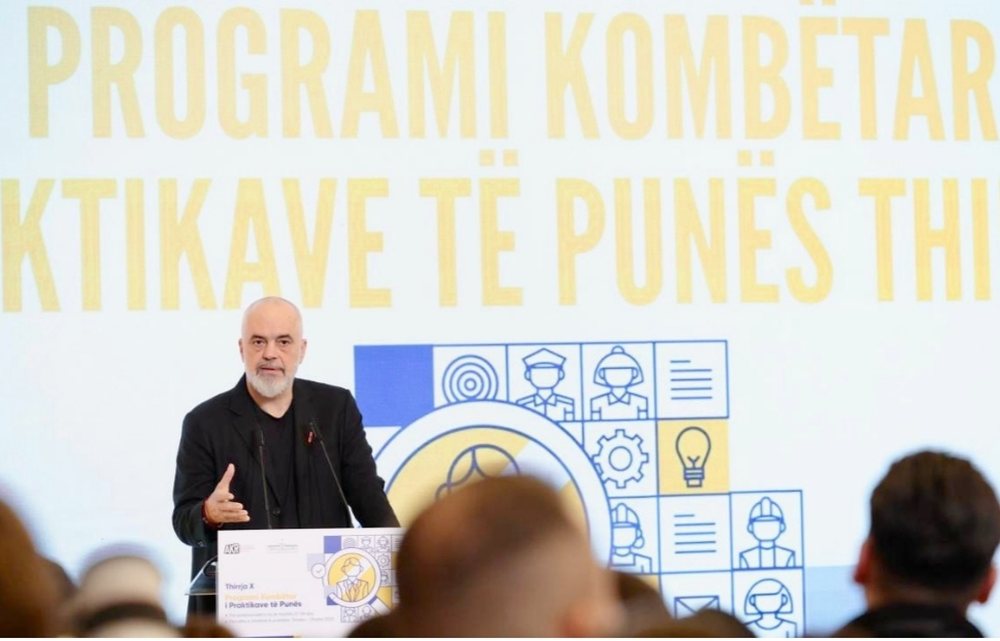
Present at the event of the National Youth Agency, at the conclusion of the 10th Call of the National Internship Program for students of excellence, Rama expressed confidence in this initiative, emphasizing that around 1,600 young people have been permanently employed in the public administration. According to him, these young people constitute the future leadership potential of state institutions.
"This program has ultimately employed around 1,600 people... these are human resources that have the potential to be the leaders of sectors and directorates tomorrow," the prime minister declared.
However, beyond the isolated figures, the reality for the vast majority of young people remains unchanged. Employment in public administration for a limited number of individuals does not constitute a structural solution for a country lacking decent wages, job security, housing policies, quality education and a competitive labor market.
In his speech, Rama also emphasized the so-called "Youth Guarantee" project, in cooperation with the European Commission, for which he said it foresees around 65 million euros in grants. The project aims to identify and activate young people through economic support, training and professional development.
"It's about 65 million euros and I would suggest you see how you can get involved," Rama said.
But this project, like many others before it, remains dependent on European funds rather than a sustainable national strategy. Critics point out that the government is using EU funds as a propaganda tool to create the perception of caring for youth, while essentially lacking a long-term vision that would keep young people in the country and make them the future of Albania.
While the prime minister talks about “potential” and “confidence,” immigration statistics show another reality: thousands of young people leave every year, not for lack of training or internships, but for lack of hope, stability, and perspective. In this context, European funds seem more like a temporary bait than a solution to the great scourge of Albanian youth flight.