



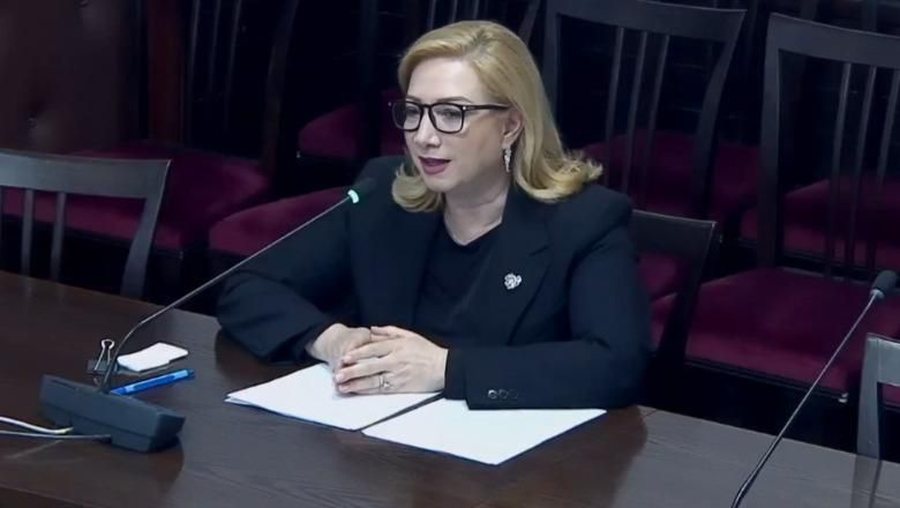
Former Constitutional Court President Holta Zaçe publicly admitted today that during her three years at the helm of this institution she acted under political pressure. The statement was made at a hearing in the Economy Committee, where she is being considered as a candidate for member of the Board of the Bank of Albania.
A fact long known in the public debate, but which comes for the first time as a direct admission from Zaçe herself, as she seeks to move from the judiciary to another key independent institution. At the same time, this admission raises strong questions about the way in which some of the Constitutional Court's decisions have been made during her mandate, decisions that have largely resulted in favor of Prime Minister Edi Rama.
According to VNA sources, Rama has ensured that Zaçe does not remain without a position after leaving the Constitutional Court, by pushing him towards the Board of the Bank of Albania. In parallel, preparations are also being made to appoint another member whose mandate has expired, Sonila Bejtja, to the vacant position of Commissioner for Protection from Discrimination.
During the hearing, Zaçe stated:
"I come from a three-year period where we have had political pressure... the pressure does not come directly, but through the media and the way issues are raised in the Albanian reality. I am prepared that the political pressure will continue even if I am elected to the Bank of Albania."
She insisted that the Bank of Albania's decisions on monetary policy are autonomous and independent, but admitted that the political climate in the Constitutional Court was heavy and meddling.
Zaçe also spoke about the phenomenon of the "judicialization of politics," saying that for a certain period, all politics was transferred to the Constitutional Court to resolve conflicts that should have been addressed in Parliament.
"I have known how to navigate an environment rife with political pressure. Even in unpopular decisions, I have acted according to my convictions and the Constitution," she added. While her decisions and positions have in fact been highly discussed for their political approach and extra-legal attempt to extend her mandate.
Zaça's today's admission of political pressure and the attempt to embroil the Constitutional Court in order to extend her mandate makes her appointment to the Bank of Albania even more controversial. An institution that, theoretically, should be immune to political influence.