


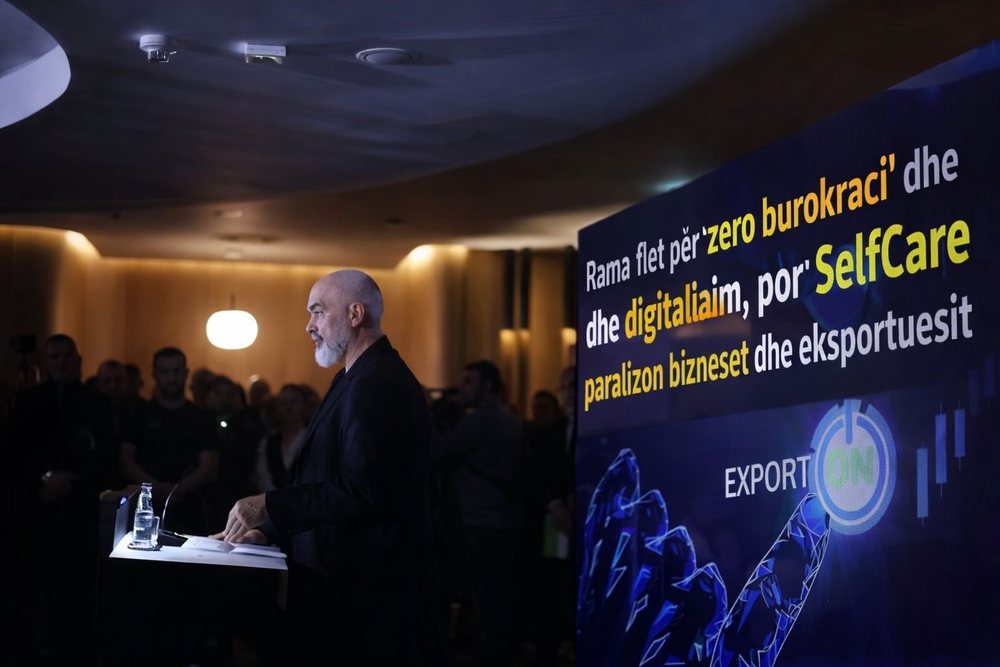
Edi Rama said today that Albanian exporters should not waste time with bureaucracy at customs, but rely on digitalization. He emphasized in a meeting that the more Albania processes raw materials domestically, the more added value it will keep within its borders, especially in the agriculture and agro-processing sector.
"Let's go without wasting much time, with zero customs bureaucracy, relying on digitalization," Rama declared, adding that the government has established new financial instruments for exporting companies to reduce their risk vis-à-vis commercial banks.
On paper, Rama's vision presents a more modern, more efficient, and less blocked Albania by counters and forms. In reality, the digitalization that Rama sells as a solution has become one of the biggest problems for Albanian business.
If one were looking for a perfect example of how technological progress can degenerate into a bureaucratic nightmare, January 2026 in Albania would be the ideal case study. Let us take the case of the SelfCare Platform, promoted as a symbol of modernization and administrative burden reduction, which today has become a paralyzing barrier, stifling economic activity and exhausting accounting professionals.
This is not just a technical glitch. It is a silent collapse of the economy's nervous system.
The blockade does not spare new businesses or existing ones, which are unable to validate electronic certificates, change personnel at cash registers or perform basic fiscal operations. While Rama talks about zero bureaucracy, businesses operate in a legal gray area, exposed to fines and penalties due to a system that does not work.
The crisis deepens during daily billing. Many entities report that invoices are being issued without the unique NIVF code, appearing as unfiscalized or with transmission errors. The law gives businesses only 48 hours to re-fiscalize in the event of an interruption – but when SelfCare remains inaccessible for days, this deadline turns into a legal trap, where the fault of the system is paid by the entrepreneur.
For companies with large volumes of automated billing – such as energy, telephone or water operators – the situation takes on even more alarming proportions. Without access to the platform, they cannot reconcile their internal systems with the central database. The result is a financial “black box”: uncertainty about the real number of invoices, their fiscalization and the risk of duplication or loss of data, with high correction costs in the future.
The irony is clear:
While the Prime Minister urges businesses to trust in digitalization to avoid bureaucracy, digitalization itself has become the main obstacle to the normal functioning of the economy.
And while on the podium, under central direction, the prime minister talks about exports, financing, and modernization, on the ground, businesses struggle to survive in a system where technology, instead of unleashing the energy of the market, is blocking it.