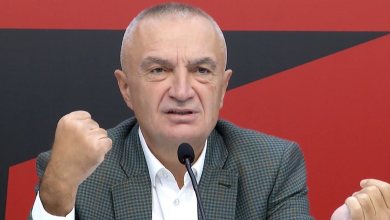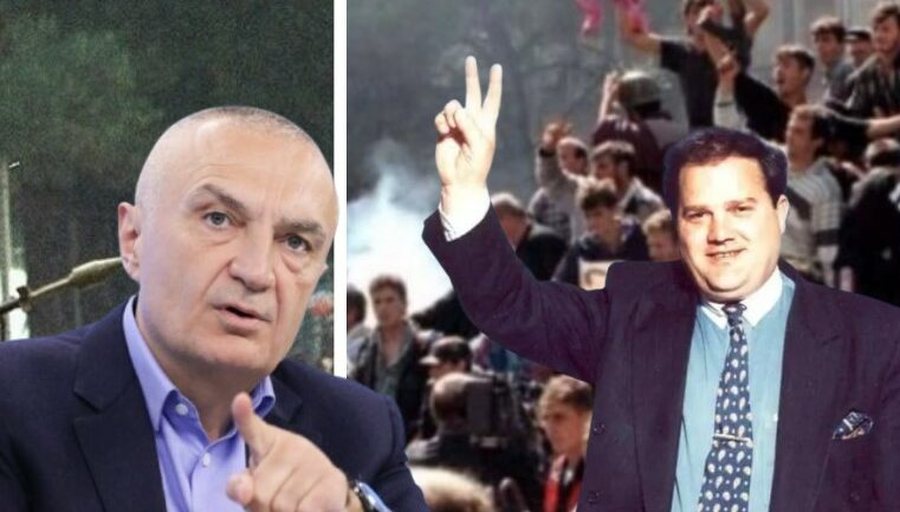
The President of the Freedom Party, Ilir Meta, has made public for the first time from prison new and previously unpublished testimonies regarding January 21, September 14, '98 and the murder of Azem Hajdari.
According to Meta, the January 21 protest, in which four innocent citizens were killed, was a reaction to the January 11 video, but it had been prepared months earlier. He says he had prior information about the escalation of the situation and the involvement of criminal elements, which forced him to resign from his post as Deputy Prime Minister and Minister of Economy a week before the tragedy.
Meta denounces blackmail attempts, illegal wiretapping and the political use of the video montage that served as an alibi for calling the protest. He says that the blackmailer later apologized and offered him a "fantastic offer" from Edi Rama to become Prime Minister with the support of the parliamentary minority, which Meta rejected.
He has also spoken about the February 1998 riots and the murder of Azem Hajdari, emphasizing that many events could have been prevented. Meta argues that Hajdari’s murder was not the product of a local conflict, but “carefully embroidered by invisible and masterful hands to achieve their objectives.”
When he became Prime Minister in 1999, solving the murder of Azem Hajdari was one of his priorities, but according to him, there was pressure not to push for an investigation. He also recalls a confidential conversation with a prosecutor, who told him that he would like the case to be solved.
FULL POST BY ILIR METES
The truths of January 21, September 14 and the Hajdari case
When people with integrity do not tell the truth, they only help the falsifiers of history legitimize their lies.
Not only that, but they are also forced to listen to lectures on "moral standards" from people who only understand by morality the pay slips they get paid (in black or white).
It's even worse when you hear lies from former heads of institutions who are held accountable for actions or fraud while in state or government positions.
Let's start with January 21, 2011.
I also heard a well-known journalist say that while 700 thousand euros were a thing of the past on January 21, now we have to be careful when talking about tens of millions of euros, etc. (This is my synthetic summary)
If the people were really revolted by that over-rehearsed montage on January 11, they would have taken to the streets that night (as happened in Hungary and other countries). The next day at the most. But January 21st happens only 10 days after the publication.
Meanwhile, preparations for January 21st had begun months ago.
After a year at the helm of the Foreign Ministry, after successfully concluding major issues such as the decision of the International Court of Justice on Kosovo, as well as the liberalization of visas after the decisive Sarajevo meeting, but also after the rejection of Serbia's Draft Resolution at the UN against the decision of the International Court of Justice, we agreed with Prime Minister Berisha to reshuffle the two ministries led by the Socialist Movement for Integration (LSI).
The main reason was not only that I had fulfilled my main objectives at the MFA, but also that I was unable to effectively lead the SMI, as local elections were approaching.
In one year, I had spent almost 170 days abroad.
I also communicated this decision to the gentleman with whom I would be making the castling.
Although unhappy, he understood my arguments.
But surprisingly, in the afternoon I received two text messages from him, telling me that he didn't agree with this move and that I should reevaluate this idea, otherwise he would have eavesdropped on me.
That was enough for him to be "fired" without being nominated.
I forwarded these messages to Prime Minister Berisha and made it clear that he could not be Foreign Minister and proposed Mr. Edmond Haxhinasto, with valuable diplomatic experience.
So the blackmail was rewarded with dismissal and not with "negotiations".
A few weeks later, the blackmailer repented, apologizing to me on his cell phone and also meeting me at the "Piazza".
After apologizing for the "rush" he brought me a "fantastic" offer from Edi Rama.
The essence of the offer was that I would become Prime Minister and we would form the Government according to our wishes, and the Socialist Party parliamentary group would support us unconditionally.
"Oh friend," I asked, "how am I going to be Prime Minister with 4 MPs?"
I had over 60 MPs as Prime Minister and I left myself because I could not accept the conditions of Fatos Nano's parliamentary minority.
In the end, the blackmailer told me that if I became Prime Minister he would not release the wiretaps.
It is understood that here the conversation ended "successfully" because the "repentant" became a recidivist.
A few days later, a media owner who was a mutual friend asked me for an urgent meeting at "Rogneri".
I remembered that he had some trouble, but he had my concern.
He showed me a photo of me with the blackmailer in his office.
"What's the urgency of this?" I asked.
"He told me," the media owner told me, "and he will publish the wiretap if you don't accept the proposal."
"Thank you," I said, "but tell him to publish whatever he wants, whenever he wants."
Of course, the blackmailer, thinking that I was taking his threat as a bluff, had sent the messenger to show me "proof" that he wasn't bluffing.
But as a responsible person who knows very well what I sign, but also what I say in every circumstance, I was very calm and certain that there could be nothing implicative in my conversations.
Of course, I informed Prime Minister Berisha about all of this. In the meantime, I had taken measures to replace him as an MP with a Socialist Party MP, at the time he was going to "desert" from our majority.
Likewise, during December 2010 and early January 2011, I spent almost 90% of my time heading the Government Emergency Committee due to the floods in Shkodra and Lezha.
Of course, due to my personal connections with Socialist Party deputies and officials in these two areas, I was informed about the orders they had received to prepare people for an unprecedented revolt, because a super scandal would erupt in the media at the beginning of January.
So, the January 11th montage was not at all unexpected for me and some others.
Immediately on January 12, in the morning, I sent an official letter to the Speaker of the Parliament, informing her that I was waiving my immunity.
After this action, I went to a press conference at the Ministry of Economy, where I made public my waiver of immunity as an MP and invited the Prosecutor's Office to investigate the case, and I also answered every question from journalists.
Meanwhile, the next day, on January 13, I accepted the invitation of the renowned journalist, Blendi Fevziu, to appear in the "arena" with a panel of analysts that he would select.
After a heated and uncompromising debate, when asked if I would resign, I replied that I had waived my immunity and that was enough.
But the next day, as soon as the sun rose, a stranger knocked on my door to bring me a message from abroad, from an extraordinary and very informed friend.
The message was that you should resign as soon as possible and you should not be in office (Minister) when people are being killed, because the situation is more serious than you think.
Having absolute faith in the integrity and kindness of the message-sender, I immediately went to the office and prepared the irrevocable resignation of the Deputy Prime Minister and Minister of Economy and went to meet Prime Minister Berisha to inform him of the new decision, as a necessity to ease the Government's position, as well as to undermine the alibi of the blood-seekers as much as possible.
Likewise, I submitted the proposal for my replacements, from the positions of Deputy Prime Minister and Minister of Economy, and from that day (i.e. a week before January 21) I never set foot in that ministry again.
That same day, at noon, the Socialist Party Assembly declared January 21st as a day of protest and hunger strike.
Meanwhile, a few days before January 21, the unknown reappeared, to bring new information and a new message for me.
The new data was that the situation was worsening as the organizers were recruiting many criminal elements in the field for January 21st.
Likewise, the message from the friend from abroad was that on January 21, I should not stay at home as the apartment could be attacked by criminal elements.
My response was grateful to my friend, for his care, but I told him that I was leaving the office because it wasn't mine, but I couldn't leave the house.
After that, on January 18, I held a press conference at the LSI headquarters where I warned Edi Rama to stop recruiting criminal elements to incite violence and bloodshed.
Concerned about the lack of proper assessment of the "underground" organization of the protest by law enforcement authorities on January 20, we sent an information letter to the General Director of the State Police regarding the most worrying data that we as LSI had.
Unfortunately, the violence was not prevented in a timely manner, even though for days on end, television was openly calling for violence and victims.
It was not the socialists (members and sympathizers) who violently attacked (stones, sticks, etc.) the Prime Minister's Office.
The Socialists were at the Lana Bridge and beyond.
But it was the recruits and the imported ones who relentlessly attacked the police for 3-4 hours until they were confronted by the Guard.
Preventing criminal elements before the rally had not worked.
Nor taking measures for the peaceful dispersal of demonstrators.
It is not my job to investigate why a timely-warned bloodshed was not prevented.
This should have been investigated in a timely manner by the General Prosecutor's Office.
But the traces of the organizers were very fresh at that time and they needed to be given time to "clean up".
But let's get back to some truths, with the video montage that was used as an alibi to call for the protest.
First, not even an official agency from the US, UK, etc., refused to conduct an expert examination of the video, because they knew better than us what it was.
Secondly, surprisingly, instead of taking the video to an audio expert, the Prosecution took it to a private computer (i.e. video) expert.
Meanwhile, there was no problem with the video, namely who the two people were.
The only and main problem was the authenticity of the conversation accompanied by subtitles and through the editing.
So, by chance, the American expert, during his search of the watch handed over by the "corruption whistleblower", found many other videos of him, which he had "deleted" thinking they were gone forever.
Their recovery, in addition to exposing many politicians, businessmen, and journalists who were wiretapped, not only in their offices, but also at home, also revealed a video where the 80 thousand euros that the gentleman received from his Deputy Minister at home were clearly visible.
For this reason, the Prosecution was formally forced to launch an investigation, since the American expert had sent it a report on the case.
But no one mentions it, and the (b)analysts are doing a good job.
Let's continue with my investigation.
The Prosecution Office deliberately violated the investigation procedures, hoping that I would request the closure of the case through court proceedings.
Although we requested and insisted that our experts be present at every expert examination that the Prosecution would select, this never happened intentionally.
Surprisingly, the Prosecutor who was assigned to handle my case, during the implementation of the Justice Reform, as part of the background check, was declared by the Files Authority as a collaborator of the State Security.
But the Court later declared that it had been another person and thus, the gentleman became a member of the High Prosecutorial Council, which also baptized the first SPAK Prosecutors.
Now let's move on to the Court and its decision.
We hear (b)analysts saying that Meta surrendered his immunity because he had guarantees from justice, etc.
I want to assure you that I have never appointed any prosecutor or judge in my life.
Secondly, if I or Mr. Berisha had so much influence on justice, why would we choose Mr. Dvorani, who is known to be very militant in the party even though he knows the laws well, as rapporteur for the case?
So there could be no intervention.
Likewise, I could have requested the exclusion of Mr. Dvorani from the rapporteur and member of the judging panel, as he had very close ties to the person who wiretapped me.
But I never did that.
Likewise, I did not request that the case be closed due to the violation of procedures by the Prosecution, but we proceeded with the trial on its merits, to the end.
The score, as is known, was 5-0.
Even the rapporteur of the case, Mr. Dvorani, voted for my innocence, like the other four colleagues.
But to "comfort" his party comrades, he made a note that, from what we have seen and investigated, he is innocent, but it would be good if the investigations were extended.
So, from two years of investigations, to continue without end, as long as the "Party" needed.
Despite all the pressure he had from the people of the Socialist Party, Mr. Dvorani did not vote as they wanted, so that there would be a vote against, which the socialists would trumpet everywhere, inside and outside the country, as the decision of the "uncorrupted minority", and other tales like these.
Meanwhile, in parallel, the gentleman who had been eavesdropping on me had gotten into big trouble because the endless videos he had made of himself with others had gotten out of control.
An irresponsible man who lived near me at the time had imposed a heavy fine using a speculative photo.
Again, the mutual friend who brought me the photo to "Rogner" asked for an urgent meeting on his behalf.
Without any desire, but because I wanted to know the truth, since my name had been mentioned by the fine-bearer, I met them both at a painting exhibition at that time, in Lalzi Bay.
After apologizing for the misuse of his wiretapping by Edi Rama on January 21, he also explained to me the circumstances of the fine by my former supporter, based on a speculative photo.
"Calm down," I told him, "it's like the photo you sent me with this mutual friend in Rogner."
"You are not obligated to pay anyone a single penny," I told him, "but your video montage cost four innocent people their lives."
Let's move on to September 14, 1998.
We all know what happened on September 12, but also on September 14, 1998.
Two events occurred that were not supposed to happen, but were conditioned by each other (cause and effect), the murder of Azem Hajdari was a foreshadowed event that should have been prevented.
His murder was not the product of a "Tropojans" conflict, but carefully crafted by invisible and masterful hands that exploited certain individuals to achieve their objectives.
I must emphasize that the person most uninterested in such a thing happening was Fatos Nano.
But the magnitude of this murder, the place where it occurred, the failure to stop the vehicles, and the fact that some of them were police officers, would in themselves make the Prime Minister, and not the Minister of Interior, who was more of a technical figure from an allied party, politically responsible for this murder.
But, between September 12 and 14 lies September 13, which was important in connecting the two events.
On the morning of September 13, a wave of revolt erupted from Democratic Party militants towards the Prime Minister's Office, thus warning of the "tsunami" for the next day.
In the evening, Prime Minister Nano held a meeting in his office, attended by several members of the Government and the Presidency of the Socialist Party.
After assessing the high risk of the situation and the unpredictable and destabilizing potential for the next day, he introduced us to a meeting he had had with two of the most important ambassadors in the Presidency about the situation.
One of them had suggested that he resign in order to de-escalate the situation, as the incident was very serious.
"Okay," Nano had said, "but who should I leave the government to?"
When Fatos mentioned a name that had been suggested to him, all those who were eager to take his place rose to their feet and said, no way, and so Nano obeyed this position.
It doesn't matter what the name was, because in any case it would be the Socialist Party that would choose the next Prime Minister.
But a great opportunity was lost to avoid September 14 and its consequences, and for this it was the responsibility of all of us that evening, for not judging more deeply and not foreseeing the consequences.
It would have been much better for the country, but also for Nanon himself, to resign that evening and not a few days later.
Let's continue with the Hajdari case now.
When I became Prime Minister a year later, in October 1999, the Hajdari issue was the "hottest potato" demanding direction.
International interest and pressure on this issue was strong and constant.
So is the internal pressure from the opposition.
I immediately met with the Prosecutor General and the group of five prosecutors in the Hajdari case, led by Haxhi Giu, if I'm not mistaken.
The purpose of the meeting was to encourage them to fully clarify the issue as soon as possible, as the Hajdari case was a very heavy cost for the state and the socialist government.
Likewise, I listened to all their requests point by point, even their personal ones.
Interestingly, one of the prosecutors in the case, through one of my advisors, asked me for a confidential meeting.
During the meeting, he asked me a strange question, whether I was serious about requesting a full disclosure of the matter or whether it was simply the way I needed to talk.
Of course, he was convinced of how necessary it was to quickly solve the case, since some of the perpetrators and witnesses of the case were being killed.
At the same time, several scandals began to be invented against the Minister of Defense, Hajdaraga, and the Minister of Finance, Anastas Angjeli, who were known as my close friends at the time.
They even went so far as to bring out a general in the media, in uniform, to attack the Minister.
It was all orchestrated pressure against me, so that I would not push forward with the investigations into Hajdar's murder.
Then my response was frontal, at a Government meeting, open to the media, where I declared that we will find not only the murderers of Azem Hajdari, but also the murderers of his murderers.
Later I was informed about the whereabouts of Jaho Salihi, one of the main defendants.
I gave an ultimatum to the people responsible, that if anything happened to him and he was not brought to justice within 48 hours, I would hold them publicly accountable.
Fortunately, there were no surprises and the arrest, let's say, went as expected.
This was an important moment not only for closing the Hajdari case, but also for discharging part of the state's responsibility for what happened on September 12th and which should have been prevented.
The purpose of this article is not only to tell some truths, today in a time of lies, but above all to emphasize that both September 12 and September 14, 1998, as well as January 21, 2011, could and should have been prevented.
And since the word geopolitical dominates these days, we should not forget that at the end of 2010, the Arab Spring had also begun.