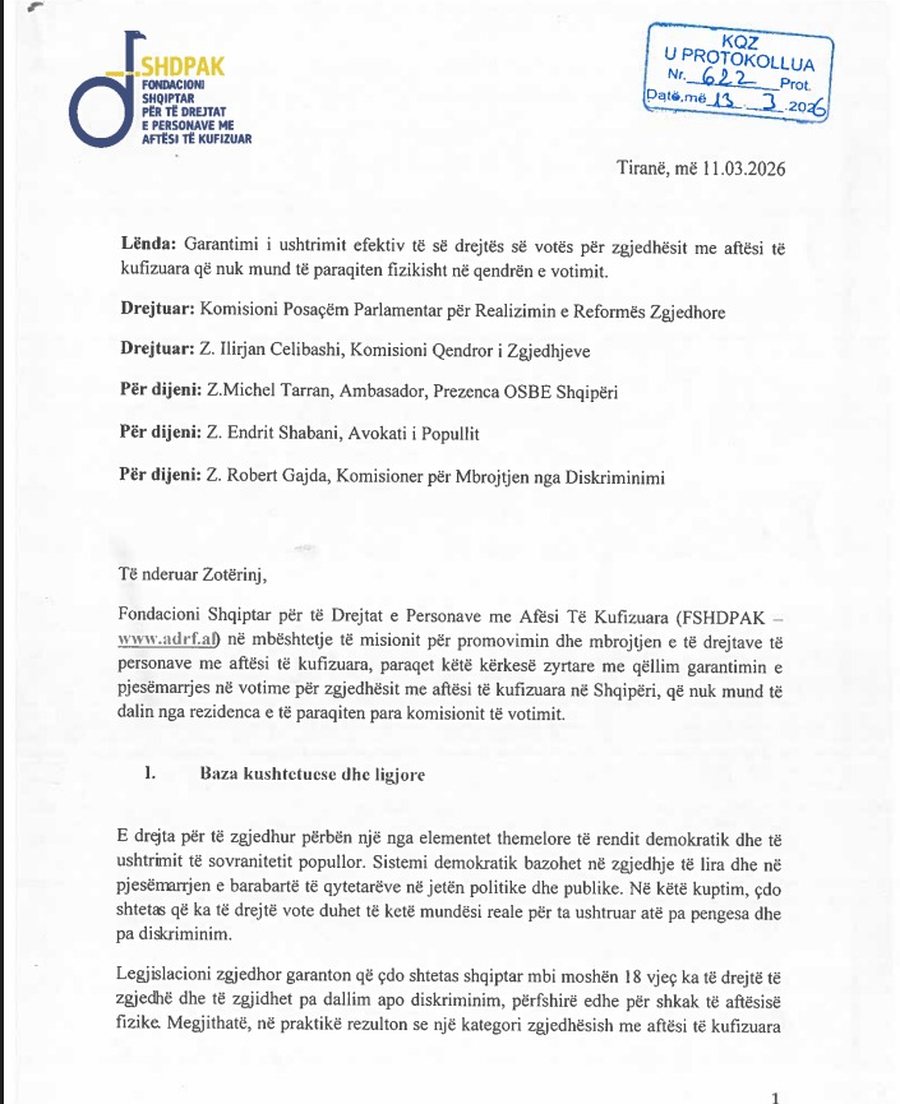



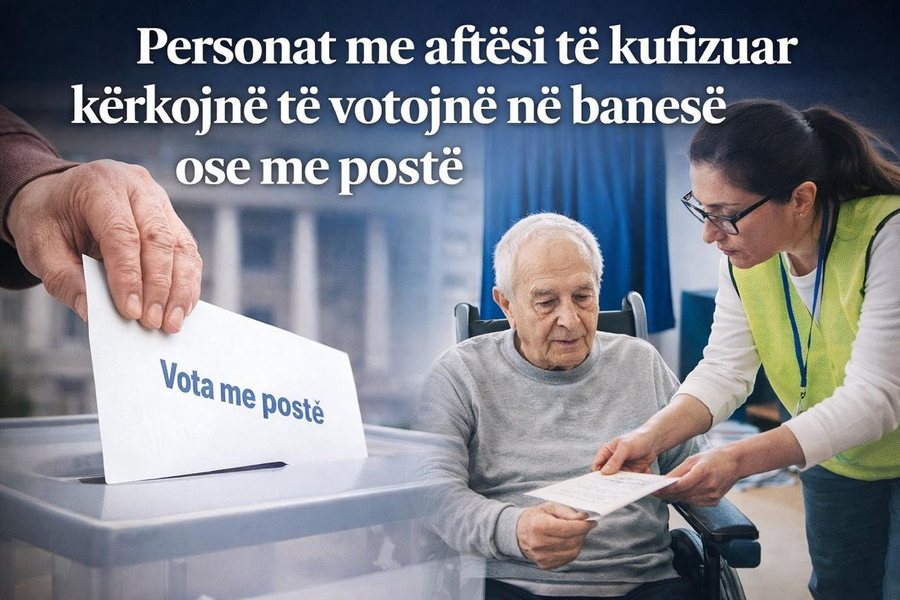
People with disabilities are requesting to vote by mail like emigrants or to have their ballots delivered to their homes. Through an official request that VNA has, addressed to the Special Parliamentary Committee for Electoral Reform and the CEC, the Albanian Foundation for the Rights of Persons with Disabilities (FSHDPAK) has requested urgent intervention in the Electoral Code to guarantee the voting of those who cannot physically appear at the polling stations.
According to a document from the association that represents them, ADRF, the current legislation offers some relief for those who manage to go to the polling stations, but completely ignores those who are isolated in their homes. The foundation emphasizes that:
"In practice, it results that a category of voters with disabilities is unable to exercise this right due to physical and procedural obstacles related to the current way of organizing voting. This situation is directly related to the inability to move, the lack of adapted transport and numerous infrastructural barriers. As a result, a significant number of citizens "remain in practice excluded from exercising the right to vote," the letter states.
The organization argues that Albania has international obligations to ensure that persons with disabilities vote "independently and without discrimination." In this request, a parallel is noted with recent achievements in Albanian electoral processes, taking the diaspora vote as an example:
"Referring to the positive results of respecting and fulfilling the right to vote for immigrants, we believe that in this revision of the Electoral Code, the realization of the right to vote for voters with disabilities will finally be fulfilled," the letter states.
The organization builds on the practices of other European countries, where alternative mechanisms are already consolidated to ensure comprehensive inclusion.
To resolve this democratic impasse, ADRF has listed four concrete proposals that should be integrated into the new electoral reform:
1. Voting at home: Creation of special election teams that visit voters at home, after a prior request and verification procedures.
2. Voting by mail: Enabling this form for those who, due to health reasons or physical disability, cannot be present at the voting centers.
3. Early voting: Establishing procedures that allow this category to vote before the official election day.
4. Special registration procedures: A mechanism that allows these voters to declare in advance their need for assistance or an alternative form of voting.
As Executive Director, Blerta Çani Drenofci, states, guaranteeing this right is not simply a legal duty, but an indicator of the level of democratic functioning of our entire society.