In Pagliara dei Marsi, an ancient rural village on the slopes of Mount Girifalco in Italy's Abruzzo region, cats far outnumber humans. They wander the narrow alleys, creep in and out of houses and lie on the walls overlooking the mountains. Their meows are a constant sound in the quiet that has come after decades of population decline.
But since March, this calm has been broken by huge celebrations for a rare event: the birth of a child.
As The Guardian writes, Lara Bussi Trabucco is the first baby born in Pagliara dei Marsi in almost 30 years, bringing the village's population to around 20 residents.
Her baptism in the church opposite the house was attended by the entire community, including the cats, and the unusual fact of the birth of a child has turned Lara into a major tourist attraction.
“People who didn’t know Pagliara dei Marsi existed came just because they heard about Lara,” said her mother, Cinzia Trabucco. “In just nine months, she’s become famous.”
Lara's arrival is a symbol of hope, but also a painful reminder of Italy's worsening demographic crisis.
In 2024, births in the country reached a historic low of 369,944, continuing a 16-year negative trend, according to data from Istat (the National Statistics Agency). The fertility rate also fell to a new record, with an average of 1.18 children per woman of reproductive age, one of the lowest in the EU.
The reasons for the decline are many: job insecurity, mass emigration of young people, lack of support for working mothers and, as in other countries, rising male infertility. Also, a growing number of people are simply choosing not to have children.
Preliminary Istat data for the first seven months of 2025 show a further decline, and of Italy's 20 administrative regions, nowhere is it more pronounced than in Abruzzo, where between January and July there was a 10.2% drop in births compared to the same period in 2024.
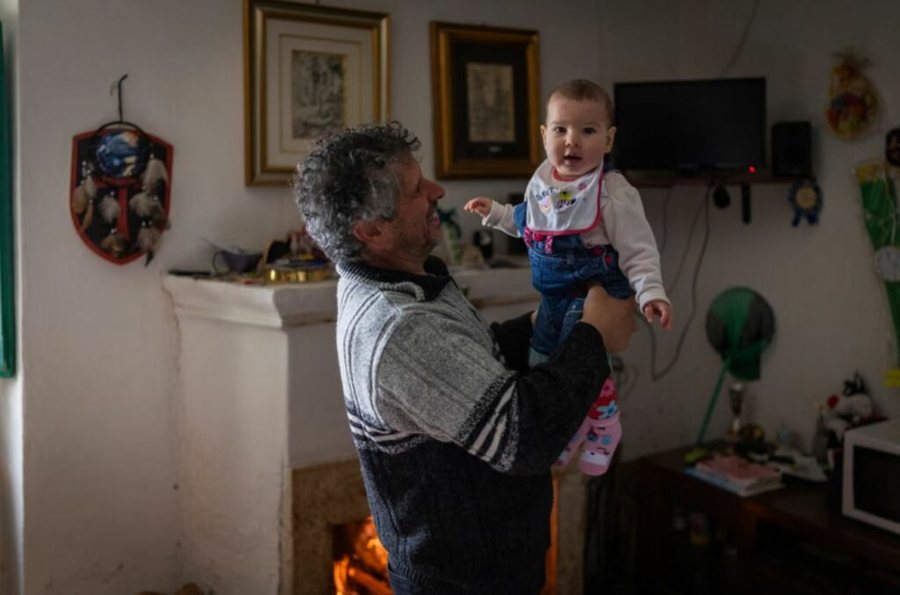
Pagliara dei Marsi is small, but it represents a national panorama dominated by an aging population and empty schools, putting pressure on public finances and presenting major economic and social challenges for local, regional and national leaders.
"We have suffered from a drastic depopulation, exacerbated by the loss of many elderly people, without any generational replacement," said the mayor, Giuseppina Perozzi.
Perozzi, who lives a few doors down from baby Lara, said she was grateful to Trabucco, 42, and her partner, Paolo Bussi, 56, for starting a family and hopes it will inspire others.
Their situation is unusual. Trabucco, a music teacher, was born in Frascati near Rome and worked for years in the capital before deciding to move to the village where her grandfather was born because she had always wanted to raise a family away from the chaos of the city. She met Bussi, a construction worker from the area, a few years ago.
The couple received a “baby bonus” of 1,000 euros after Lara’s birth, a one-off payment for every child born or adopted from January 2025, introduced by Giorgia Meloni’s government as part of a pledge to combat what the prime minister has called Italy’s “demographic winter.” They also receive a monthly allowance of around 370 euros for the child.
But their main challenge is balancing childcare with work. Italy's childcare support system is chronically inadequate, and the Meloni administration, despite presenting the fertility crisis as a battle for national survival, has so far failed to deliver on its promise to increase the number of nurseries. Many women who become pregnant are forced to leave work and then find it difficult to return.
The couple also worry about Lara's future education. The last time Pagliara dei Marsi had a teacher whose home also served as a school was decades ago. There is a primary school in nearby Castellafiume, but given school closures in Italy due to falling birth rates, it remains to be seen whether there will be enough children to keep it open.
Trabucco said financial incentives are not enough to stop the trend. “The whole system needs to be revolutionized,” she added. “We are a high-tax country, but that doesn’t translate into a good quality of life or good social services.”
About an hour away from Pagliara dei Marsi is Sulmona, a once vibrant town where the rapid pace of depopulation over the last decade has brought a battle to save the maternity ward at the Annunziata hospital from closure.
The ward, which serves the city and surrounding villages, delivered 120 babies in 2024, far short of the 500 needed to maintain funding. If it closes, pregnant women will have to travel to L'Aquila, the regional capital, about an hour away, putting themselves at risk in case of emergency.
“The region is vast and especially in winter, travel conditions can be dangerous,” said gynecologist Gianluca Di Luigi, who recalled the birth of a woman who had been stranded in a snowstorm for eight hours. “When we managed to get her to the hospital, we had to perform an emergency caesarean section. It was her first child and she was traumatised by the whole experience.”
Those fighting to keep the ward open argue that the target of 500 births a year, set in 2010, is no longer realistic. “We’ve never reached the magic number of 500 here,” said Berta Gambina, a midwife who has worked at the ward for 39 years. “Even in the best of times, the average was about 380 births a year. But we will do everything to keep it open, my biggest fear is abandoning pregnant women.”
Ornella La Civita, a municipal councilor with the center-left Democratic Party, said financial incentives to encourage births are welcome. “But how can you give women money to have children without guaranteeing them a safe and protected place to give birth?”
An often overlooked topic in the debate over fertility in Italy is fertility preservation, Di Luigi said, through methods such as egg freezing. “Ideological thinking in Italy has always been an obstacle,” he added. “But if we want to have babies, then we also need education, yes, to provide decent jobs for young people, but let’s also start teaching them about fertility preservation.”/Taken from The Guardian/