

Albania and Serbia lead the region in terms of women's representation in leadership positions, according to data from Eurofound (European Foundation for the Improvement of Living and Working Conditions).
In these two countries, in Albania, about 33% and in Serbia, 35% of employees report having a woman as their superior, a figure that is close to the average for European Union countries and significantly exceeds other Balkan neighbors.
This level of leadership by women indicates a higher maturity of the labor market in terms of gender diversity, leaving behind more conservative models that dominated in the early years of transition.
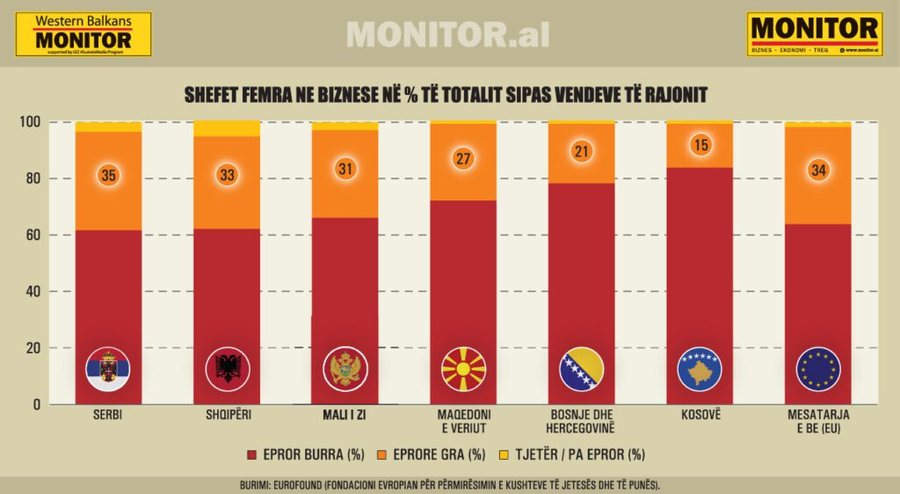
Montenegro and North Macedonia have the lowest female representation in business leadership, at 28% and 32%. Although these countries are making efforts to integrate women into decision-making, male dominance remains high, with around 65-70% of managerial positions held by them. Traditional barriers are still present, but are beginning to give way to new leadership trends.
At the bottom of the regional ranking remain Bosnia and Herzegovina and Kosovo, which mark the lowest levels of women running businesses across the European continent.
In Bosnia, the figure of male superiors exceeds 75%, while in Kosovo this dominance reaches a peak of over 80%, leaving the representation of women at minimal levels, around 15-18%. These data confirm a deep gender gap in these two labor markets, where the figure of the “boss” remains almost exclusively male.
The European Union (EU) average for male bosses hovers around 64%, meaning that around a third of EU employees have a woman as their boss. In the region, Albania and Serbia are the only countries that manage to stay very close to or within this average, showing a level of convergence with European practices of corporate leadership.
Countries like Sweden, with around 50% male and 48% female superiors, or Finland, represent the greatest gender equality in Europe.
Some countries in our region perform better than some older EU members. For example, Albania and Serbia have a higher percentage of women in leadership positions than Greece, where male superiors occupy around 72%, or Malta, where male superiors occupy 73%. / B.Hoxha