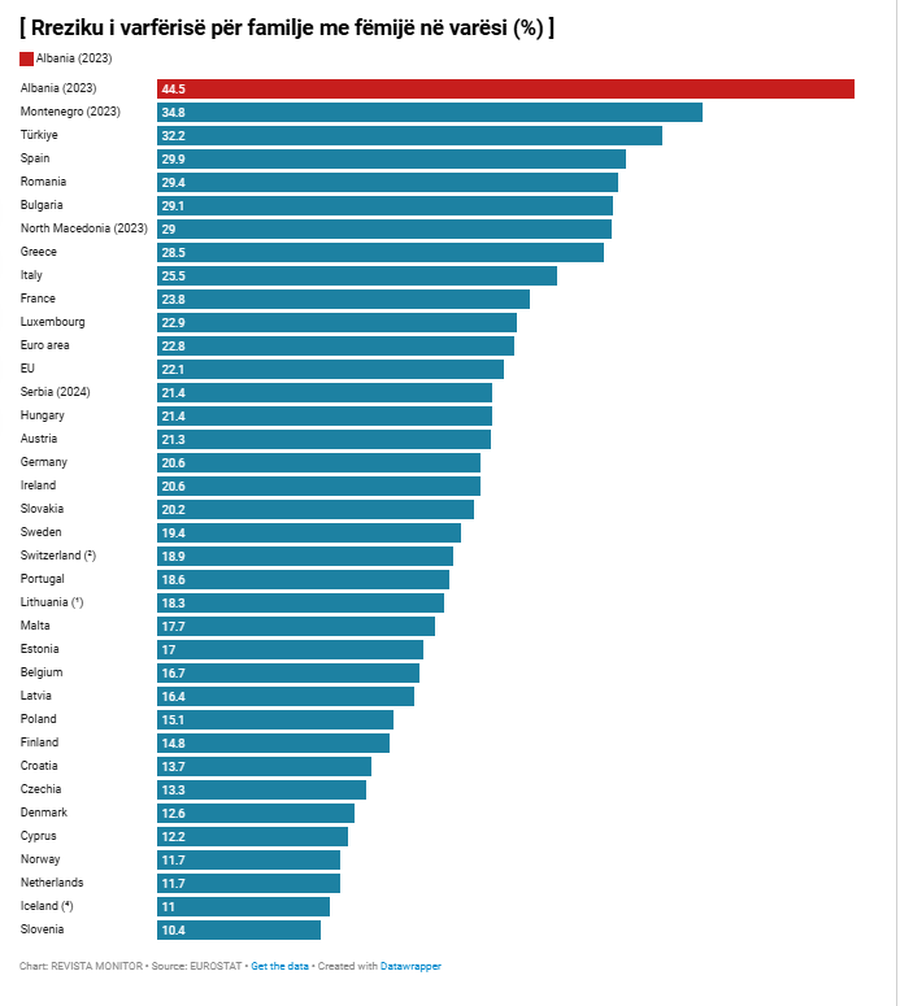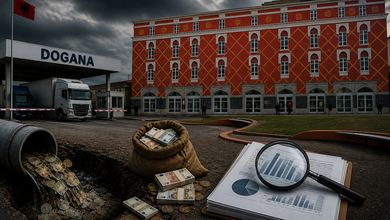


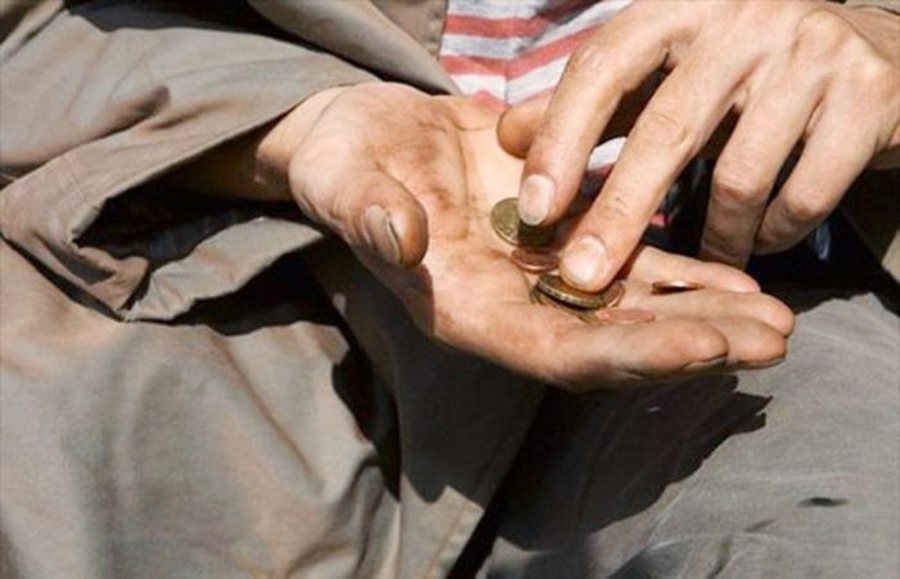
Nearly 45% of families with dependent children in Albania are at risk of poverty, face severe material and social deprivation, or live in a household with very low work intensity. The data was published by Eurostat in today's report on the risk of poverty faced by families with children.
This percentage is much higher than the European average of 22.1%.
Eurostat measures the AROPE indicator, which shows the percentage of the population at risk of poverty or social exclusion.
Specifically, in Albania, 44.5% of families with dependent children in Albania either have an income of 60% of the national median, or are unable to pay bills, unexpected expenses, holidays, food, or live in a household where most members work very little, or a combination of some of these conditions. For families without children, this percentage is 37%, again much higher than the EU average of 19.8%.
Poverty among Albanian families with children is much higher than in the region. In Montenegro, 34.8% of families with children are at risk of poverty, the second highest in Europe, after Albania. In Serbia, only 21.4% of families with children are at risk of poverty.
North Macedonia also has 29% of families with children at risk of poverty. Data for Kosovo and Bosnia are missing.
According to Eurostat, the “at-risk-of-poverty” indicator measures the percentage of people living with an income below a certain threshold in their country. According to Eurostat, a person is considered at risk of poverty if their disposable income (after social transfers) is below 60% of the national median income.
The “Severe Material and Social Deprivation Rate” (SMSD) measures the percentage of the population that cannot afford to meet some basic living needs. According to Eurostat, a person is considered to be in severe material and social deprivation if they cannot afford at least 7 out of 13 basic items, such as paying bills, unexpected expenses, holidays, regular food, internet or participation in social activities.
The Severe Material and Social Deprivation Rate (SMSD) measures the percentage of the population that cannot afford to meet some basic living needs. According to Eurostat, a person is considered to be in severe material and social deprivation if they cannot afford at least 7 out of 13 basic items, such as paying bills, unexpected expenses, holidays, regular food, internet or participation in social activities.
Persons living in households with “very low work intensity” are those living in households where working-age members worked 20% or less of their total work potential during the year.
europe
According to Eurostat, in 2025, 22.1% of people living in households with dependent children in the EU were at risk of poverty or social exclusion (AROPE), compared to 19.8% of those living in households without dependent children.
The AROPE rate for people living in households with dependent children was highest in Spain, at 29.9%, followed by Romania, at 29.4%, and Bulgaria, at 29.1%. In contrast, the lowest rates were recorded in Slovenia, at 10.4%, the Netherlands, at 11.7%, and Cyprus, at 12.2%.
In 16 out of 27 EU countries, the AROPE rate was higher for people living in households with dependent children than for those living in households without dependent children./Monitor.al/