


A new genetic study, published today in the journal Nature Human Behaviour, has provided the clearest picture yet of the origins of the Albanian people, revealing deep roots in the Balkans and an unusual continuity from the Bronze Age to the present day.
The Albanians are a relatively small people in the Balkans, but their history has long attracted the attention of scholars. The Albanian language occupies a unique place in Europe: together with Greek, it is the only surviving branch of the ancient Balkan languages. However, the origins of the Albanians and the connections of their language to these extinct groups have long remained unclear, fueling intense debate among historians and linguists.
To answer these questions, an international team of researchers analyzed over 6,000 ancient genomes from the Balkans and Western Eurasia, as well as 74 new genomes from modern-day Albanians. Using advanced statistical methods, the researchers were able to trace genetic connections that stretch back thousands of years in time.
The results show that, unlike other parts of Southeast Europe that were transformed by large-scale migrations in late antiquity and the early Middle Ages, the ancestors of modern Albanians remained relatively intact. The mountainous terrain served as a natural refuge, preserving genetic links with ancient populations of the Western and Central Balkans.
The researchers point out that Albanians represent one of the clearest examples of long-term genetic continuity in the Balkans. The analyses also show that they descend from a relatively small and stable population, which is related to isolation and limited contact with other populations over the centuries.
The study also identifies distinct influences from Eastern European populations, especially in areas where there was historical contact with Slavic populations. This pattern is consistent with linguistic evidence, such as Slavic loanwords and toponyms in Albanian, creating a rare link between genetics and linguistics.
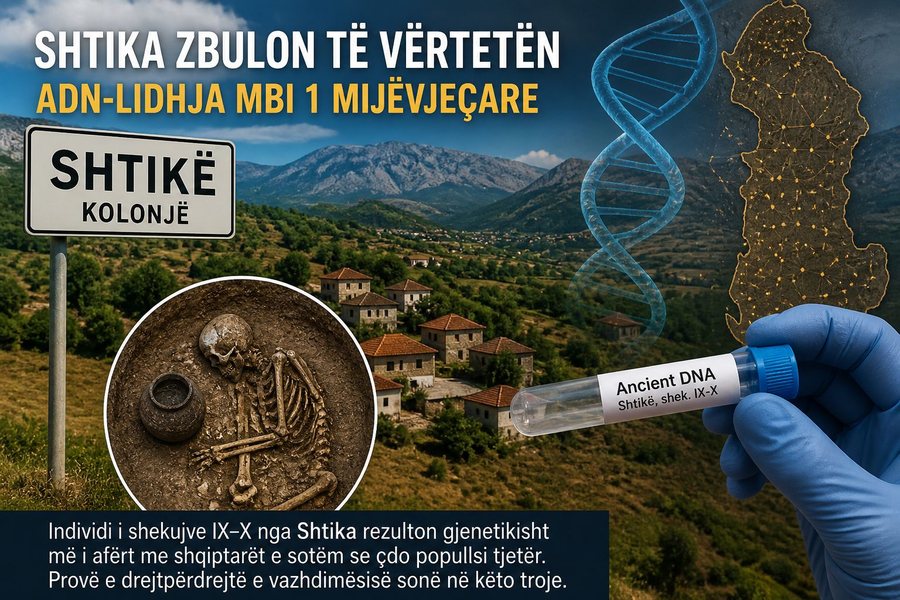
One of the most significant discoveries concerns a 9th–10th century individual from Shtika in southern Albania who is genetically closer to modern Albanians than any other known population. This is one of the first direct evidences that communities related to Albanians existed in the south of the country long before the Albanian language was documented in writing.
The study also confirms that Ghegs and Tosks share a common origin, but retain minor genetic differences that reflect the history of regional settlement and interactions.
In conclusion, the study concludes that Albanians are largely descended from indigenous populations of the Balkans, maintaining a strong genetic and identity continuity over thousands of years, despite migrations and historical upheavals in the region. The study, “Ancient DNA evidence for the history of the Albanians,” is published in Nature Human Behaviour.