


A recent Eurostat publication, "Digitalization in Europe", which provides data on the basic digital skills of European countries as well as internet usage, includes Albania.
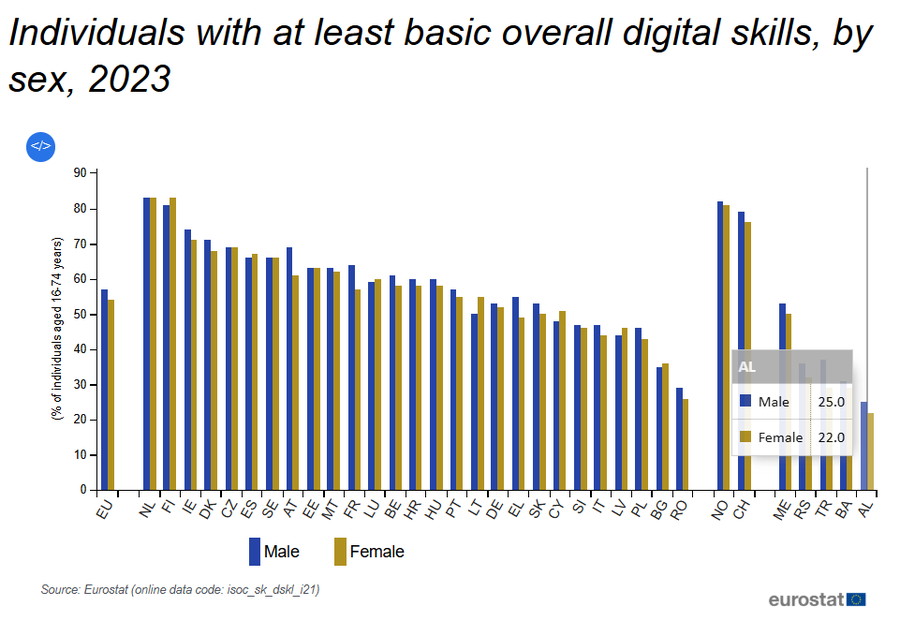
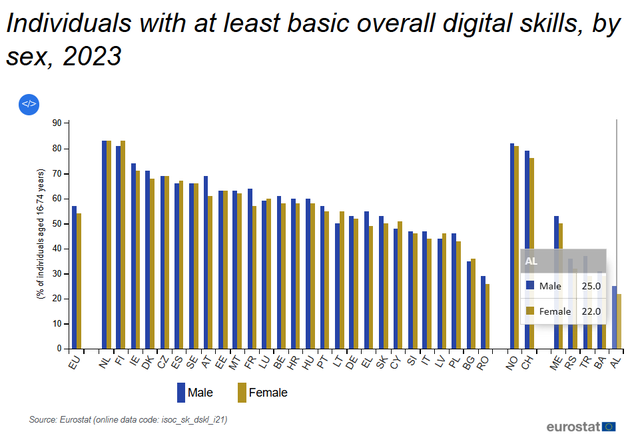
The latest data on basic digital skills are from 2023, while in the Eurostat chart, Albania ranks last in Europe, for both men and women, in terms of individuals with at least one basic digital skill. Only 25% of men and 22% of women had a basic digital skill, compared to 57% and 54%, which is the European average. Montenegro leads the region (53 and 50%), followed by Serbia (36 and 32%). There is no data for Kosovo.
According to Eurostat, the digital skills indicator (DSI) covers five domains: information and data management skills; communication and collaboration skills; digital content creation skills; security skills; and problem-solving skills. These reflect the five competence domains of the revised Digital Competence Framework (DigComp 2.0). To have at least basic digital skills (acquired as a combination of basic and above-basic levels), individuals should be able to perform at least one activity related to each of these domains.
In 2023, 56% of people aged 16–74 in the EU had at least basic general digital skills, 24 percentage points below the 2030 target set in the Digital Decade. The highest shares of people aged 16–74 with at least basic general digital skills were recorded in the Netherlands (83%) and Finland (82%), followed by Ireland (73%), Denmark (70%) and the Czech Republic (69%). On the other hand, the lowest levels were recorded in Romania (28%) and Bulgaria (36%). In most EU countries, the share of people with at least basic digital skills was higher among men than among women, with Austria, France and Greece recording the largest differences, at 8, 7 and 6 percentage points respectively. In 8 EU countries, the situation was the opposite, with a higher percentage of women with at least basic digital skills, while the largest difference was recorded in Lithuania.
According to Eurostat, digital technologies have spread to almost all areas of people's lives. They are transforming business models, jobs and production processes, driving growth and innovation. The rapidly advancing digital transformation is increasingly revealing its potential for society and the economy: supporting employment, health and education, improving the economic viability of businesses and contributing to sustainability.
Internet access of Albanian families among the highest in Europe
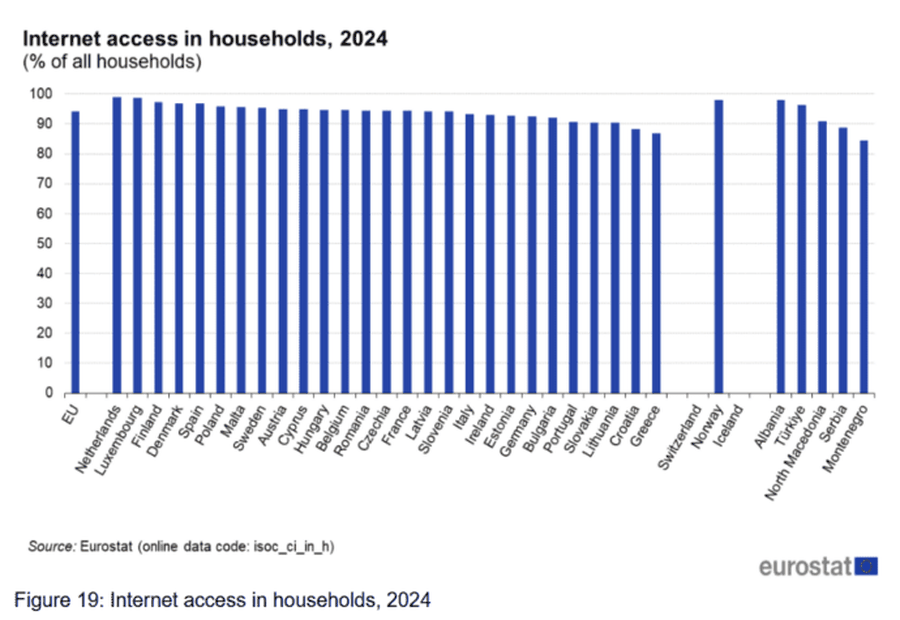
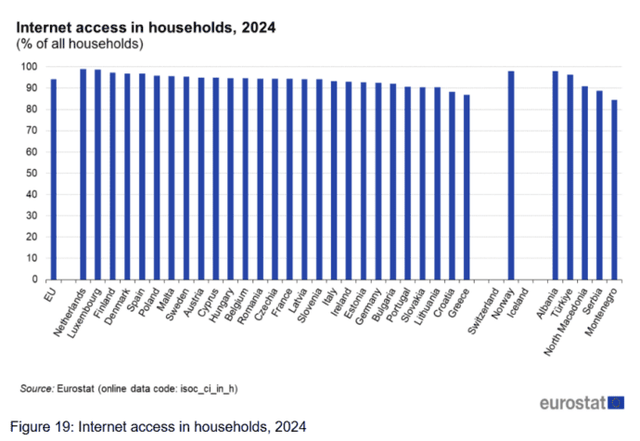
Although Albanians lack digital skills, Albanian households rank among the countries with the highest internet access in Europe, with 99.27% of households having internet access, according to data from 2025, compared to the 94.74% average for the European Union. In the region, Kosovo has slightly higher access, at 99.35%.
According to Eurostat, although all households in the EU were covered by broadband technologies, internet use by households in the EU remained below 100%. In 2024, 94% of households in the EU had internet access at home. The highest proportions of households with internet access at home were recorded in the Netherlands and Luxembourg, both at 99%, followed by Finland, Denmark and Spain, all at 97%. The lowest proportions of households with internet access at home were recorded in Greece at 87%, Croatia at 88% and Lithuania at 90%.
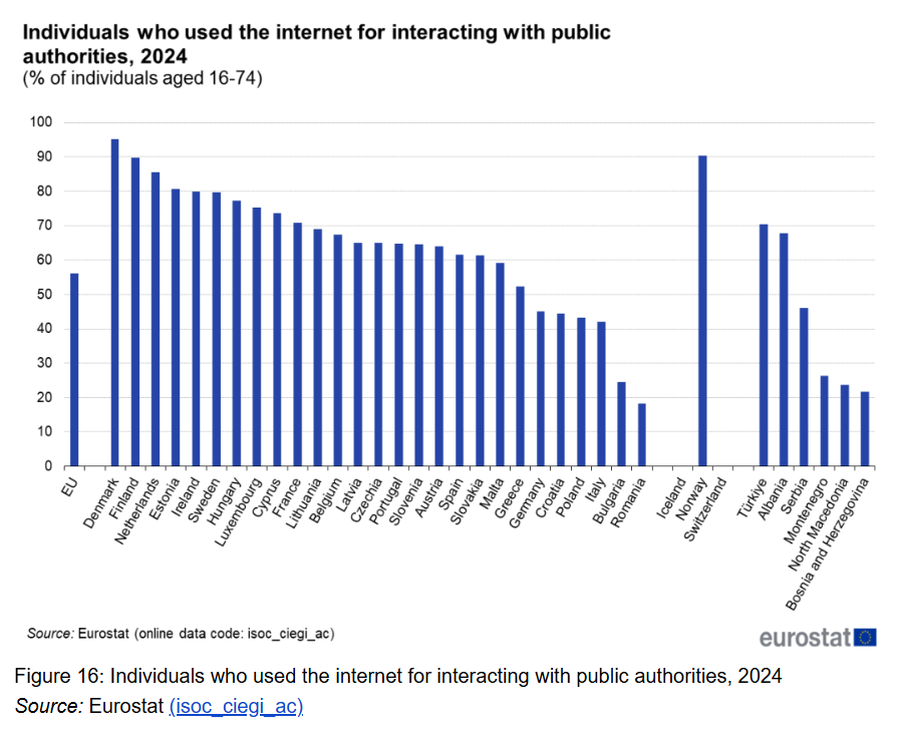
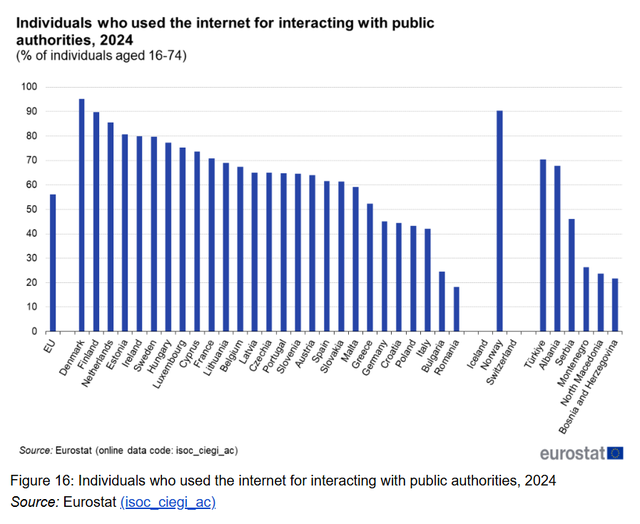
Albania also ranks high in the percentage of individuals who have used the internet to interact with public authorities in 2024, with around 70%, compared to the 56% average for the European Union, due to the high number of services received online in the country.
According to Eurostat, in 2024, 56% of people aged 16-74 in the EU, in the 12 months preceding the survey on ICT use in households and by individuals, had contacted or interacted via the internet with public authorities or public services for personal purposes. The highest rates of e-government use, including sites related to citizens' obligations, such as tax declarations or notification of change of residence, rights, such as social benefits, official documents, such as identity cards or birth certificates, public education services, such as public libraries or information on enrolment in schools or universities, and public health services, such as those of public hospitals, were recorded in Denmark (95%), Finland (90%) and the Netherlands (86%). The lowest use of e-government was recorded in Romania (18%) and Bulgaria (25%).
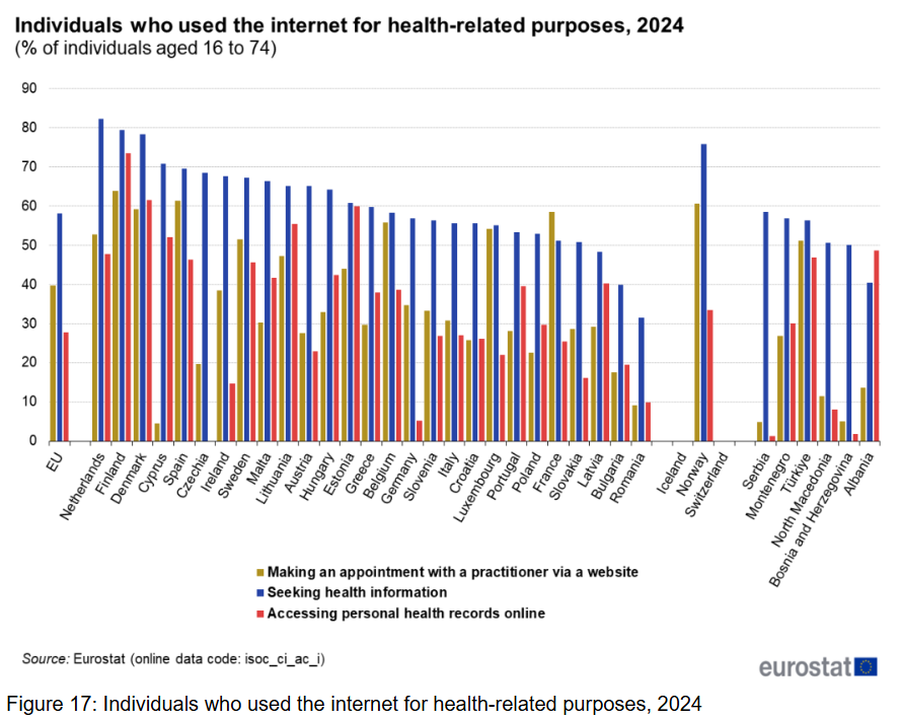
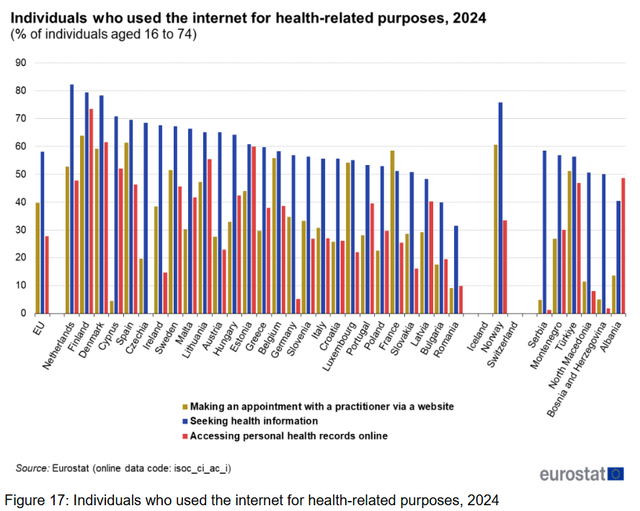
Even when it comes to health, Albanians interact, especially to access personal health data online, with around 56% of individuals.
According to Eurostat, in 2024, 28% of EU citizens aged 16-74 reported having accessed their personal health information online, 40% had booked an appointment with a doctor via a website, and 58% of EU citizens had searched for health-related information online. Two of these percentages were highest in Finland, where 74% of citizens had accessed their health information online and 64% had booked an appointment with a doctor via the internet. The Netherlands had the highest proportion of people using the internet to search for health information, at 82%.
Eurostat does not have information on the use of information technology by Albanian enterprises. In the region, Montenegro has similar percentages of use of analytical data by external contractors above the European Union average (47% by men, compared to 33% EU average) and 37% by its own employees (28% EU average)./Monitor.al/