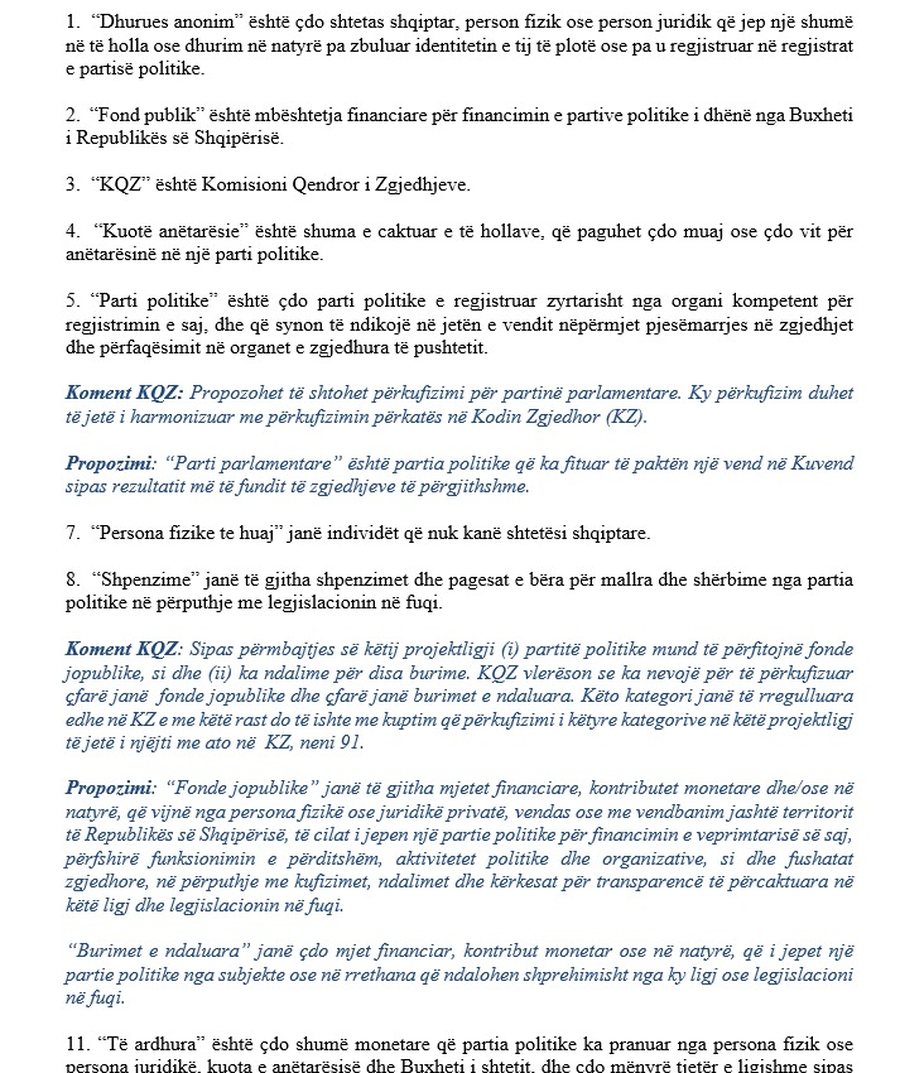




The Central Election Commission (CEC) has submitted a long list of remarks and concrete proposals to the new draft law "On the Financing of Political Parties", drafted by the special commission for electoral reform co-chaired by Gjiknuri and Bylykbashi. Through a detailed analysis, the institution led by Ilirjan Celibashi is demanding radical changes, starting from penalties for "ghost parties" to the way the state should pay rent for political headquarters.
Exclusion from elections for parties that hide finances
One of the strongest proposals of the CEC is related to the discipline of parties that do not submit financial reports. According to the document obtained by VNA, the CEC considers the current practice of fining parties that do not really exist to be "fictitious".
The CEC proposes that: "political parties that have not received funding from public funds for at least the last 2 (two) years, or the last 2 (two) elections, are excluded from participating in the next elections, unless they submit all outstanding reports". For parties that have received public funds, the sanction is even stricter: they cannot compete without first paying any fines and without submitting any overdue reports.
Stop "auditing reports that do not exist"
The CEC has strongly attacked the current logic of control over small parties. According to the institution's experts, it is pointless to waste resources on auditing entities that do not submit anything. "You cannot audit something that does not exist. Therefore, the audit should only be done on reports that are submitted," the CEC's comments expressly state.
Exclusive responsibility of parties, not donors
Regarding fines for exceeding sponsorship limits, the CEC demands that the legal burden not fall on citizens, but on the political entities themselves. According to the document, “the responsibility for respecting the rules on funding sources should lie fully and exclusively on the beneficiary political party.” The institution argues that individual donors cannot be held responsible for the internal administration of the party.
Remarks on sanctions: "Remove criminal articles from fines"
The CEC has requested the removal of several articles that provide for fines for "exerting pressure" on donors, arguing that this is the competence of the prosecution. "If it is proven that there is illegal pressure or influence, this would constitute a criminal offense" and not simply an administrative offense. The CEC also requests that its fines have immediate effect: "The fine imposed by the CEC constitutes an executive title and is executed according to the procedures provided for in... the Code of Civil Procedure."
Party headquarters, better "bonus" than state buildings
Another interesting point is the treatment of parliamentary party offices. The CEC suggests that the search for free public buildings is a process that "takes time and energy for both parties and practice has shown that it is not productive". Instead, a fixed "financial bonus" on the public fund is proposed, which would allow parties to rent premises according to their needs.
Auditors and transparency
To increase professionalism, the CEC requires party auditors to have at least 5 years of experience (out of 3 provided for in the draft) and proposes a new rule for rotation: "The statutory auditor cannot audit the same political party for more than 3 (three) consecutive years."
These 23 remarks (marked in blue in the original document) are expected to be at the center of debates in the Laws Committee, where the draft proposed by MPs Gjiknuri and Bylykbashi will have to face the technical filter of the institution that will monitor political money.