


Intermediation agencies report a decline in demand for local nannies, but there is an increasing trend in demand for Filipinos. The growing demand in Tirana is being driven by the monthly payment of 600 to 700 euros for much more flexible working hours than hiring local nannies and the lack of public services. The number of women migrating to Europe for nannies has also decreased, due to the increase in seasonal employment in the South during the tourist season. Experts raise concerns that the market still remains informal and uncontrolled in terms of qualifications.
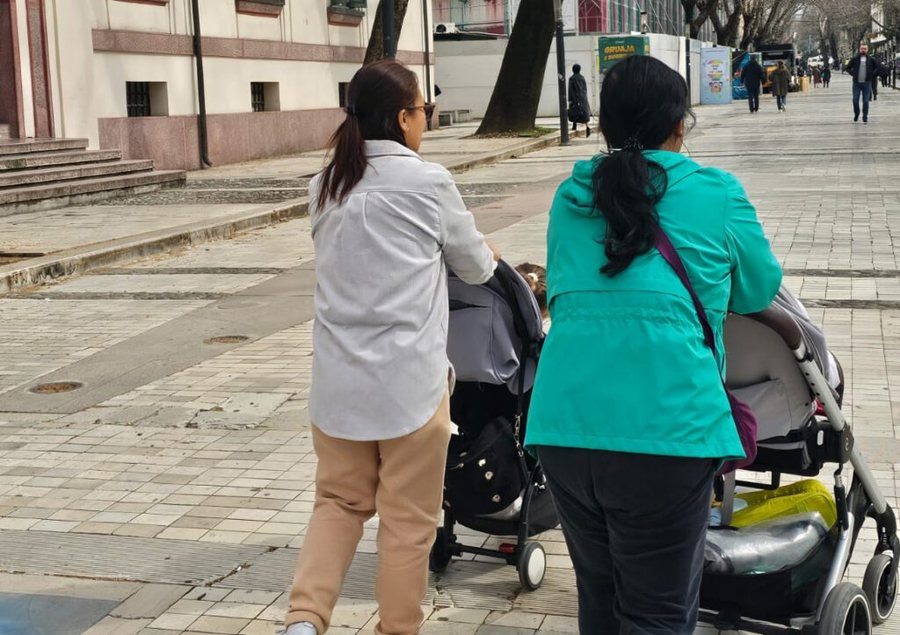
We met Sinagoa, a 46-year-old from the Philippines, in one of Tirana's shopping malls, while she was walking her 3-year-old daughter Ela, whom she has been taking care of since she was just 3 months old.
She says that for more than two years she has been working for a family in Tirana as a nanny and from time to time they move to the employer's apartment in Lalëzi Bay to take care of their 3-year-old daughter.
Sinagoa says she came to Albania after leaving her job in Hong Kong, where she was also working as a nanny for a family. She came through an employment agency, but according to her, this agency no longer exists (she declined to be photographed).
Her monthly salary is 650 euros, which includes accommodation and food provided by the Albanian family that employed her.
"I send about 500 or 550 euros a month from my salary to my family. I have a husband and two children in the Philippines. The remaining 100 or 150 euros I spend on the outings I usually go on during the weekend."
"Every Sunday I get together with my friends from the Philippines to spend time together. I had to emigrate because the wages in the Philippines are very low and you can't afford to live," she says.
Sinagoa says she feels very good in Albania. She adds that she has developed a great rapport with the girl she is caring for and that she sometimes sleeps in the same room with her at night.
If years ago, hiring Filipino nannies who lived inside the employer's home was only done by wealthy families, currently hiring them in Tirana is becoming a trend.
Several working families contacted by "Monitor" claimed that their payment scheme is almost the same. The main thing is that the Filipino nanny is provided with accommodation within the home, including free food and a monthly salary of 600, 650 to 700 euros per month.
The demand is greater for foreign nannies and is increasing from couples employed in professions such as architects, media workers on news television, who are forced to work long hours.
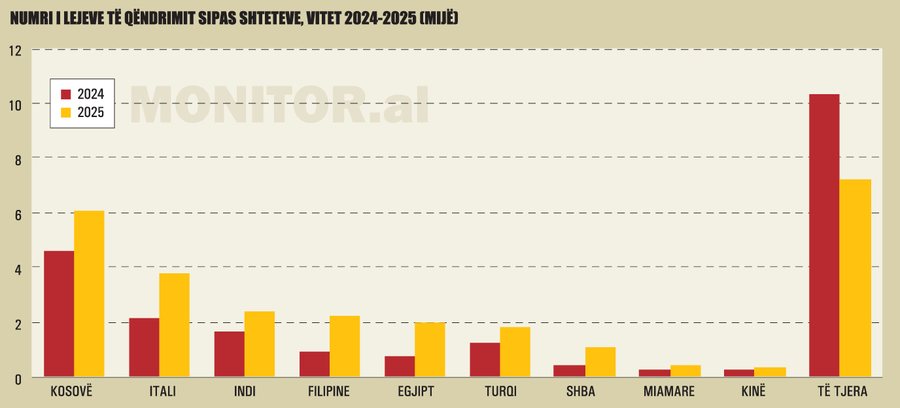
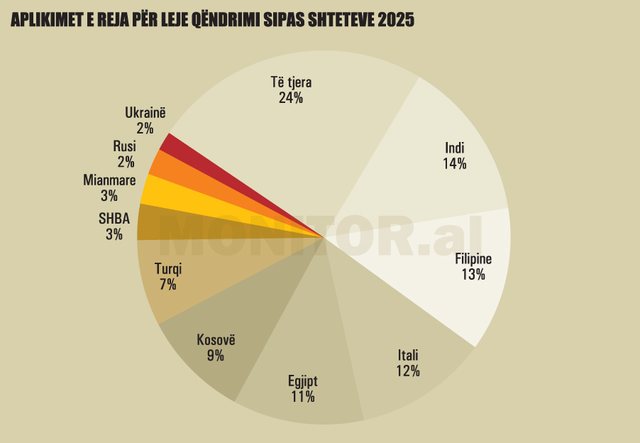
13% of residence permit applications in 2025 were from Filipinos
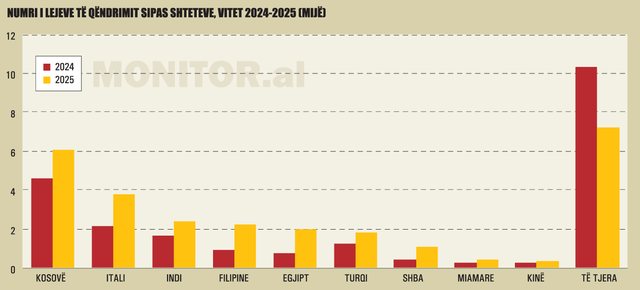
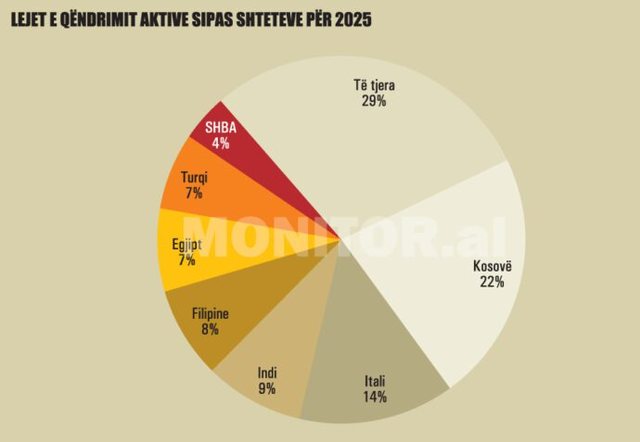
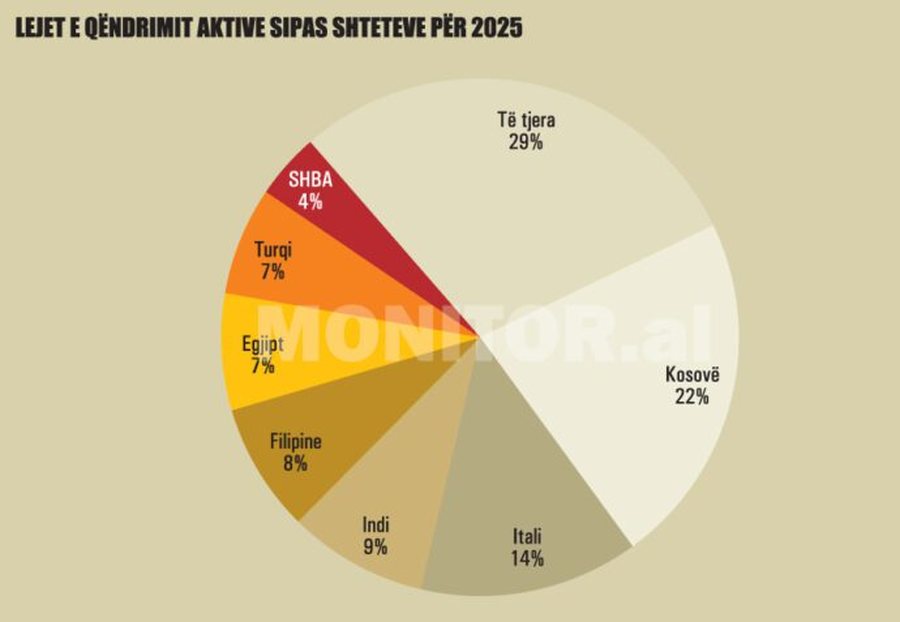
In 2025, according to State Police data, there were 2,213 citizens from the Philippines with residence permits. Compared to 2024, their number increased by about 130%.
In total, in 2025 the number of foreigners with residence permits reached 27,514 citizens. Compared to 2024, the number increased by about 22%. For the year 2025, citizens from the Philippines with residence permits accounted for 8% of the total.
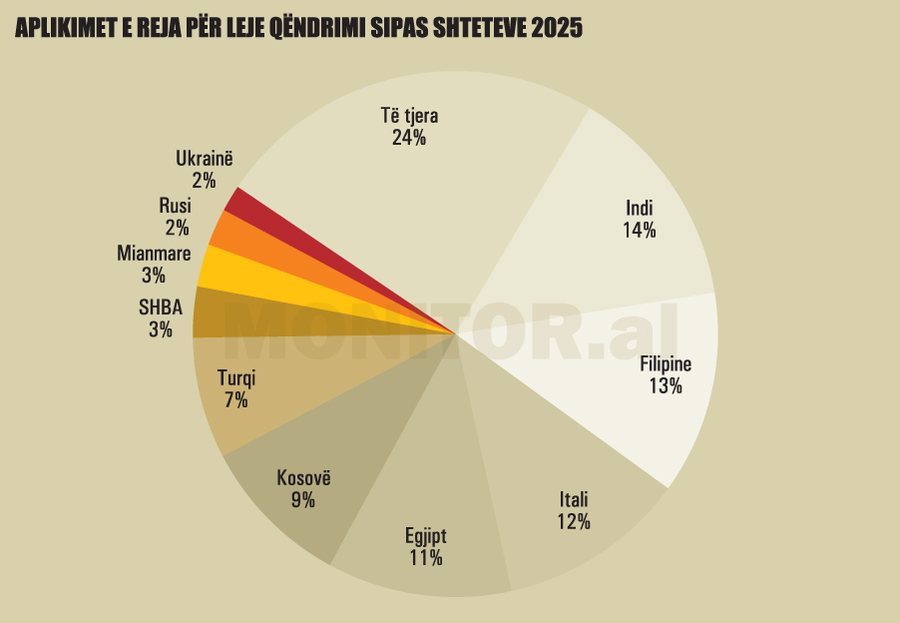
During 2025, 19,321 applications for residence permits were processed in the electronic register for foreigners. Compared to 2024, the number of new applications increased by about 6,145 applications, or 47% more applications than the previous year.
For the first time, 2,415 citizens from the Philippines applied for a residence permit in Albania in 2025. According to data from the Electronic Registry for Foreigners (FER) made available to "Monitor" by the State Police, citizens from the Philippines who applied for a residence permit for the first time accounted for about 13% of the total.
The main nationalities that have applied for a residence permit for the first time are led by India with 2,691 applications, which accounts for 14% of the total; Philippines with 2,415 applications (13%); Italy with 2,239 applications (12%); Egypt with 2,198 applications (11%); Kosovo with 1,813 applications (9%); Turkey with 1,441 applications (8%), USA with 606 applications (3%); Myanmar with 506 applications (3%); Russia with 442 applications (2%) and Ukraine with 312 applications (2%).
For the year 2025, of the total applications, 65% of them were for a unique employment permit, followed by applications for family reunification which constituted 13% or about 5% of them were for study purposes. While the number of foreign citizens who applied for a permanent residence permit was 40 or 0.2% of the total number of applications for the year 2025.
According to data from the State Police, out of the total applications for 2025, 7,049 or 36.4% of applications were from women and 12,272 or 63.6% from men.
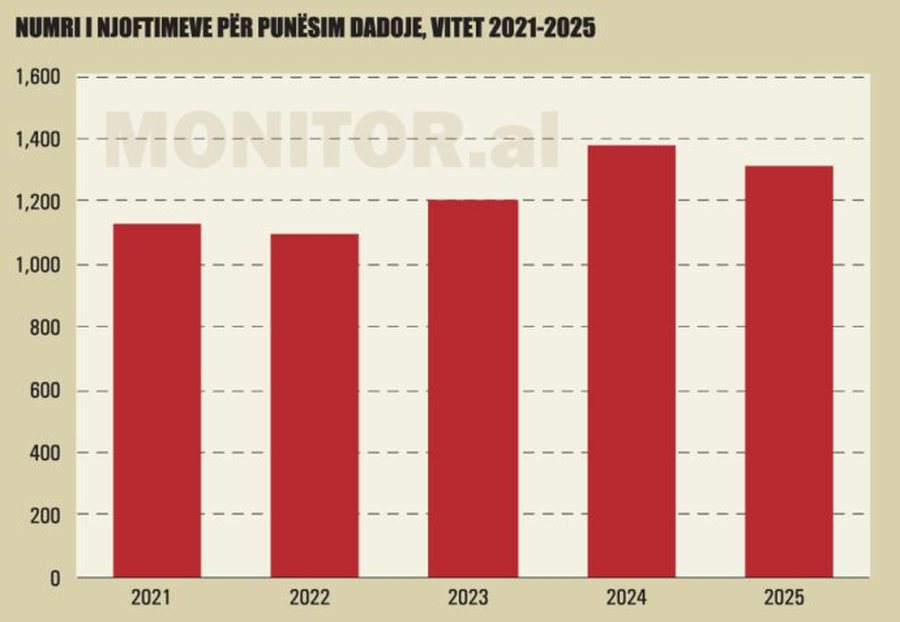
The nanny market, how demand is changing
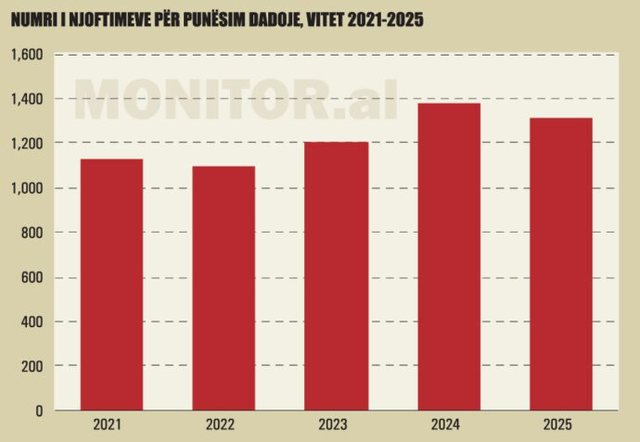
For the year 2025, nationwide, according to data from the database of the "Çelësi" portal and the "Profesionisti" recruitment agency provided to "Monitor", 1,312 announcements for the employment of nannies for children were published.
Compared to 2024, the data shows that the number of babysitter job postings decreased by 5%.
The managers of the Mediation Agencies in Tirana, specialized in mediating the employment of child caretakers, elderly caretakers, or even housekeepers, claim that overall, the demand for these professions has decreased this year compared to the previous year.
The decline in demand, according to them, is being influenced by a number of factors, including the high salaries demanded of employees in return for short hours and inflexibility towards employee demands, which are also influencing the transformation of this market.
Firstly, nanny employment agencies claim that this year they are experiencing a declining demand for the Albanian nannies profession, but there is an increase in demand for hiring Filipino women as nannies for children.
Albana Uku, head of one of the mediation agencies for child nannies and elderly caretakers, told "Monitor" that in the market, demand is high only for Filipino nannies, while there is a decline in the employment of Albanian workers.
Ms. Uku emphasizes that the main reason for the decline in demand for Albanian nannies is the high salaries demanded of them and the lack of flexibility in working hours. Among other things, she adds that for this profession, the offer continues to remain without professional qualifications.
"This year, overall, the demand for childcare professions has shown a decline, but the demand for Filipino nannies has increased, a service that is not offered by our agency. The decrease in demand for local nannies is related to the increase in the number of children attending daycare centers or kindergartens and the high salaries for childcare workers."
Currently, if an Albanian family hires a nanny to care for their child, the salary required from them ranges from 50,000 to 60,000 lek per month for 8 hours of work per day from Monday to Friday. It should be noted that this category of profession still lacks qualifications, despite the fact that the women who practice this profession are former teachers or former child educators.
Ms. Uku explains that the main reason for the increased demand for Filipino nannies in Tirana is related to the affordability of the payment versus the flexibility of working hours.
"Foreign nannies are more in demand due to the flexibility of their work schedules, as they live in a house with the employee and are paid up to 600 euros per month.
"For many families, this is more financially beneficial, but above all more convenient for organizing schedules, compared to hiring an employee who stays 6 or 8 hours a day with a monthly salary of 50 thousand or 60 thousand per month," underlines Ms. Uku.
Gladiola Balliu, an architect by profession, mother of a 2-year-old daughter and expecting her second child, has been hiring a nanny from the Philippines who lives in her house for several months. Gladiola tells "Monitor" that she initially did not think of hiring a Filipino nanny, but her opinion changed after an unsuccessful experience of hiring an Albanian nanny.
The Filipino nanny employed by her family is paid around 600 euros per month (including accommodation, free food, and social and health insurance paid by the employee).
Gladiola Balliu highlights that flexible schedules and the stability of nannies are the main reasons that led her to hire a foreigner to take care of the house and children.
"I hadn't initially considered hiring a Filipina nanny, as I was looking for a local maid for housework a few times a week. But it was difficult to find someone consistent, with longer hours and affordable demands."
The current nanny was recommended to us by a close friend and we decided to give her a try. She has proven to be very kind, tidy and dedicated and does not need constant guidance. She takes her job very seriously, as with the income she earns in Albania, she guarantees a living for the 4 children in the Philippines.
The monthly payment is 600 euros. The nanny is also paid regularly every month for social and health insurance, including housing and food within the home. The total cost comes to approximately 1,000 euros per month.
"The working hours start from 09:00 in the morning until 13:00 and continue from 15:00 to 19:00. Compared to the offers we had from Albanian nannies, which required salaries of up to 800 euros per month for a limited schedule of 6 hours, this solution has proven to be more functional for our family," she claims.

How has the number of children attending kindergarten changed in the last decade?
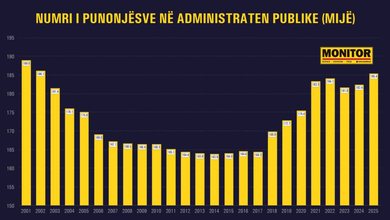
According to INSTAT data for 2024, the number of children attending kindergarten nationwide was 65.9 thousand. Compared to 2023, the number of children attending kindergarten decreased by 1%.
In 1991, according to INSTAT data, the number of children enrolled in kindergarten was 108.8 thousand children. After this period, until 2010, the number of children enrolled in preschool institutions decreased.
Further, in 2011, there was an increase in the number of children by 5% compared to the previous year. The upward trend continued until 2016. From 2017 to 2023, the number of children attending kindergartens again continued the downward trend.
Albanian nannies immigrate to the South
Over the years, the salaries of domestic nannies have shown an upward trend. According to data obtained from the female employment market in this sector by mediation agencies, it turns out that after the Covid-19 pandemic, salaries for domestic childminders have increased by 50 to 80%.
According to market data, for an experienced nanny, net monthly payments range from 50 thousand lek for 6 hours of work per day to 80 thousand lek for 8 hours of work. The working conditions for receiving these payments include caring for 1 child, 8 hours a day, 5 days a week.
If the employee will take care of 2 children, the monthly payment reaches up to 80 thousand lek. In some cases, according to market sources, payments for nanny reach up to 1,000 euros per month.
Employment agency executives claim that the commissions paid by employers have increased significantly this year. Unlike previous years, when families or employers paid a one-time commission, ranging from 10% to 60–100% of the employee's monthly salary, this year the agencies are applying a new fee structure.
The basic commission starts at 50% of the employee's monthly salary paid by the employer, and an additional commission of 10% of the monthly salary paid by the employee to the mediation agencies is added.
There has also been an increase in payments for nannies outside Albania.
If in 2024, payments for employed nannies start from 800 to 1,000 - 1,100, this year payments start from 1,000, 1,200 to 1,300 per month. On social networks, most often you come across announcements for hiring nannies or employees to care for the elderly from immigrant families living in Switzerland, Germany or Belgium.
The employment requirements for performing these services outside Albania include as a main condition the employee's 24-hour stay at home, providing free accommodation and food.
But for the head of one of the agencies for mediating the employment of caregivers, Ms. Albana Uku, in 2025 there was a significant decrease in the demand for women to emigrate abroad to be employed as nannies.
Ms. Uku says that the decline in emigration has been influenced by the increased demand for seasonal employment in the South of the country, such as sanitation workers or dishwashers in restaurants or hotels with salaries ranging from 800 to 1,000 euros per month.
"Last year we had a high number of employment mediation contracts during the tourist season for women in the South of the country, in some cases even in Durrës, for waitress or dishwasher positions."
Most of them were women who emigrated abroad to be employed as nannies with payments of 1 thousand euros per month. But in those years, seasonal employment with payments of 800 to 1,000 euros per month was seen as more profitable than emigration. The trends are expected to continue for this tourist season as well.
The employment market for caregivers continues to remain informal
The market for employing family caregivers continues to be informal.
For several years, the market for recruiting child and elderly care workers has been organized with the employment model through intermediary agencies. Interested families can turn to intermediary agencies for employment of personnel.
But the agencies only guarantee employment mediation, as for these professions, an employment contract continues to be signed and employees are not paid social and health insurance.
Erald Pashaj, administrator of EPPC Albania and Kosovo, which specializes in the field of staff training and development, previously explained to "Monitor" that a family that hires for this type of service finds it impossible to provide the employee, as it needs to function as a business, registered with NIPT.
The only ones who manage to provide these employees are entrepreneurial families. If an entrepreneurial family hires a caregiver, they register them as employees through their business. Their number is very small. Consequently, not only the employment market for nannies and family caregivers, but also for the employment of drivers in the family, are non-formalized employment, they are informal.
"There are no genuine employment agencies in the country for these types of services, only through which the employment contract and social and health insurance payments are made possible. Meanwhile, mediation agencies cannot formalize this labor market, since their object of activity is mediation," Mr. Pashaj said earlier.
Sociologist Gëzim Tushi has also previously emphasized the need to address the qualification and regulation of the market (nannies or caregivers) in order to guarantee the provision of services to the elderly through a process of monitoring skills and recognizing specific standards for this age./Monitor.al/