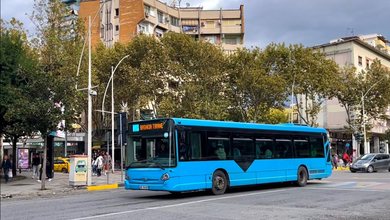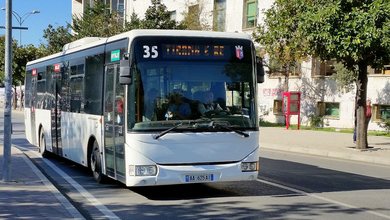



Air pollution and noise in Tirana and other cities in the country continue to be above the permitted norms. This is according to an alternative monitoring report for 2025, presented by CoPlan within the framework of the GreenAL project. Construction, traffic and lack of vegetation are cited as the main reasons for the pollution.
Anila Bejko, director of CoPlan, stated that unlike other years, when monitoring was conducted only in Tirana, this year other cities such as Durrës, Korça, Shkodra, Elbasan and Fier were also included.
"Thanks to more than 800 mobile monitoring points in six cities and 15 fixed stations, this year we bring a much more complete picture of the health of our cities," said Bejko.
Also present at the presentation of the report's findings was the Deputy Minister of Environment, Genti Gazheli, who stated that environmental protection is a national priority and an essential part of commitments to European integration.
According to him, this was one of the reasons that led to the creation of a ministry dedicated to the environment. However, challenges remain numerous.
"The monitoring system requires further technical improvements, as well as expanding coverage for important pollutants such as heavy metals and aromatic hydrocarbons. Also, strengthening laboratory capacities and improving real-time data transmission remain important directions for the future," Gazheli stated.
Air pollution above the norm
In Tirana, according to the report, 66.7% of monitoring points exceed the nitrogen dioxide (NO₂) reference value. The main impact is related to road traffic and combustion sources in certain urban areas.
"The amount of NO2 exceeds the norm of 40 mcg/m3 by 3-4 times. The most problematic points are the intersection of the boulevard extension with the Ring Road, the New Maternity Hospital, Ali Demi, Elbasani Street and the Kristal Center area," said Kejt Dhrami, territorial governance expert at CoPlan.
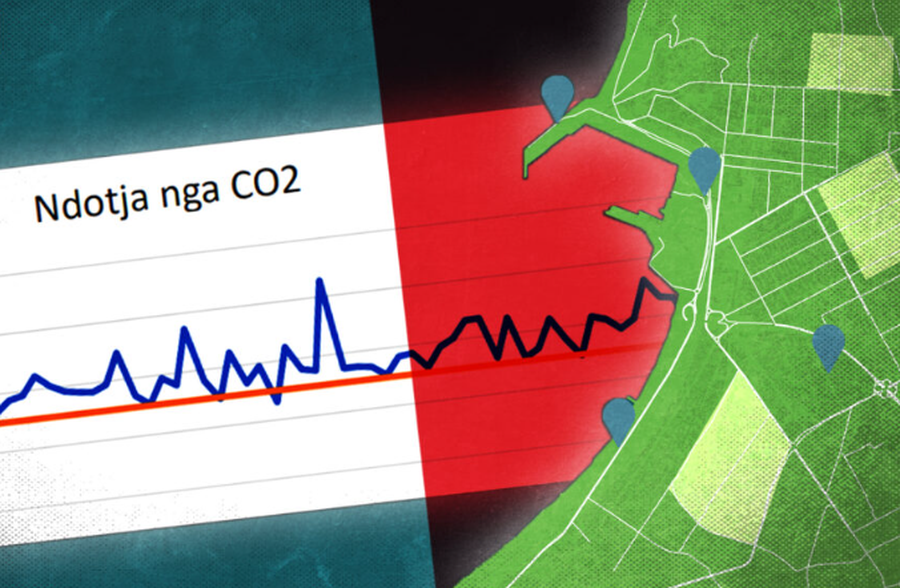
Also, in 98.3% of monitoring points, carbon dioxide (CO2) levels result above the reference level.
"About 95% higher than the standard. This is related to very busy urban systems, the exchange of polluted indoor air with outdoor air, and the lack of vegetation," said Dhrami.
Regarding fine dust particles from vehicle emissions (PM2.5) and larger particles (PM10), the report shows that they rarely exceeded standards in Tirana for the period when monitoring was conducted, July-August 2025.
"The reason is that this period is associated with fewer vehicle movements and more limited use of heating systems. However, there are areas where values approach or exceed maximum limits, such as on Dibra Street, Student City and the Madrasa area," Dhrami added.
In Durrës, dust levels are above standards.
"The most polluted areas are the Volga, Hospital Street, the stadium and the boulevard. This is related to urban intensity and activity near the port area," argued Dhrami.
In Elbasan, about 91% of points exceed the standard for NO₂, while 95% are above the reference threshold for CO₂.
In Fier, 73% of monitored points exceed the standard for PM2.5 and PM1, while 67% of monitoring points for NO₂ are above the standard.
In more than half of the monitored points in Korça and Shkodra, it results that fine particles in the air exceed standards.
Noise pollution, a daily reality
Dibra Street, the Madrasa area, Student City and the Artificial Lake are some of the areas where the noise level exceeds the normal limit, according to the report.
"During the day, 88% of monitored points exceed the 55 decibel limit, mainly due to traffic," said Greta Shehu, environmental expert at CoPlan.
According to her, at night the exceedance is somewhat lower and occurs mainly in urban areas such as Astir and the Dogana area.
In Durrës, 87% of monitoring points exceed the 55 decibel level, mainly in the Volga promenade, the port area and surrounding neighborhoods.
"During the night, 92% of monitoring points exceed the standard, creating problems for health and sleep quality," said Shehu.
In Elbasan, the most affected areas are the highway, the Skënderbeu neighborhood, and the city center. At night, 86% of the monitoring points exceed the 45 decibel limit.
In Fier, 61 out of 99 monitoring points are above the standard during the day, while at night 46 of them exceed the limit.
In Korça, the situation appears more stable, with 37% of stations exceeding the standard during the day. However, at night, 65% of them exceed the limit.
In Shkodra, 89% of monitoring points exceed the 55 decibel limit during the day, mainly on main roads and roundabouts.
Water quality, unstable
The novelty of the 2025 monitoring is also the analysis of waters, which included 9 lakes, 5 reservoirs, 4 streams and an irrigation system.
According to Imeldi Sokoli, territory and environment expert at CoPlan, 18 measuring components were used for water analysis.
"The Roskovec-Hoxharë canal, out of 18 components analyzed, 12 result above the norm," said Sokoli.
He also mentioned several drainage channels in Fier-Divjaka, where increased electrical conductivity has been observed due to urban discharges and agricultural activities.
The main lakes around Tirana are also found to be polluted.
"Lake Bovilla, Lake Farka and the Artificial Lake of Tirana have high organic pollution," said Sokoli.
According to him, the Tirana River has also shown the presence of heavy metals. The Tregan, Blesh and Tafan lakes also resulted in high levels of pollution.
Sokoli emphasized that concrete measures are needed to improve water quality, through the control of mining activities and the reduction of urban discharges. /Citizens.al/