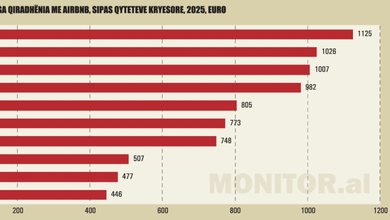




Albania ranks 83rd in the world for per capita income in dollars and 85th in the next most important indicator, per capita income according to purchasing power standards, for the year 2025.
The data were released on IMF data. For both indicators, Albania ranks among the last in Europe.
The indicator of per capita income in relation to the size of the economy has reached 11 thousand dollars in 2025, according to IMF data. With these levels, Albania has surpassed North Macedonia (10,377 USD) and Bosnia and Herzegovina (9467), when a few years ago it was ranked behind them.
Meanwhile, the poorest country in Europe continues to be Kosovo (8033 USD per capita). Albania has benefited in recent years from the depreciation of the Euro and Dollar, automatically increasing the per capita income of the population.
In the region, Serbia took the lead, with 15.3 thousand dollars per capita, surpassing Montenegro (14.9 thousand), which had held the lead for many years.
Albania's per capita income is 28% of the European average and 23.7% of the European Union average ($46,804). Albania has not even reached the global average, which is $14,600 per capita, but remains at 76% of it.
In the other indicator, that of per capita income according to purchasing power parity, which is measured in international dollars, Albania lags behind North Macedonia, an indicator that money in the country is worth less than in the neighboring country, due to the higher cost of living, although incomes are higher. Albania is 85th in this ranking with a level of 23.3 thousand international dollars. North Macedonia is in 77th place, Bosnia and Herzegovina 89th and Kosovo 98th.
This indicator, of domestic product per capita (GDP) according to purchasing power parity (PPP), shows how much economic output each resident in a country receives on average, taking into account how expensive or cheap goods and services are there.
Unlike GDP per capita, which is calculated using exchange rates alone, PPP corrects for price differences between countries by converting income into what is called the “international dollar,” which represents the same purchasing power everywhere. In simple terms, this indicator shows not only how much an economy produces per person, but also how much a person can actually buy with that money in their own country, so it is used to compare living standards between countries./Monitor