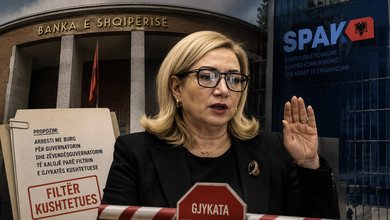



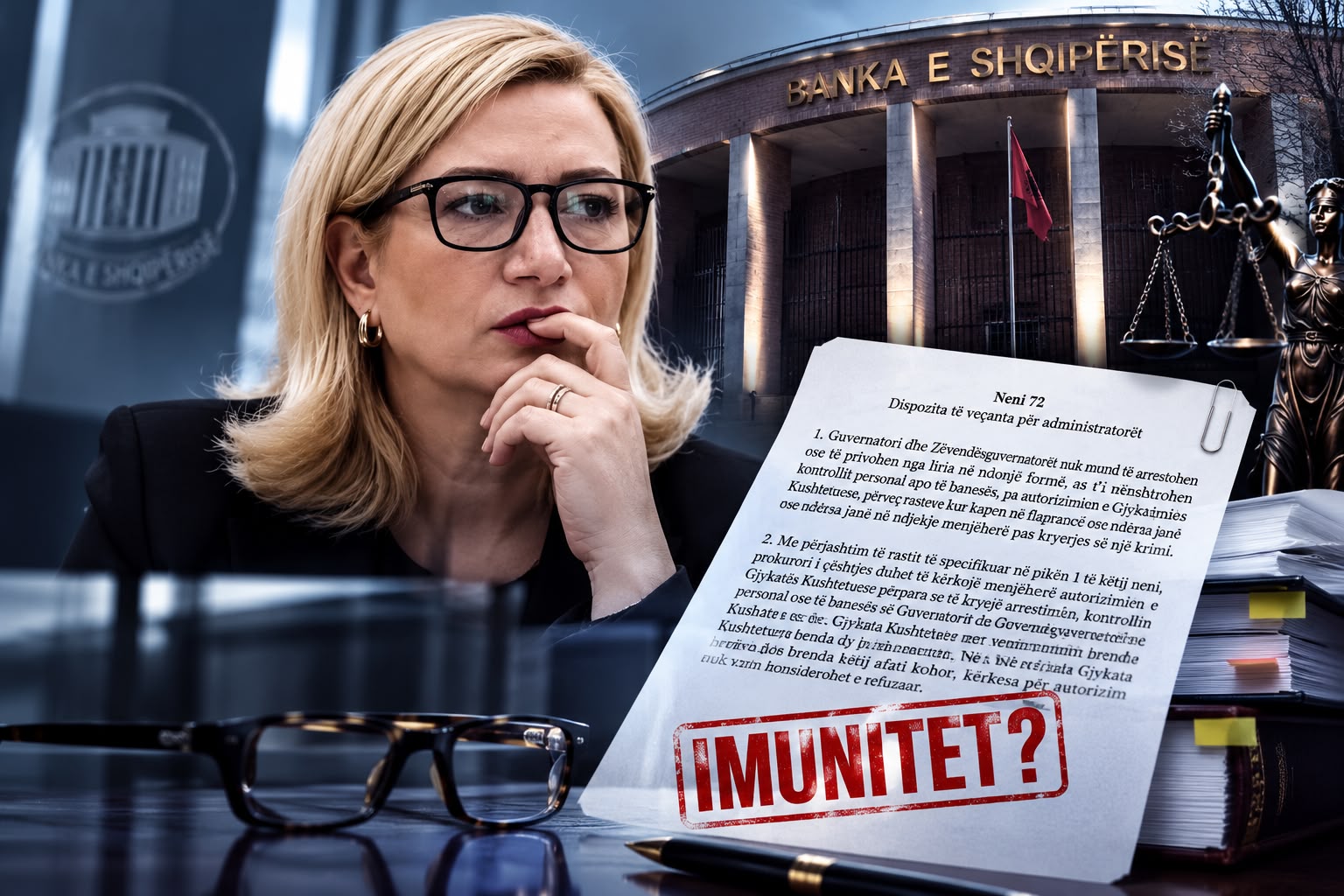
The Minister of Finance has accepted and initiated the procedure for reviewing several amendments to Article 72 of the Law “On the Bank of Albania”. Essentially, the proposal from the Bank of Albania itself aims to guarantee the Governor and the two Deputy Governors protection from personal search, search of residence and the security measure “arrest in prison”, by setting as a condition the prior authorization from the Constitutional Court. You can use as many technical terms as you want to describe this mechanism, but in the end the content is one: procedural immunity. Because, at the moment when the Prosecutor's Office cannot exercise its powers without first obtaining the approval of another body, we are dealing with an immunity regime.
Most likely, the author of this solution is Holta Zaçaj, former President of the Constitutional Court, to whom Edi Rama secured the position of First Deputy Governor of the Bank of Albania with the votes of the majority in Parliament. The paradox is not small. A former President of the Constitutional Court proposes that the Constitutional Court exercise a competence that the Constitution itself does not recognize. The formulations presented as draft provisions seek to overcome the normal procedure of judicial review and designate as the “competent court” an institution that is not a criminal court and that does not have jurisdiction over security measures.
Any personal search, home search or arrest measure passes through the ordinary courts. The Constitutional Court can only be invested at the end of the process, when it examines the constitutionality of an act or claims for the violation of constitutional rights. That's all. The Constitution does not attribute to it the powers to authorize security measures, while the judicial power is expressly regulated by the Constitution itself. For this reason, a special law cannot create new powers or invent a procedure that the Constitution does not recognize.
Another fact is equally important. Immunity is a constitutional concept. Members of Parliament enjoy it because the Constitution recognizes it. The President also enjoys it because the Constitution provides for it. Meanwhile, for the Governor and Deputy Governors of the Bank of Albania, there is no special constitutional status and no authorization for an ordinary law to create procedural privileges in the event of a criminal investigation. However, this is precisely what the new formulation aims to do.
This is also why the proposal raises more questions than it answers. Holta Zaçaj is not just the lawyer who drafted the wording. She is the First Deputy Governor, the functionary who legally filters the acts submitted to the Board, and one of the three administrators who would directly benefit from this new procedural regime. She is also the official responsible for the legal processes of the Bank of Albania, including tender procedures and processes related to the issuance of money.
This is where the essential question arises. What is happening in the Bank of Albania that its three administrators feel the need to ask the majority for a procedural shield before the Prosecution exercises the powers recognized by law? What is it that drives them to ask for a special immunity regime right now? Because, usually, those who are convinced that they have nothing to hide do not start by changing the rules of criminal procedure for themselves. On the contrary, they wait for justice to do its job.
Proposed draft provision
Article 72 – Special provisions for administrators
1. The Governor and Deputy Governors may not be arrested or deprived of liberty in any form, nor be subject to personal or home search, without the authorization of the Constitutional Court, except in cases where they are caught in flagrante delicto or while being pursued immediately after committing a crime.
2. Except in the case specified in point 1 of this article, the prosecutor of the case must immediately request the authorization of the Constitutional Court before carrying out the arrest, personal search or residence search of the Governor and Deputy Governors. The Constitutional Court shall decide on the authorization within two weeks from the date on which the case is submitted to it. If the Constitutional Court does not decide within this time limit, the request for authorization shall be deemed rejected.
In the end, a question remains, which must be answered not only by the leaders of the Bank of Albania, but also by the majority expected to vote for these changes: why is a special procedural regime being sought for the three highest administrators of the Bank of Albania right now and what makes this immunity so necessary?