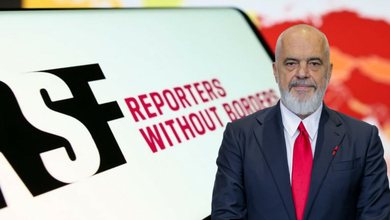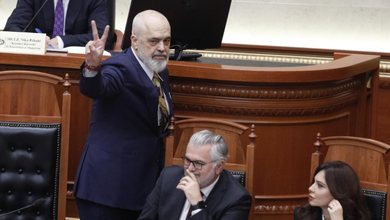



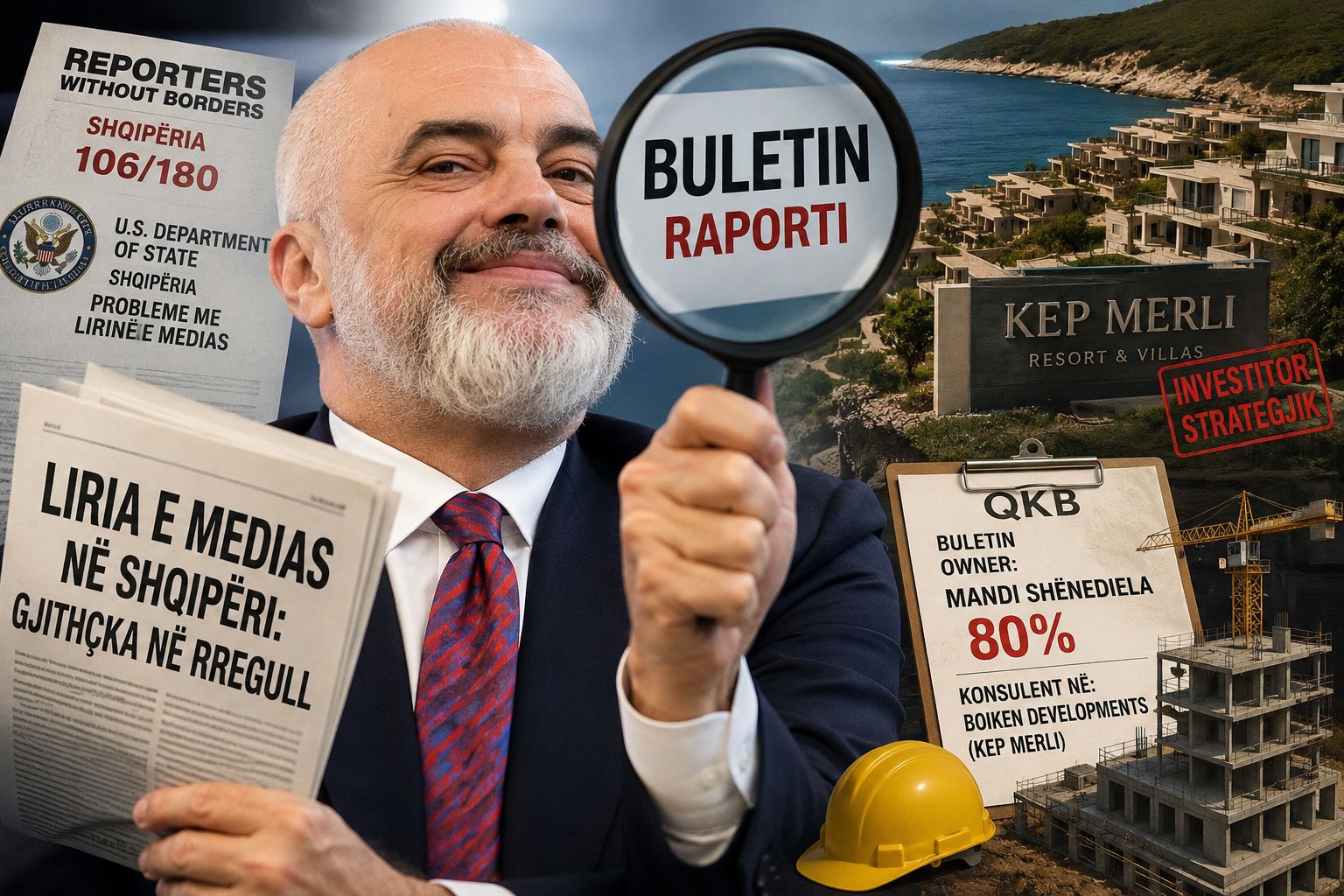
When the Prime Minister needs to prove that media freedom in Albania is flourishing like an olive tree, the gloomy reports of Reporters Without Borders or the US State Department are no longer helpful.
He needs something more "scientific", more convincing and, above all, more benevolent.
Thus, in a final attempt to dispel the perception that the government has captured the media, the chief executive brought up a report by the media platform "Buletin" as an argument.
For all the skeptics who have never heard of this gem of journalism, there is an explanation: it is a platform created in 2020, which has had the luck and inspiration to bring only one report to light. But, as they say, quality weighs more than quantity.
If you dig a little into the documents of the National Business Center (NBC), you will discover that this stronghold of media independence is owned 80% of the shares by Mr. Mandi Shënediela (and 20% by Ardit Dine).
From the news office to building permits in the South
As is often the case in Albania during the Administrative Renaissance, the passions of our publishers are not limited to freedom of speech. Mr. Shënediela, in addition to being concerned about the health of the media, turns out to be a very hardworking guy even in the much more profitable sectors of elite tourism and construction:
He owns the company "Bhospitality", which has taken over the management of "Kep Merli Resort and Villas" - one of those fabulous projects in the south of the country.
This resort, by an absolutely "random" coincidence, has received the coveted "Strategic Investor" status from the government of the same Prime Minister.
Furthermore, the same publisher also appears as a consultant in the construction company "Boiken Developments" (trade name "Kep Merli"), owned by Agim Shënedielë.
In the end, this attempt by the Prime Minister to clean up the image of media freedom resulted in a spectacular own goal under international rules.
The source he carefully chose to show that the government has not captured the media actually did the opposite: it confirmed point by point the main finding of Reporters Without Borders.
He proved that in Albania, the "independent media" that defends the government is often nothing more than an extension of economic interests in construction and tourism, two sectors that breathe and receive "strategic" statuses with just a signature and a smile from the Prime Minister's office.