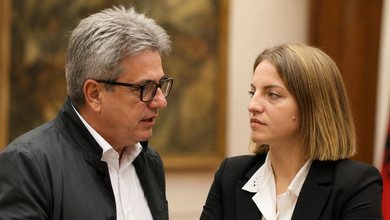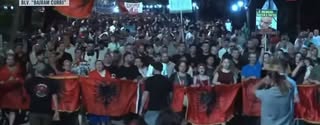


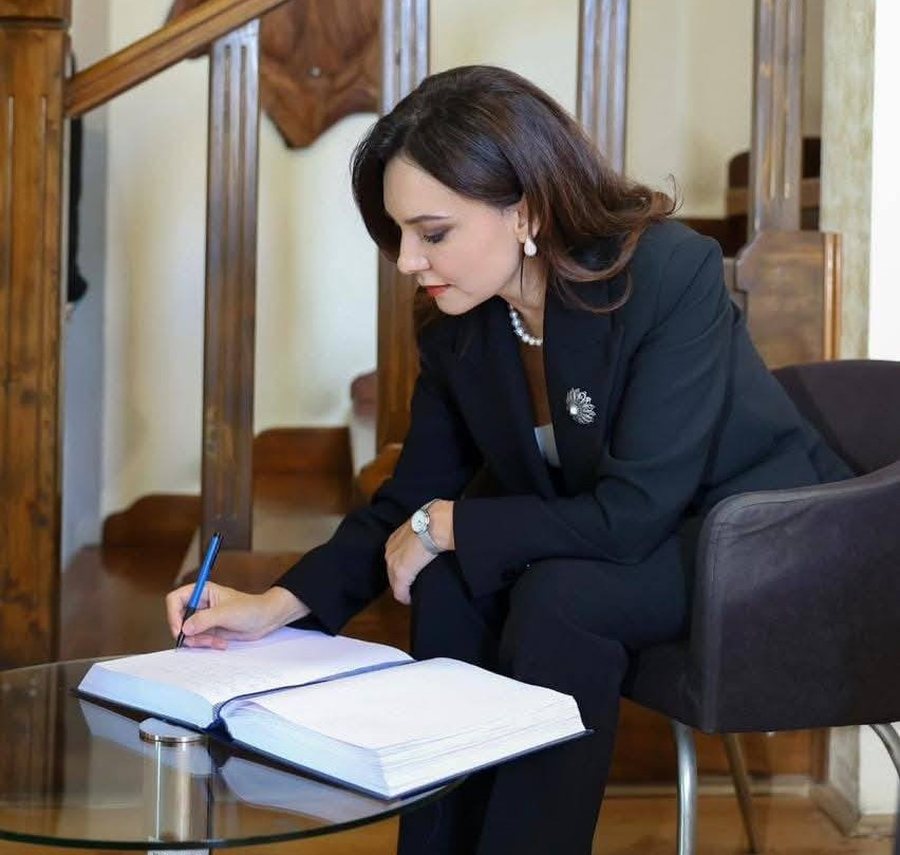
Former Foreign Minister Elisa Spiropali has momentarily put aside the "battles" and political agenda both alongside and opposite Prime Minister Edi Rama, reacting to the recent protests by Albanian students in North Macedonia.
Since Edi Rama has not yet "cut off his head" even though she challenged him with the "exclude me" letter, the MP has put to sleep the initiative to guarantee internal democracy in the SP and to improve governance that is already outside of it.
Through a public stance, Spiropali has unequivocally aligned himself with young Albanians, describing their rise in protest for the Albanian language not simply as an administrative event, but as a deep systemic crisis.
“This fact alone is serious enough to understand that the problem is not procedural, but deeply political, institutional and moral,” says Spiropali, directly attacking the approach of the authorities in official Skopje.
Spiropali emphasized that this protest has brought to light the failure of formal politics to resolve basic issues of coexistence and fundamental rights in the neighboring country. According to her, the street is saying what the institutions are trying to hide.
"Yesterday's protest showed that sometimes a state reveals unresolved issues not in the halls of parliament or in political statements, but on the streets. It reveals them in the faces of students. In the way a young person is forced to protest for something that in Europe should have been resolved long ago."
According to the former minister, the students' reaction proves that the equality of Albanians in North Macedonia is still not being treated as a natural and constitutional right, but as a "bargaining currency" or compromise between the ruling parties.
Albanian language, dignity and state-forming pillar
In her reaction, which is also being read as a clear diplomatic message to the political class in Skopje (including the Albanian political factor there), Spiropali demands that the Albanian language not be seen as a purely bureaucratic tool, but as an existential element.
“A language is not an administrative translation. It is dignity, memory and identity. It is the way a people survives history, time and any attempt at fading or assimilation.”
“Albanians as a political ethnicity, the Albanian language and collective rights must be clearly, firmly and unequivocally defined in the Constitution of the state, because Albanians are not a tolerated minority, but one of the state-forming pillars of North Macedonia itself.”
Call for a European vision
In closing her statement, Spiropali requested that the full implementation of the Ohrid Agreement and European standards not be done with interpretations that change according to the "climate of power". She recalled that the recognition of these rights does not endanger North Macedonia, but on the contrary, makes it stronger and more democratic.
“At this moment, more wisdom, more dialogue and more vision are required. It is required to believe that equality does not weaken the state, it strengthens it... Because in the end, the Albanian language is part of our soul. And no one can ask a people to be silent in their own language,” she concludes.
This reaction by Spiropali comes at a delicate moment of political transition in North Macedonia, where interethnic tensions and the issue of the use of the Albanian language often return to the center of debates for electoral interests, neglecting precisely those who are most affected: the younger generation.