

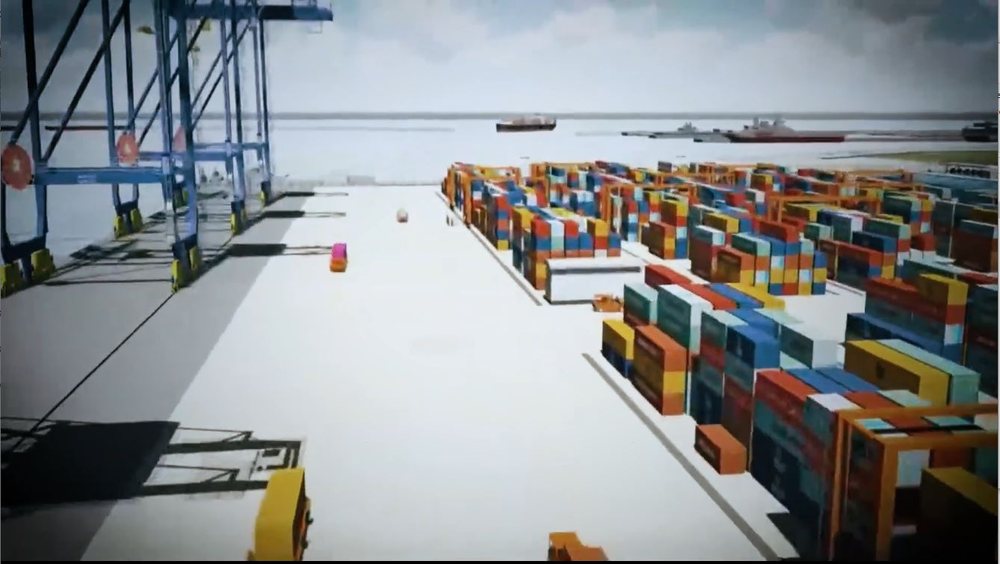
The show "Në Shënjestër" published this Tuesday an exclusive document related to the Durrës port project.
This is the Master Plan of the Port of Durres, approved by the Council of Ministers' decision no. 546, dated May 28, 2009, and published in the official gazette on June 4 of that same year.
A master plan with a total of 727 pages, available from the show 'Në Shënjestër', and which is a thorough study for the expansion of the current port of Durrës, a project which was planned to be extended into 4 phases.
But the most important detail of this master plan is the fact that it was made by the company 'Royal Haskoning'.
So the same company, to which the Rama government gave a full 25 million euros in 2022 and 2024 to carry out a new project for Porto Romano, and then to supervise the construction works of the new port.
The 2009 Master Plan, which was funded by the European Union, where apparently 18 years earlier the Port of Durres was seen as a strategic hub not only for Albania but also for the European Union itself, where on page 30 of the 727-page Master Plan, the advantages of expanding the current Port of Durres are shown.
The advantages of the master plan are:
The implementation of the Master Plan can begin within a short period without major investments, as the various terminals will remain on site and in the existing area.
There is a possibility of implementing the Master Plan in phases.
The use of the existing port basin and land areas are optimized.
All planned traffic can be processed, and there is even the possibility of expanding it further (pier 13) if required.
It offers flexibility, if the study on the national port strategy shows that at a certain time in the future dry bulk cargoes need to be moved from the port of Durres to another port (existing or new),
Dry bulk cargo terminals can be used for container processing.
Likewise, the phases of expansion of this port were also determined.
With the aim of turning it into a strategic hub for Albania but also for the European Union itself.
The Masterplan sketch which actually shows the port at the end of the project. Where the masterplan would be developed in four phases.
Where the main characteristics are also defined.
By 2010, with the expansion of the existing container terminal across Quay 6, and with major reconstruction works and dry dock terminals.
Relocation of the oil terminal and fishing port
Expansion of the container terminal with quay 7/8, commencement of work on the cement/clinker terminal, scrap terminal and a reconstructed terminal for minerals and coal.
Expansion of the container terminal with additional area and behind pier 5, and expansion of the ferry terminal in the area currently occupied by fishing vessels
Expansion of the container terminal with pier 5, an additional storage area behind pier 4.
Relocation of grain processing from pier 5 to pier 4.
According to the voluminous document, this master plan also detailed the financial costs associated with several optional variants of the expansion of the current Port of Durres.
Where, according to this document, the maximum investment costs until 2030 were estimated to be up to around 70 million euros.
So, referring to this material, in approximately 20 years of investments that would be made in the Port approved by the government, Albanians would pay, according to the investment plan set until 2030, no more than 70 million euros for approximately 20 years of investments for the expansion of the current Port of Durrës.
Meanwhile, so far, 41.3 million euros have been spent on studies and designs for the port of Porto Romano alone, not counting the 2 billion euro investment expected to be made in the coming years.
Because the Albanian government decided to give the current port of Durrës to businessman Muhamet Alabar to build a yacht marina there, precisely in the strategic port of the US, the European Union, and NATO.
The 2009 master plan, funded by the European Union, apparently 18 years earlier saw the Port of Durres as a strategic hub not only for Albania but also for the European Union itself.