

Through a new investment package, mainly in road infrastructure, the Albanian government is planning to spend 100 million euros alone on the municipalities of the Shkodra region on the eve of local elections, through the project known as the "Gateway to the Alps".
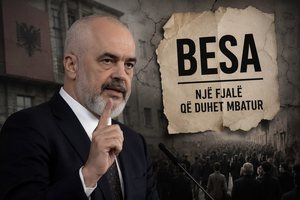
According to Prime Minister Edi Rama, the "Gateway to the Alps" project will be an addition to the "Mountain Package" - a controversial initiative accompanied by concerns over property rights and how it will be applied.
"This is a massive investment for the development of tourism with a focus on mountain tourism," Rama said on Sunday during a video published on social media.
According to him, it concerns investments in road infrastructure, wastewater management, interventions in urban development and the preservation of historical and natural heritage, works which seemingly are investments directly related to local government.
In implementation of this project, the government has submitted to the Parliament a draft law for the ratification of the financial contract with the European Investment Bank with a value of 50 million euros in loans, which will be used for "municipal infrastructure works for the 'Gateway to the Alps' project. This loan will be joined by a 50 million euro fund from the state budget for the development of sustainable tourism. The project will be implemented by the Albanian Development Fund.
The SP won the city of Shkodra for the first time since the fall of the communist regime in the 2023 local elections with Mayor Benet Beci, a former director of the Albanian Development Fund. Two of the other municipalities in the district, Puka and Fushë-Arrëz, are run by the opposition.
The new project has most of its components linked to the city of Shkodra, such as the rehabilitation of squares, boulevards, construction of parking lots, as well as a road corridor connecting the Alps to the Adriatic coast, via Shkodra, Lake Shkodra and the Buna River, Velipoja and Shëngjin.
The use of public investments as a mechanism for electoral influence is an unstoppable phenomenon in Albania, which, although it does not formally violate the provisions of the Electoral Code, often serves to flatter voters.
But according to civil society experts, even the new project known as the "Gateway to the Alps" cannot be seen outside of the political mechanism for electoral influence.
“The government should have been very transparent about all the costs, risks, benefits and strategic approach for the future,” said Afrim Krasniqi, director of the Institute for Policy Studies. Krasniqi sees the ‘Mountain Package’ or ‘Alpine Gateway’ as initiatives that connect many sectors, affect private property, affect citizens’ relations with the state, cadastral services, economic competition, the tourism sector and with elements of national security.
"As such, they should be very transparent and sustainable initiatives," he stressed.
In the absence of these elements, according to Krasniqi, these are closed, non-transparent initiatives driven by questionable interests.
The Director of the Albanian Institute of Municipalities, Agron Haxhimali, says that this investment package is necessary for mountainous areas, but he places emphasis on the fair distribution of the fund.
"All five municipalities of the region should be beneficiaries. Each municipality should be part of the consultation and decision-making for strategic projects, to ensure social cohesion, economic growth and repopulation," he said.
While the law obliges the government to have investment restrictions only four months before the elections, Krasniqi believes that investments in such large amounts are not seen outside of electoral political influences.
"In the absence of elements that ensure transparency and the interest of long-term economic development, the new project may suffer the fate of previous projects that have resulted more as 2-3-year political-electoral or clientelistic projects than projects for the development of Albania," he concluded./BIRN