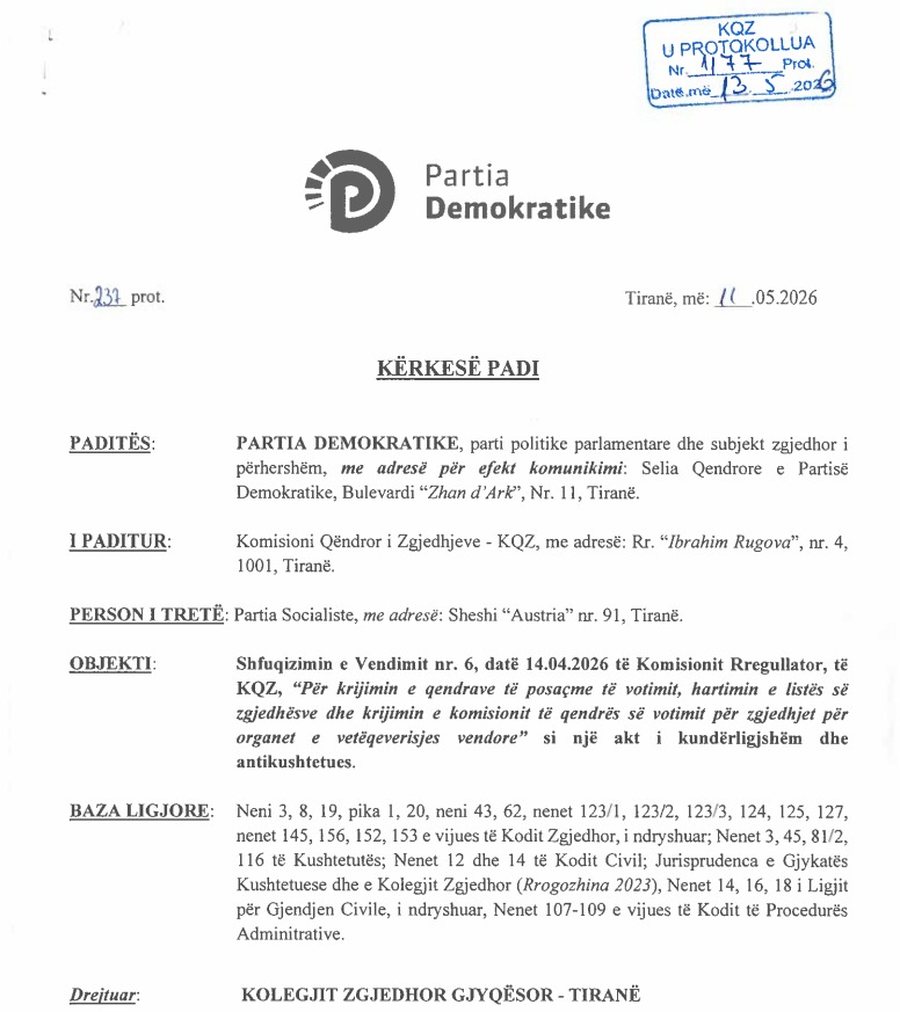




The Democratic Party has officially submitted to the Electoral College a request-claim for the annulment of Decision No. 6 of the Regulatory Commission in the CEC, regarding the vote of prisoners in local elections, describing it as an "essentially political" and "artificial" act aimed at distorting the results of the local elections. This legal step comes as a result of an unexpected development within the CEC, where former Democratic MP Arben Ristani, now a member of the Regulatory Commission, voted in favor of the draft act, siding with the members proposed by the Socialist Party.
From the "Rrogozhina Precedent" to the April 14 meeting
The debate on the vote of prisoners is not new. In its lawsuit, the DP repeatedly refers to the "Rrogozhina Precedent" of 2023, where it was decided that prisoners cannot determine the winner in a municipality with which they have no social or economic ties.
March 2025: A similar draft act is proposed to the CEC, but is rejected by the Regulatory Commission on the grounds that it conflicted with the Electoral Code.
April 14, 2026: The State Commissioner brings back the draft act. Despite strong opposition from fellow DP member Helga Vukaj, the act is approved with 4 votes in favor.
Surprise vote: Arben Ristani (PD) joins the votes with Ilirjana Nano, Bledar Skënder and Dritan Çaka (PS), making the decision possible.
DP's lawsuit: "Artificial construction for political purposes"
In the 31-page document filed with the College, the DP argues that this decision violates the constitutional principle of residence. According to the lawsuit, the CEC has illegally used the 2024 Civil Status Law to "invent" the concept of residence for electoral purposes within prisons.
"How can a law approved by a simple parliamentary majority reconceptualize the notion of residence and in this case surpass the Electoral Code and the very definitions of the Civil Code??"
"The Municipality of Rrogozhina cannot respond to the social, economic and legal demands of a prisoner who has no legal connection with this Municipality due to the fact that he is a resident of Tepelena..."
"The act complained of is not the product of an objective analysis... but an essentially political creation, constructed through the deformation of the concept of 'residence'... with the aim of artificially creating a subjectively usable electoral base."
The clash within the CEC
The document also sheds light on internal debates. Member Helga Vukaj warned during the meeting that this act "avoids the legal references that the Electoral Code establishes" and that an isolated person "has a place of residence, the one determined according to the Civil Code."
In contrast, member Bledar Skënderi (SP) has defended the idea that "only for electoral purposes will the institution where they serve their sentence be their place of residence", a stance which has already received the "blessing" of Arben Ristan's vote.
Now, the fate of this rule, which is expected to have decisive weight in small municipalities where large prisons are located, remains in the hands of the five judges of the Electoral College.