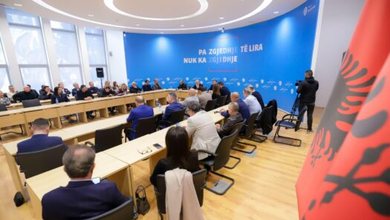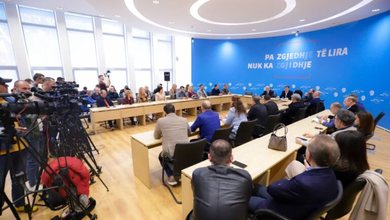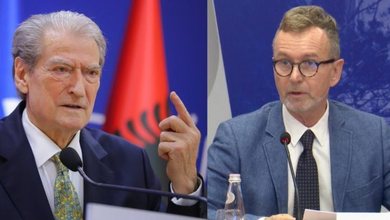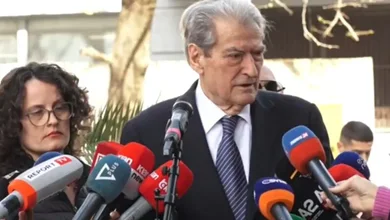


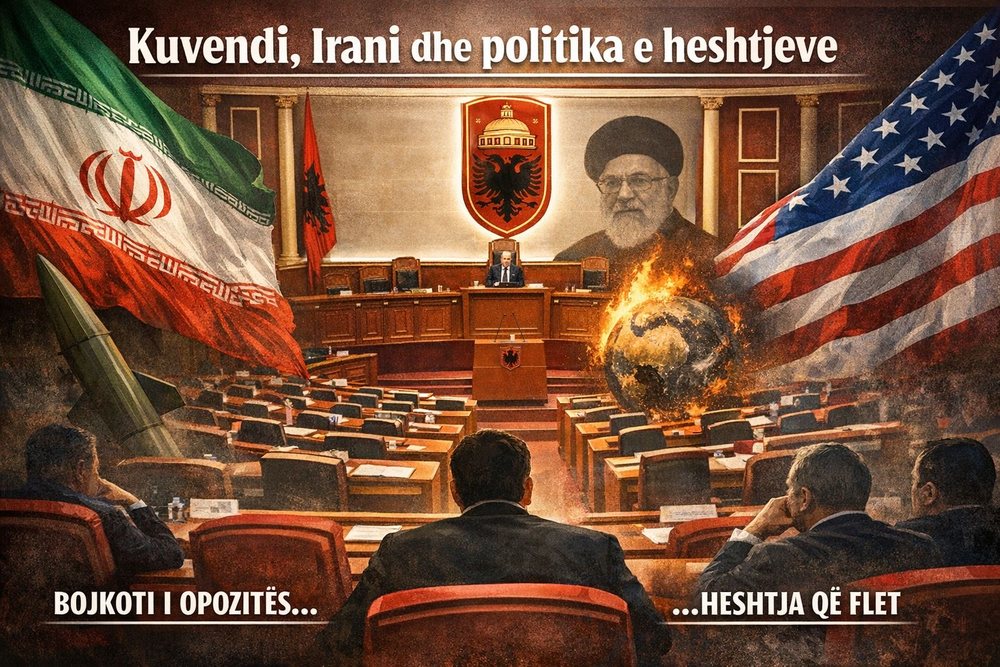
Tomorrow it has been announced that the Albanian Parliament will convene in plenary session. The official announcement does not contain an agenda, which in itself is unusual for an institution that, in theory, should function on procedural transparency. However, the Conference of Speakers is expected to convene in the morning, where, according to public statements by the majority of the Socialist Party of Albania, a draft resolution aimed at declaring Iran a state sponsor of terrorism in the world will be proposed for inclusion in the agenda.
At the same time, the parliamentary group of the Democratic Party of Albania has announced a boycott of tomorrow's session. This is a fact that deserves special attention, not only for procedural reasons, but especially for the political meaning it may take on in the current international context.
The first irony is evident. The opposition has long complained that there is no space in the Assembly, that its voice is limited, that parliamentary debate is replaced by unilateral decision-making by the majority. However, at a time when a geopolitically weighty issue is expected to be decided on the agenda, its choice is precisely not to be in the hall.
This creates a political paradox: the opposition, which seeks space for debate, chooses not to participate in a potentially very important debate.
Of course, parliamentary boycotts are not unknown in Albanian politics. They have often been used as a means of political pressure. But they are usually related to internal institutional conflicts: elections, investigative committees, parliamentary procedures or clashes with the government.
Tomorrow's case is somewhat different.
The announced resolution concerns Albania's positioning towards an important state in the Middle East and towards a conflict that is currently developing in a tense manner in the region. In such a context, every vote, every position and even every absence can be interpreted politically.
In diplomacy, not only words but also silences have meaning.
Albania has for years maintained a clear strategic position in relation to its Western allies, especially the United States. Every parliamentary statement that touches on issues of international security and terrorism is inevitably read in this light: as a confirmation of the country's strategic orientation.
Precisely for this reason, the absence of the opposition from such a vote raises questions that are not simply procedural.
Is this boycott a common opposition act?
Is it an attempt to deny the majority a symbolic success in foreign policy?
Or is it simply an attempt to avoid a difficult vote?
Because the reality is that the issue of relations with Iran is not only diplomatic; it is also politically delicate.
Over the years, rumors, insinuations, and suspicions have circulated about informal contacts, indirect influences, or shady financing channels that may have affected segments of Albanian politics. These rumors have never produced full public evidence, but the fact that they are repeatedly rumored shows that the topic remains sensitive.
In this context, any open positioning – for or against – may have political costs.
For some politicians, a vote against Iran could be interpreted as a strong geopolitical statement. For others, an abstention could be seen as a more comfortable way to avoid any interpretation.
This is why tomorrow's boycott can be read in several ways.
The mildest interpretation is the classic one: the opposition does not want to legitimize a session that it considers manipulated by the majority.
But there is another, more difficult interpretation: a choice not to publicly take a stand on an issue where any position could raise uncomfortable questions.
Because in politics, it's often not just politicians who are exposed. In many cases, attention also shifts to their close networks: business connections, family relationships, economic activities, or channels of influence that can extend beyond the country's borders.
When politics becomes international, these networks automatically become part of public analysis.
In this sense, the real question is not just why the opposition is boycotting the session.
The question is: why this particular session?
Because if the resolution passes with a majority vote, Albania will have an official parliamentary stance on Iran. But another detail will remain in history: that the opposition was not in the hall when this stance was taken.
And in politics, sometimes, absences remain more visible than votes.