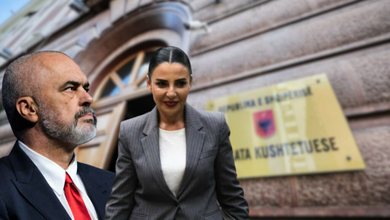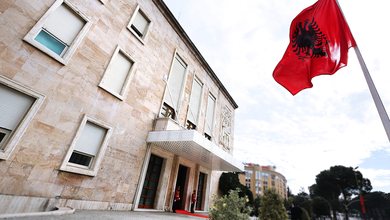



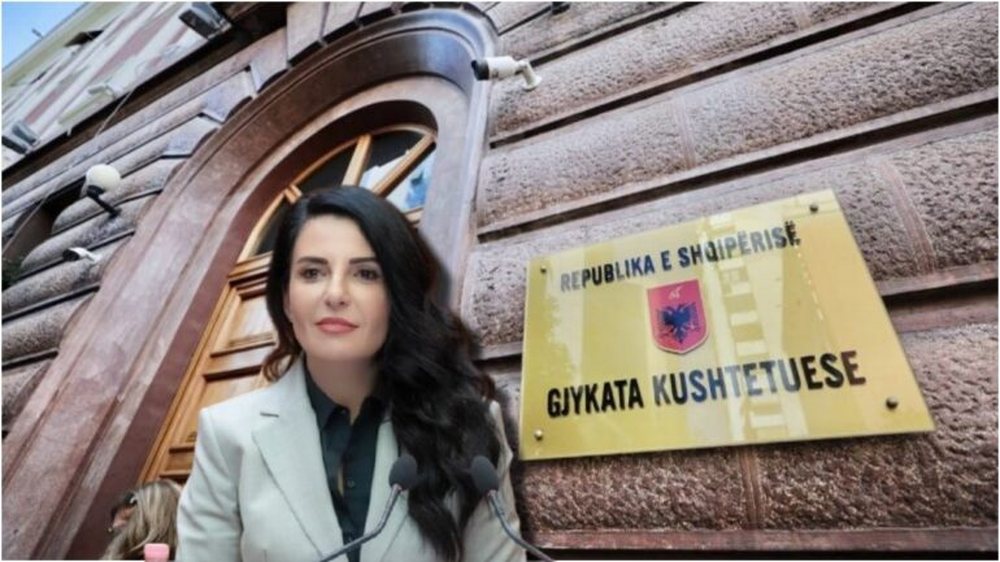
The Constitutional Court examined on 6 February 2026 the request of the Prime Minister of the Republic of Albania for the resolution of the dispute over jurisdiction with the Special Court of First Instance for Corruption and Organized Crime (SCCOC), as well as for the annulment of the decisions that imposed and continued the measure of suspension from office of the Deputy Prime Minister and Minister of Infrastructure and Energy, Belinda Balluku. The Prime Minister also requested the interpretation of Article 103, point 3 of the Constitution on the immunity of ministers.
The Court unanimously assessed that the immunity of the minister is regulated by Article 103, paragraph 3 of the Constitution, in conjunction with Articles 73, paragraphs 1 and 2, and that the constitutional regime of immunity does not include the guarantee of Article 242, paragraph 2 of the Code of Criminal Procedure, according to which suspension from office does not apply to persons elected under the electoral law.
The Constitutional Court also emphasized that according to the Constitution, ministers are subject to the law and can be held legally responsible if they violate it, in accordance with the principles of the rule of law, the supremacy of the Constitution, and the separation and balance of powers.
Two different positions among the judges
At the end of the discussions, the judges' assessments were divided into two opposing positions, and the Court did not reach the required majority for decision-making (5 votes), according to Article 133, paragraph 2 of the Constitution and Article 72, paragraph 2 of its Organic Law.
First position (4 judges against suspension):
According to this position, the immunity of deputies is not a personal privilege, but aims to protect the Assembly and its functioning. Similarly, the immunity of ministers under Article 103, point 3 aims to protect and function the executive branch.
The Court considers that the suspension from office, by its degree and intensity, affects the constitutional political function of the minister. Therefore, in balancing the effectiveness of criminal prosecution and the functioning of the executive, prior authorization of the Assembly is required for this measure as well, according to the principle of separation and balance of powers (Article 7 of the Constitution).
Second position (4 judges in favor of suspension):
According to this position, the Constitution – after the 2012 reform to narrow immunities – provides for parliamentary authorization only for procedural measures expressly listed in Article 73, point 2. This provision does not include suspension from office under Article 242 of the Code of Criminal Procedure, even though this measure prevents the exercise of the minister's functions and interferes with the activity of the Council of Ministers.
According to this position, adding guarantees beyond those provided by the Constitution belongs to the constitutional legislator, not the Court.
Final decision
In these circumstances, the Constitutional Court decided:
1. The rejection of the Prime Minister's request.
2. The lifting of the measure of suspension from duty imposed on 12.12.2025 by the Meeting of Judges of the Constitutional Court of Kosovo.
3. The decision is final and enters into force upon publication in the Official Gazette.
The court announced that the full reasoning for the decision will be announced within the legal deadlines.