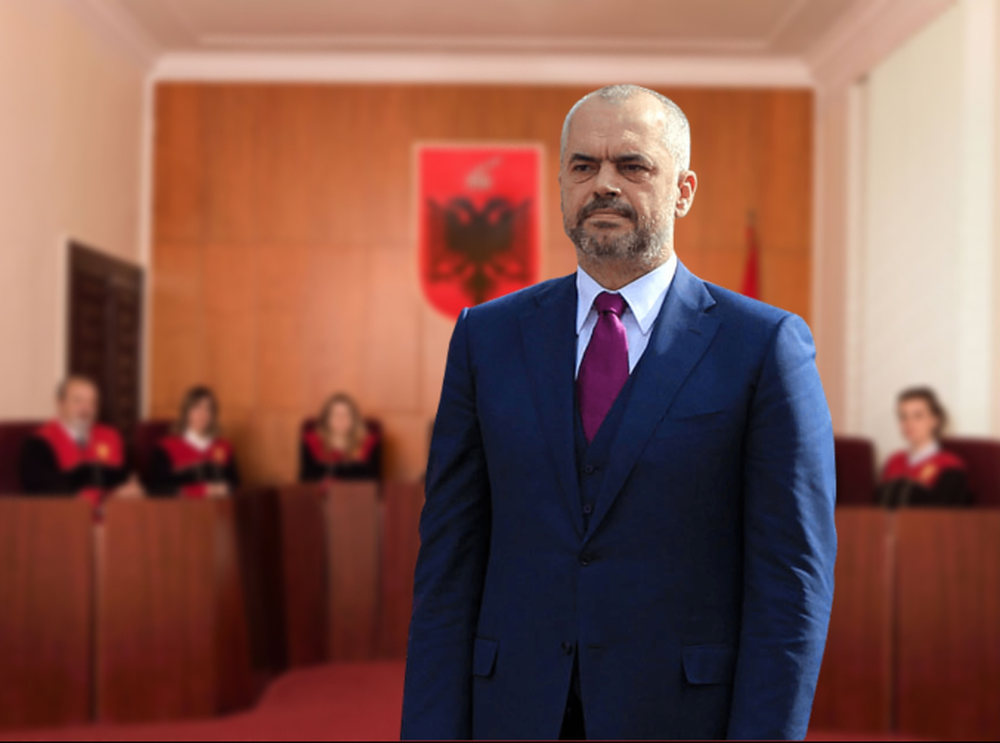
The Constitutional Court decided on Friday to reject Prime Minister Edi Rama's request and uphold the decision of the Special Court (GJKKO) to suspend Deputy Prime Minister Belinda Balluku from office. With this decision, the Constitutional Court not only confirmed the effect of the GJKKO measure, but also rejected the political argument that Rama had used to postpone the decision on SPAK's other request to lift Balluku's immunity from arrest.
After a marathon session of over 12 hours, the eight-member Constitutional Court panel voted 4-4 in favor of the prime minister’s request. In the absence of the required majority of five votes, the request was deemed dismissed and, consequently, the suspension decision of the GJKKO remains in force. This means that Balluku cannot exercise her duties until a new court decision.
In its reasoning, the Constitutional Court emphasized that the minister does not fall into the category of "elected persons" within the meaning of the electoral law and that suspension from office is not included in the coercive measures that require prior approval by the Assembly, even when the person enjoys parliamentary immunity.
The case against Balluku began after she was found guilty of violating equality in tenders, following SPAK investigations that revealed communications with the former director of the Albanian Road Authority on determining the winners in tenders worth tens of millions of euros. Initially, she was investigated without security measures, but the GJKKO decided to suspend her from duty after establishing suspicions of systemic manipulation of public procurement in road construction.
Prime Minister Rama had argued that the GJKKO did not have the authority to suspend a member of the Council of Ministers, as ministers enjoy “immunity of a deputy” and, according to him, this status exempts them from suspension. SPAK opposed this thesis, explaining that “elected positions” are only deputies, mayors and members of municipal councils, while ministers are appointed executive positions.
At the January 22 session, prosecutors Dritan Prençi and Dorina Bejko warned that accepting Rama's request would seriously violate the constitutional order and the principle of separation of powers.
Now, after the Constitutional Court's decision, the ball is back in the Assembly: the Socialists must consider SPAK's request to lift Balluku's immunity from arrest, a procedure that is independent of the suspension issue and should be handled separately.
Today's decision marks an important moment in the clash between the executive and the special judiciary, strengthening the procedural positions of the GJKKO and putting the Assembly face to face with new political and legal decision-making.