



Sali Berisha appeared at a press conference today to once again attack the Constitutional Court for delaying the decision in the Balluku case. The rhetoric was harsh: the Constitutional Court was called "the last den of Albanian thieves," a formulation that places the court under direct political pressure.
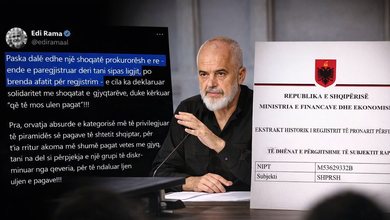
But beyond the tone, what stands out is a political fact: Berisha is acting in the same line of pressure on justice and especially on the Criminal Court as Edi Rama.
In early January, the Constitutional Court publicly reacted to Prime Minister Edi Rama's attacks, describing them as unacceptable pressure on an independent institution. That reaction was read as an act of defense of the independence of the judiciary.
Today the situation is symmetrical: Berisha is exerting the same kind of public pressure on GJK, even with even more stigmatizing language. At this point, GJK has a moral and institutional obligation to react in an equal manner — not only to Rama, but also to Berisha.
This is not to protect one political party, but to defend the principle: no one has the right to threaten, intimidate or delegitimize the Constitutional Court.
The problem is that, in their attacks on this court, but also on justice in general, neither Rama nor Berisha are motivated by public interest in justice, but by narrow political interests. Both are treating the Court of Justice as a battlefield, not as a guarantor of the Constitution.
On the other hand, today at a press conference, Berisha criticized the salary mechanism of magistrates, admitting that there is currently a serious problem in this scheme. This is essentially correct: the salary system is divisive and discriminatory between prosecutors and judges.
But herein lies the political paradox. Berisha is today attacking the 2016 salary scheme. But he deliberately forgets that in 2023 he was a co-author of the destruction of the legal scheme, along with the votes of his and Rama's deputies.
This very legal violation is the basis on which the associations of prosecutors and judges have raised the claim of salary discrimination. In other words, Berisha is criticizing today a problem that he himself helped create yesterday.
This act places the DP leader in a silent, but clear, synchronicity with Edi Rama: both have interfered with the legal architecture of the justice system, and today both complain about the consequences.