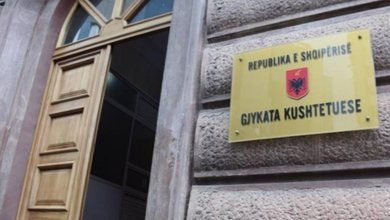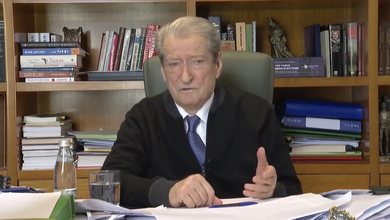



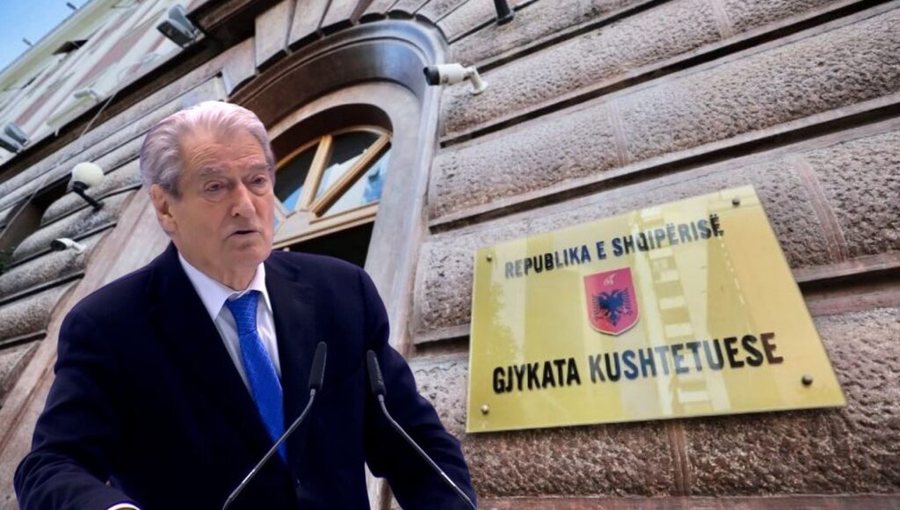
The leader of the Democratic Party, Sali Berisha, continued his harsh accusations against the Constitutional Court during a meeting with the Kamza Democrats, claiming that the judges reviewed a case that, according to him, did not concern them and unfairly kept it pending for two months.
Berisha focused specifically on the procedure, emphasizing that in any normal judicial case, a case must first go to the Appeal Court, then to the High Court and only finally to the Constitutional Court. According to him, in the case of Deputy Prime Minister Belinda Balluku, this path was deliberately bypassed.
"The judges held four sessions for a decision that, absolutely, was not their responsibility to review. Every citizen goes to the Appeals Court, from the Appeals Court to the High Court, and from the High Court to the District Court. While Lubia and these judges keep her directly at the District Court for two months, fabricating and tearing up documents. Only because she is Edi Rama. She is a thief because she has no one, but she is Edi Rama", said Berisha.
However, despite the delay, the Constitutional Court’s decision – which rejected the prime minister’s request to declare Balluku’s suspension unconstitutional – was objectively a blow to Rama’s government and a political favor for Berisha’s discourse and his action to overthrow the government. But the leading democrat chose again to attack judges in general terms, without mentioning names, even those who voted in favor of Rama’s request or delayed the decision. This rhetoric contradicts his previous political style, where he has often publicly mentioned the names of judges and prosecutors and directly attacked or exposed them.
Essentially, Berisha is right in the principle he articulates: a normal citizen should exhaust the judicial ranks – first the Appeals Court, then the High Court, and only finally the Constitutional Court. But this very principle exposes its contradiction.
But in his personal case, when he opposed the "compulsory appearance" measure, Berisha took the case directly to the Constitutional Court, without first going through the Appeals and the Supreme Court. So, what he now calls a violation in the Balluku case, he did himself when he was interested.
Moreover, there is a significant parallel between the two cases: in the Balluku case, the request to the Constitutional Court was not sent by the minister herself, but by the Prime Minister; while in the Berisha case, the request was not sent by Berisha herself, but by the DP parliamentary group. In both cases, the essence of the claim was the same – that prior authorization from the Parliament was required for the imposition of the measure: Berisha for “compulsion to appear”, Rama for “suspension from duty”.
This procedural symmetry makes the political question inevitable: are the DP and the SP like “two drops of water” at this point? And is it permissible to say that, even in this case, they act on the same institutional logic, despite the harsh public rhetoric?