



By Genc Sejko
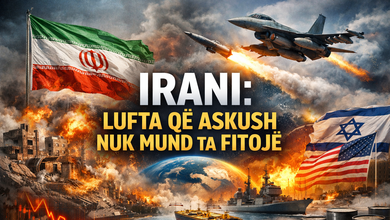
Although it is too early to assess whether the ceasefire in Iran will transform into a lasting peace agreement, early signs point to a Pyrrhic American victory in Iran. The war, which began without any concrete plan and with intelligence that later proved to be completely false, promised a swift end to the Iranian regime and the destruction of Iranian military capabilities.
Although the US and Israel managed to eliminate the ruling elite in Iran, the regime continues to exist. Until the last minute, Iran's military capabilities continued to attack Israeli-American interests in the region.
The ceasefire that was reached at the last minute was based on a 10-point plan, dictated by Iran and not by the US. This fact alone would be enough to understand who won in the latest conflict in the region.
In this plan, the only US achievement is the opening of the Strait of Hormuz, although this will be done under Iranian supervision and at a cost.
So, a strait where passage was free two months ago will now be subject to a toll. The funds raised from this toll will go towards rebuilding the damage caused by the war. This cost will be paid at the gas pump and on the supermarket shelves by every citizen in the world, including Americans.
But this is only the first point of the agreement. The other nine show even more clearly the real balance of power on the ground.
First, Iran retains the right to continue its nuclear program for civilian purposes without being forced to dismantle existing infrastructure. This means that the technological and scientific capacity built up over the years remains intact.
Second, all new sanctions imposed during the conflict will be gradually lifted, giving the Iranian economy an immediate breathing space.
Third, an international fund will be created for the reconstruction of damaged areas, with a large portion of the funding coming indirectly from energy transportation tariffs in the Persian Gulf.
Fourth, the US military presence at several bases in the region will be reduced, reducing pressure directly on Iranian borders.
Fifth, Iran's allied militias in the region are not included in the agreement and are not forced to disarm, which leaves Tehran with an important instrument of strategic influence.
Sixth, Israel and the US commit to stopping covert operations inside Iranian territory, including sabotage and assassinations of state figures or scientists.
Seventh, it opens a permanent diplomatic channel between Iran and Western powers for future negotiations, giving Tehran a stronger negotiating position on the international stage. Meanwhile, the US will have to sit down at the table with those who were on its elimination list until yesterday.
Eighth, Iran receives security guarantees that there will be no attempts at regime change through military intervention. So the regime not only did not fall, but was replaced with a newer and, according to information, even more radical leadership than the one that existed.
Ninth, the countries of the region will be included in a new collective security mechanism where Iran is one of the main actors.
And tenth, the agreement de facto recognizes Iran's role as a regional power in the Middle East, something that has been opposed by American policy for decades.
When all these points are seen together, the outcome of the conflict appears much more complex than the initial narrative of a quick military victory. Rather than being permanently weakened, Iran has managed to survive politically, maintain strategic capabilities, and emerge from the war with a consolidated role in the region.
In this sense, even if Washington can claim a tactical success, the strategic reality is more like a Pyrrhic victory: an expensive victory, with huge costs and much more limited benefits than expected.