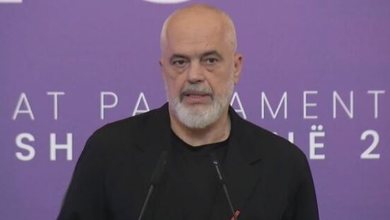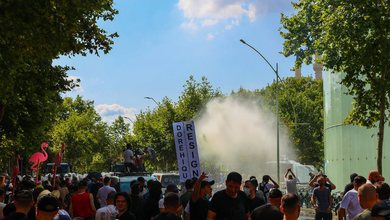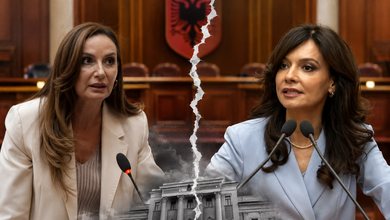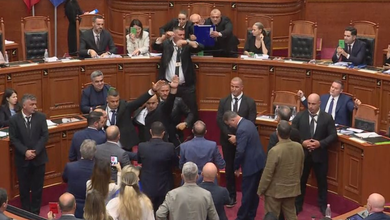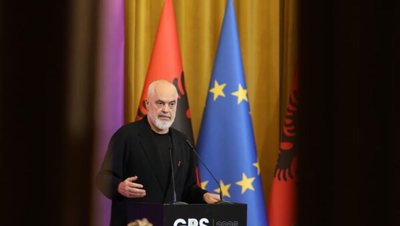



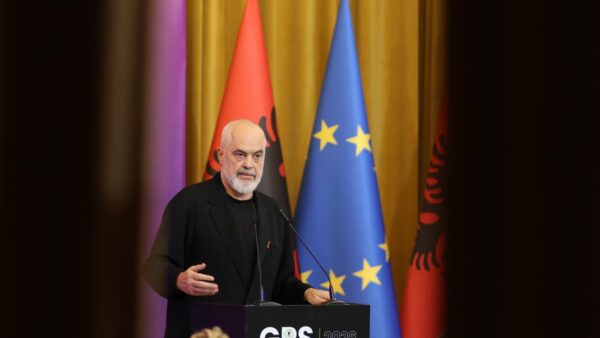
After more than two months of protests, Edi Rama decided not to respond to the protesters only politically. He chose a more refined argument. He quoted Alexis de Tocqueville to explain why people protest even when, according to him, the country has made progress. He recalled the well-known idea that societies become more demanding precisely when they improve and that “the most dangerous moment for a bad government is usually when it begins to reform.” It was an elegant way of saying that the protest is not necessarily proof of government failure, but can also be a consequence of rising expectations.
The argument is interesting. Even Tocqueville would accept it.
But only up to a point.
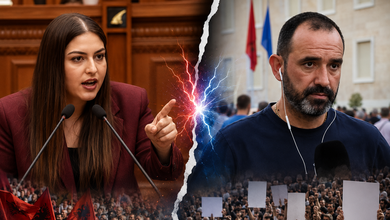
Because the protest that has been taking place in Albania for weeks has not come out to demand more reform. It has not even come out to demand better public services. It has chosen a much more brutal slogan: “Rama in prison, Berisha in prison.” A slogan that does not speak of higher expectations, but of a deep crisis of confidence in the entire political class.
Paradoxically, it was Rama himself who gave the protest some of its arguments.
In his speech before the socialist group, he admitted that the administration has become arrogant, that citizens wait for years for answers, that there are officials who speak to people "with a chair instead of a face," and he even admitted that there are those who ask for money. He acknowledged the lack of empathy and admitted that trust has weakened so much that, according to him, even facts no longer manage to convince citizens.
It is difficult to find a harsher description of an administration that has been built and run by the same majority for twelve years.
Here begins the second paradox.
While publicly admitting that the system has produced arrogance, corruption, and distrust, Rama does not pause for a moment to consider political responsibility. He does not ask why this happened. He does not ask who built this administration. He does not ask why, after twelve years, citizens no longer trust him.
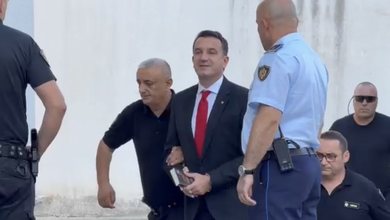
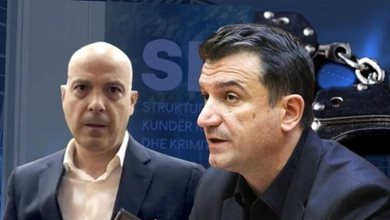
And perhaps I cannot ask this question without facing another reality: some of the most powerful people in his system are today under investigation or indictment by SPAK. The mayor of Tirana, Erion Veliaj, is facing criminal proceedings. Former ministers, former directors, high-ranking officials and figures who have been pillars of the socialist government for years have entered the justice files. This does not mean that the protest is right about everything. But it makes it much more difficult to explain the citizen anger only with the theory of “rising expectations”.
Instead of reflecting on this reality, Rama presented "Besa", the manual with which the Socialists will enter their fourth mandate.
And it is here that Tocqueville begins to spoil the scenario.
Because he wasn't just writing that reforms raise expectations. He was also warning that "in democratic societies, centralization easily gains extraordinary strength." It's not a phrase for protesters. It's a warning for power. About the danger that, the longer it stays in power, the more it identifies itself with the state and the less it manages to distinguish the line between responsibility and justification.
Perhaps this is why the protest continues even after the prime minister himself accepted a large part of its diagnosis. Because citizens are not just demanding acknowledgement of the problems. They are demanding to know who is responsible for them.
And this is the chapter of Tocqueville that was not heard in the parliamentary group meeting. Because the classics are not dangerous when you quote them. They are dangerous when they force you to follow to the end the logic of what you have just accepted.