


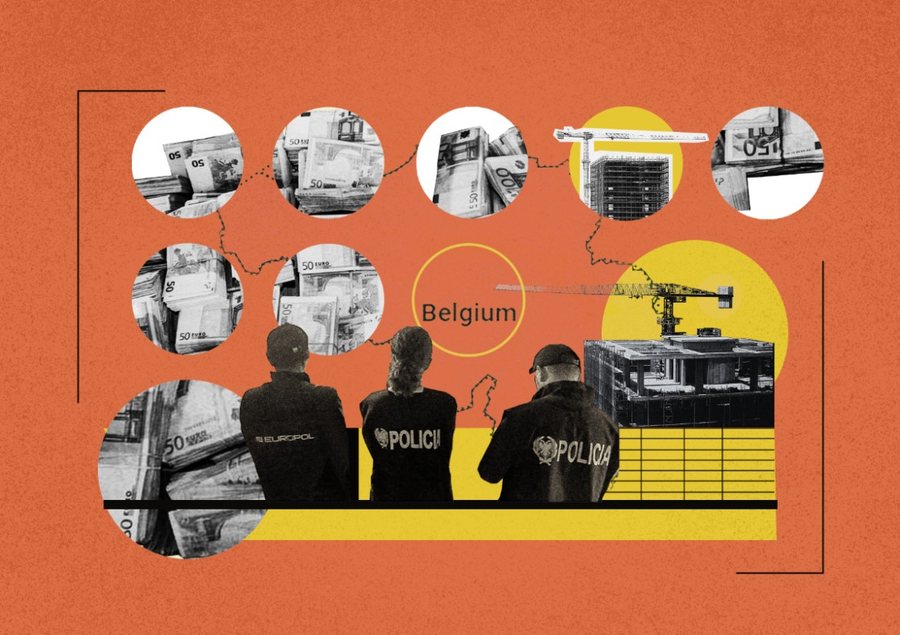
The investigation in Belgium and Albania of a person involved in drug trafficking reveals how businessmen with clean criminal records are being recruited into transnational money laundering operations.
In December 2019, an Albanian citizen, resident in Antwerp, Belgium, was boasting about his long list of assets in Albania, while under surveillance by Belgian authorities for involvement in the drug trade.
During a casual conversation with another Albanian, he also revealed his money laundering scheme in agreement with a local hydrocarbon trader from his hometown.
“I have 17 in Fier, I think I have 17 entrances, I have about 15 in Durrës, I have about 7 in Tirana, I have about 3 shops,” Besjan Ramaj is quoted as saying in the court file. “I had some olive trees in Belishovo, Ardjani bought them for me, supposedly,” he says.
Besjan Ramaj, 56, had been involved in the criminal activity of drug trafficking for at least a decade and had a criminal conviction from 2012 by Norwegian justice, at the time he was being wiretapped by Belgian authorities.
But his criminal record in Europe did not prevent him from investing more than 1 million euros in real estate in Albania, using businessman Ardjan Malasi and his company "Ledio - 04" as a front.
Unlike Ramaj, Malasi had a clean criminal record and fueled his seemingly legitimate business with cash originating from the drug trade. According to investigations initially conducted by the Belgians, Malasi's business also served as a cover for transfers of tens of thousands of euros from Albania to Belgium through banking channels.
In the money laundering schemes investigated, this is not an isolated case.
According to the Special Prosecution Office, members of organized crime are increasingly taking care to recruit people without criminal records and with business connections for their money circulation and laundering operations.
“Persons involved in money laundering are not necessarily connected to drug trafficking,” said Dorina Bejko, SPAK prosecutor.
"Mostly they are people with clean profiles, to imply that the activity is legal and everything is in accordance with the law," she added.
Money laundering fronts
Albania is the main destination for the profits of Albanian organized crime networks and one of the countries with the highest risk of money laundering in Europe. In 2025 alone, the Special Prosecution Office stated that it had seized and confiscated criminal assets worth 45.4 million euros – over 98 percent of which is suspected of originating from international drug trafficking.
Money laundering schemes have become sophisticated over the years, using various channels of transferring and masking funds through informal systems, the use of cryptocurrencies, and intensive cash circulation.
According to an analysis by the Special Prosecution Office, Albanian organized crime also uses formally legal commercial entities as a cover for the circulation and recycling of funds. The final stage of laundering includes investments in real estate, businesses with high cash turnover, and commercial activities with weak internal controls.
According to prosecutor Dorina Bejko, Albanian criminal groups are constantly looking for trusted third parties to use as a front in their money laundering operations; who could be business partners, founders of fictitious companies or their friendly connections.
"In cases of family members, trust is understandable, since due to the connection, the risk of betraying them is lower. But in the case of other third parties, [trust] can be created through notarial documents, financial dependence that third parties may have in relation to the person involved in drug trafficking, or even through pressure," Bejko explained.
Based on the files investigated by the Special Prosecution Office, the third parties are mostly entrepreneurs in the construction field, bar or restaurant managers, traders in the hydrocarbons field, or real estate agents.
"These are precisely the sectors where cash circulation is most sensitive, which makes money laundering easier and possible to mix between money generated from illegal activities and money that can be generated from the activities of these commercial companies," added Bejko.
The flow of criminal money no longer follows one direction, but is also transferred from Albania to European Union countries or Latin America, where Albanian organized crime groups operate. For this reason, international cooperation is essential for tracking and investigating these cases.
"Drug trafficking as a criminal offense has transnational elements. In this form, money laundering and the proceeds from this process can also be invested in foreign countries, making the criminal scheme even more complex," Bejko told BIRN.
Cleaning scheme
The city of Antwerp in northern Belgium is considered one of the main cocaine gateways in Europe, along with the port of Rotterdam in the Netherlands. According to a Europol estimate, around 70% of cocaine entered the European market through these two ports during 2024.
Anversa is also an early operational base of Albanian criminal groups, according to data obtained from messages exchanged through the Sky ECC application.
According to court documents obtained by BIRN, Belgian police tracked down Besjan Ramaj in September 2017, following an investigation into the sale of a quantity of cocaine. A second tip in 2019 linked him to a cannabis plantation in a building in Ternat, a rural municipality not far from Brussels.
After being arrested in 2020, Ramaj was sentenced in October 2021 to eight years in prison and an 80,000 euro fine for illegal cannabis cultivation and the export and transportation of 1,550 kilograms of cocaine. His brother, Leonard Ramaj, was also found guilty as part of the group and sentenced to 2 years in prison and an 8,000 euro fine.
According to information sent by registered letter from the Belgian authorities, Ramaj was accused of having, in collaboration with other persons, organized fictitious sales of his assets in Albania in order to secure "clean money", transferred through bank accounts to invest in the purchase of real estate in Belgium.
The investigation has documented how an olive grove in Belishovo, Mallakastra, was fictitiously sold to Malasi for 102 thousand euros - money transferred through a bank in Belgium and which served as the main source for the purchase of an apartment worth 198 thousand euros.
During the search of his home in Belgium after his arrest, documents related to the apartments in Fier or other transactions carried out by Malasi were also seized as evidence.
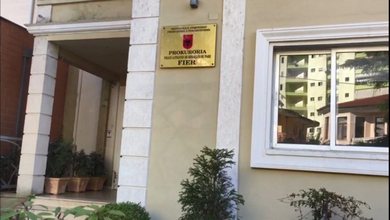
Based on information provided by Belgian counterparts, the Special Prosecution Office registered in 2023 a criminal proceeding for money laundering against the Ramaj brothers and two of their associates, Ardjan Malasi and Rajmonda Dashi – a former director of the Cadastre with friendly relations with Ramaj. The Special Prosecution Office also seized 19 apartments and garages in the cities of Fier and Tirana with an estimated value of 1.2 million euros; purchased mainly by Malasi, his company “Ledio -04” and Leonard Ramaj.
In October 2025, the Special Court found the four guilty of the criminal offense of “laundering the proceeds of crime” as part of an investigation based on the “Anti-Mafia” law, while dismissing the charges of a structured criminal group. The four defendants denied the charges and their collaboration with each other.
According to the court's decision, Ramaj had built a scheme characterized by the use of cash, its integration into commercial companies, loan transactions, and transfers between company accounts and personal accounts.
"Citizen Ardjan Malasi has continuously deposited cash into his trading company and then used it to purchase real estate for the defendant Besjan Ramaj. They have also been involved in fictitious sales and purchases, enabling the money to be put into banking circulation and then transferred to the personal account of the defendant Besjan Ramaj," the court's decision states.
"The issuance of fictitious invoices was also carried out through commercial companies established in Belgium by the two brothers and the company of citizen Ardjan Malasi. The amount of money involved in the criminal activity of laundering the proceeds of crime turns out to be approximately one million two hundred and fifty thousand euros and nine million lekë," the court's decision concludes. /BIRN/