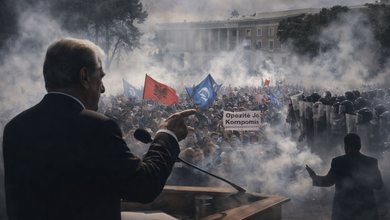



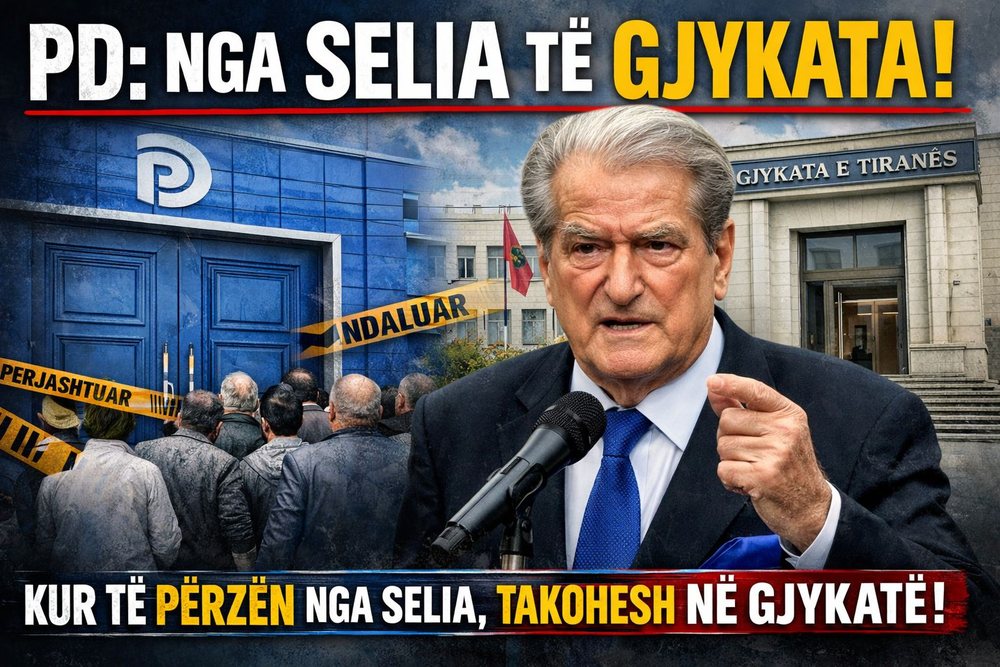
Today's scenes in front of the DP headquarters, where some former functionaries and former members of the Democratic Party of Durrës were confronted with the closed doors of their headquarters, brought to mind scenes that this party has seen not so long ago. The irony of history is almost cynical: the same people who once stood by Sali Berisha's side in his clash with Lulzim Basha, today find themselves on the other side of the door – excluded, unaccepted, anathematized. A return to what in popular language is summed up with a simple expression: karma is a bitch.
But beyond the anecdotal and symbolic dimension of this role reversal, the Durrës event is much more than an isolated episode. It is the clearest reflection of a deeper and more disturbing phenomenon: the institutionalization of exclusion as a political tool within a party that, at least in theory, should function on the principles of pluralism and internal competition.
For months now, the Democratic Party has been experiencing a wave of exclusions that hits any individual who shows, even indirectly, signs of dissent or ambition for challenge. This is an unusual development even by the standards of this party, which historically has not been a model of internal democracy.
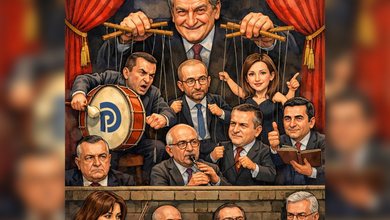
The paradox is obvious: in a party where most actors accept, tacitly or openly, that leadership is uncontested and that the outcome of every race is predetermined, the nervousness and aggressiveness of the leadership have never been so pronounced. In fact, the need to simulate a formal process of legitimization through a controlled race – a practice that at least maintained a procedural facade – has disappeared.
The announcement of a mayoral race a few weeks ago was accompanied by public statements from several party figures about running. Under normal circumstances, this would be a sign of the democratic health of a political organization. But in the current reality, these candidates themselves seem aware that the race is more of a formality than a real competitive process.
However, for this very reason, their responsibility becomes even greater. If they are serious about the challenge to leadership, then their response must be proportional to the attacks and exclusions they face. Otherwise, they risk being reduced to decorative figures – to a weak alibi for a predetermined process.
In any functional political party, internal conflicts have two paths to resolution: through political understanding or through internal institutions. In this case, both of these paths seem closed.
Public labels as “collaborators of the opponent,” “sold out,” or “caught in a crime” have burned every bridge of understanding. Meanwhile, the party's internal institutions are paralyzed by the dominance of an individual's will over any formal rule.
The images of local officials claiming to have been dismissed without being heard, without evidence, and based on hearsay are indicative of an institutional degradation that cannot be relativized. Even if one accepts the cynical argument that they are “reaping what they have sown,” this does not negate the fact that they are victims of a system that denies any minimum standard of internal justice.
In this situation, there is a clear legal instrument within the Democratic Party's statute itself. Article 46, point 8 – the so-called “Basha article” – provides that if the party loses the elections, the chairman's mandate automatically ends and he cannot run for re-election.
This article, once used as a political weapon against Lulzim Basha, today could become a precedent that directly affects Sali Berisha. The facts are simple: the elections were held, the Democratic Party participated, the results were certified and the party did not emerge victorious. Moreover, its representatives themselves continue to recognize the institutions that emerged from these elections, actively participating in parliamentary processes and reforms.
Arguments that the elections were a “farce” or “invalid” have no legal weight, neither in the statute nor in court. They remain simply political narratives for internal consumption.
In the absence of functional internal mechanisms, only one path remains: the judicial one. Ironically, it is the same path that Sali Berisha himself followed to take control of the party, in a process that also included much-discussed judicial decisions.
Therefore, today's scenes in front of the DP headquarters may only be the beginning of a new chapter: from the closed doors of the headquarters to the open doors of the court. If the opponents of the leadership decide to use the same instrument that Berisha himself used to take over the party, then the political battle will move to where it has already been fought before – to the courtroom.
The argument that this might “help the opponent” or create negative perception is more of an alibi than a strategy. After all, the recent history of this party itself proves that legal battles are not only legitimate, but also effective.
Moreover, the issue is not only related to the upcoming electoral process. There is a preliminary problem: since the certification of the elections by the CEC, the mandate of the current chairman is considered completed according to the statute and the position of chairman is vacant. This makes the position of the current party leadership, to put it mildly, legally questionable.
At this point, the dilemma is no longer procedural, but deeply moral and political. Not acting, in the name of excessive caution or tactical calculation, carries the greatest risk: delegitimizing oneself.
If these aspirants are excluded, prevented from competing, and yet do not use the legal instruments available to them, then the message they send to the public is clear: their dissatisfaction is not principled, but personal. And in this case, they not only lose the political battle, but also their moral credibility.
The situation in which these opponents of leadership find themselves today leaves no room for ambiguity. It is a point of no return. A real test, where public statements or internal rhetoric are not enough.
If they aspire to lead a political party, they must prove that they are capable of confronting real conflicts and using the instruments that politics and the law themselves offer. The challenge is twofold: to oppose illegal exclusions and to challenge the legitimacy of the current leadership's re-election.
This is the only serious, concrete and dignified path. A path that does not pass through violence or chaos, but through law and principle. And perhaps that is where the great irony of this story will end: the party that ended up in court to be taken, may end up in court again to be challenged.