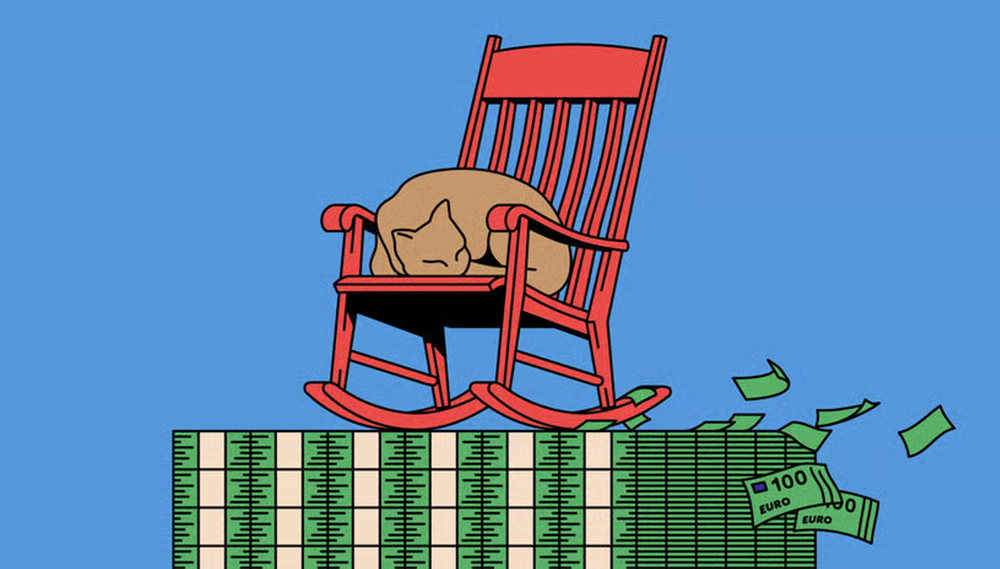
European pensions are a $30 trillion missed opportunity . If only more countries would follow the Dutch model, writes The Economist
Europe is known as the “old continent” because it is not the “new world.” From the democracy of ancient Greece to classical music, it is the cradle of Western civilization. Today, however, a less generous comparison is not with the new, but with the young.
The median age in the European Union is 45, six years higher than in America and four years higher than in China. The EU already has fewer than three working-age residents for every pensioner.
Public spending on pension benefits, healthcare and long-term care for the elderly is as much as a fifth of the bloc's GDP, and it is rising.
Proposals to cut pensions almost always face fierce opposition from aging voters. Resources are diverted away from important investments in sectors such as defense and infrastructure.
Pensions are, in other words, a huge economic burden for the EU. At the same time, however, they also represent a huge wasted opportunity. Pension funds in America manage assets worth $43 trillion, equivalent to almost 140% of GDP.
In the EU as a whole, this figure is just over $5 trillion, less than 30% of GDP. Its growth could do wonders for Europe's capital markets, which suffer from limited development.
In many European countries, the majority of pensions are provided by public schemes, and most of them operate on a “pay-as-you-go” model. Contributions are deducted from workers’ wages in the form of a payroll tax and used to finance payments to current retirees.
Very little of these funds are invested. In Germany, France, Italy and Spain, these systems cover more than 90% of workers. They create huge deficits that governments have to cover, ranging from 2% of GDP in Germany to 6% of GDP in Italy, according to the Boston Consulting Group.
Let's occupy W all Street!
There are also some occupational schemes, where employees set aside a portion of their salary. But these are small and, because they often guarantee minimum payments, a large portion of the funds are invested in safe government bonds.
In the EU's four largest economies, only about a fifth of the money in these schemes ends up in capital markets. Individual pension plans (which usually enjoy favorable tax treatment) are equally conservative, and often charge fees that erode already low returns.
A few exceptions show that this is not necessarily the case. Relative to GDP, pension assets in Sweden are almost as large as in America. Those in the Netherlands and Denmark are even larger (see chart).
At least 20% of pension portfolios in these three countries are invested in stocks, while the rest lies mainly in government bonds and other less risky assets.
A large portion of this equity capital goes to domestic businesses, which helps explain why these three countries have some of the most dynamic stock markets in Europe.
Some large Dutch professional funds have about half of their portfolios invested in European assets. AP4, one of the funds supporting the Swedish “pay-as-you-go” system, invests 15% in Swedish stocks and 9% in Swedish bonds, partly to match assets with liabilities in Swedish kronor and partly because of mandates that favor domestic investment.
Although only between 5% and 10% of Danish funds' equity investments are domestic, this still exposes them disproportionately to the domestic stock market, which represents only 0.5% of global market capitalization.
Historically, investing such a large portion of portfolios domestically has prevented European pension funds from benefiting from strong stock market growth elsewhere, particularly in America. However, the situation is now changing.
First, European stocks have recently outperformed their American counterparts. Since the start of 2025, the STOXX 600 index of large European companies has risen 36% in dollar terms, compared with 15% for the S&P 500, its counterpart across the Atlantic.
US companies are already highly valued relative to earnings, which could dampen future returns, while many European companies still look relatively cheap. And European tech firms are finally gaining traction.
This makes those investments more attractive to pension funds that are diversifying into venture capital and other alternative assets.
Reforming the rigid pension systems in countries like France and Germany to make them more like those in Denmark, the Netherlands and Sweden will not be easy. But the payoff is huge. If all EU countries had pension assets of 140% of GDP, the same as the US, then these funds would amount to almost $30 trillion.
If a quarter of that were invested in stocks, mirroring the share in Danish, Dutch and Swedish funds, and a fifth of that stayed in Europe, then the capital available to European companies would increase by $1.5 trillion.
For comparison, the current market capitalization of the STOXX 600 is $18 trillion. Europe would remain the old continent, but at least it would be more energetic./monitor.al