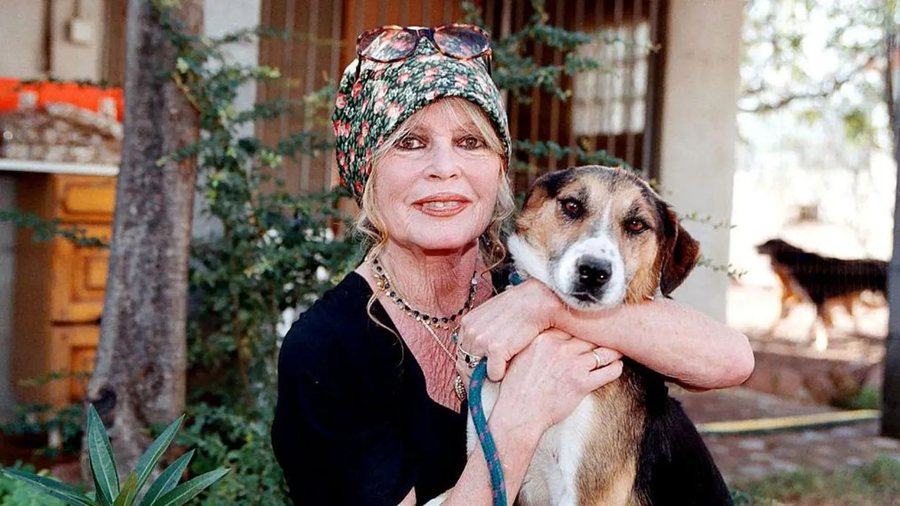
French right-wing figure Éric Ciotti has called for a national tribute to cinema legend Brigitte Bardot, prompting opposition from political rivals on the left.
"France has an obligation to honor its Marianne," Ciotti said, referring to the symbol of French freedom, whose face was entrusted to Bardot in the 1960s.
Bardot died on Sunday at the age of 91. A petition launched by Ciotti has so far collected more than 23,000 signatures and has the support of some far-right allies.
But the leader of the Socialists, Olivier Faure, has stressed that national tributes are reserved for “exceptional services to the nation.” Bardot was an iconic actress, but she also “turned her back on republican values,” Faure argued.
Bardot has been hailed by President Emmanuel Macron as a "legend of the century" who embodied a life of freedom, and Ciotti, the leader of the right-wing UDR party, has called on him to organize a national farewell ceremony.
Ciotti said France should recognize a woman who brought the country an extraordinary level of international recognition and who actively helped fight for women's freedom and abortion rights.
Meanwhile, the mayor of Nice, Christian Estrosi, has announced that the city will name a "symbolic place" after Bardot.
But Bardot is destined to remain a controversial figure in death, just as she was in life. Faure recalled that she was convicted five times for inciting racial hatred.
Bardot starred in around 50 films, after bursting onto the cinematic scene with the film And God Created Woman in 1956.
She retired from cinema in 1973 to devote herself to animal protection and lived for decades in Saint-Tropez, on the French Riviera, in her home called La Madrague.
But she became as well known for her far-right sympathies as for her love of animals. Some of her statements targeted Muslims, while others insulted the inhabitants of the French island of Réunion in the Indian Ocean.
"To be moved by the suffering of dolphins and be indifferent to the death of migrants in the Mediterranean - what level of cynicism is this?" Green MP Sandrine Rousseau asked on social media.
In France, there are various forms of national homage. Robert Badinter, who abolished the death penalty in France, was honored with a national homage in the form of a solemn ceremony in 2024, as was the singer Charles Aznavour in 2018.
A more likely option for Bardot would be a public farewell similar to that of rock star Johnny Hallyday, when huge crowds filled the streets of Paris in 2017.
Not everyone on the left is against the idea of a national tribute to Bardot.
"Why not? We have done it for other figures, especially for Johnny Hallyday," Socialist MP Philippe Brun told French radio. "If the president of the republic decides on this, I don't see why we should oppose it."
Bardot will be buried next to her family's graves in the Saint-Tropez maritime cemetery.
Bardot herself had avoided the public eye for decades, and her close friend, Wendy Bouchard, said she had no interest in medals and ceremonies.
"Maybe it comes from a good intention, but I'm not sure that she, who lived a life of simplicity and deprivation, would have wanted this national homage," she told French television.
Journalist Steven Bellery, who interviewed Bardot earlier this year, agreed that she wanted something much simpler and more intimate.
Bardot had asked to be buried at her home on the Riviera, in La Madrague, rather than in a public cemetery, fearing that "a crowd of idiots might damage the graves of my parents and grandparents."
However, the municipality of Saint-Tropez has announced that she will have a private burial in the public cemetery overlooking the Mediterranean, near her home.
The Brigitte Bardot Foundation, dedicated to animal welfare, announces that her funeral will be held on January 7 at the Notre-Dame de l'Assomption church and will be broadcast on screens throughout the city.