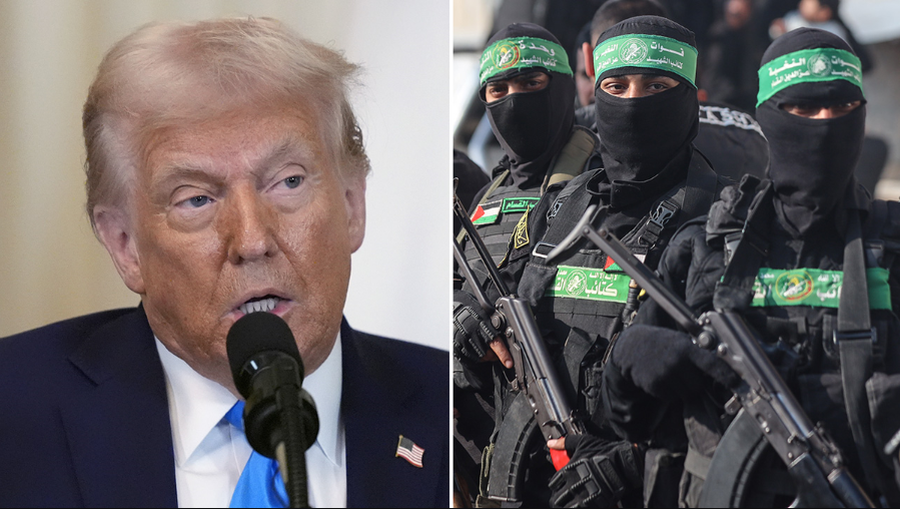
Hamas will be forced to allow the destruction of its extensive network of tunnels in Gaza and hand over its weapons in stages over an eight-month period, according to the disarmament plan presented to the fighters by Donald Trump's "Peace Council".
The plan follows a timeline that begins with a Palestinian technical commission, backed by the US, taking control of Gaza's security, and ends with the full withdrawal of Israeli forces "once it is confirmed that Gaza is free of weapons."
Disarming Hamas is a key point in talks to implement Trump's plan for Gaza and consolidate the October ceasefire, which ended two years of war.
Hamas has long rejected demands to hand over weapons, believed to be stored mainly in Gaza tunnels. Israel says it will not agree to withdraw from Gaza without a complete disarmament of Hamas.
A Palestinian official close to the talks described the plan as “unfair” and predicted that Hamas could demand some “changes and improvements.” The official, who requested anonymity because of the sensitive nature of the negotiations, said the plan provides no guarantee that Israel will fulfill its obligations and could increase the risk of a resumption of war by linking reconstruction and improving living conditions to political issues such as disarmament.
Reuters obtained the full text of the plan, which was first reported by Al Jazeera, from two Palestinian officials who attended the talks. A Hamas official confirmed its authenticity.
The Peace Council presented the plan to Hamas last week, and the organization has yet to make any public comment. A Hamas official said they are reviewing the document.
Three other Palestinian factions, including Islamic Jihad, criticized the plan, saying it unfairly prioritizes disarmament over reconstruction and the withdrawal of Israeli forces.
The plan consists of two elements: a 12-point document titled “Steps for Implementing Trump’s Comprehensive Peace Plan for Gaza” and a five-phase calendar where Hamas hands over its weapons within eight months.
According to the document, all armed factions in Gaza, including Islamic Jihad, will participate in the disarmament process under the supervision of Palestinian experts from the NCAG (National Committee for the Administration of Gaza).
“Gaza will be governed according to the principle of 'one power, one legal system, one army,' where only persons authorized by the NCAG may bear arms and all armed factions will cease military activities,” the document states.
The disarmament process will be verified by the Arms Collection Verification Committee, a body created by Nikolay Mladenov, the Peace Council's chief representative. Reconstruction will only be allowed in demilitarized zones.
Eight-month disarmament plan
After the October ceasefire, Israel controlled more than half of Gaza, while Hamas held the other half and its two million residents, most of whom were homeless after two years of intense bombardment.
Hamas, committed to armed resistance and sworn to the destruction of Israel, has publicly rejected disarmament, but in private talks has appeared willing if the process is accompanied by a political path leading to the creation of a Palestinian state. The 12-point plan does not mention the creation of a Palestinian state.
According to the plan's points, during the first phase, which will last 15 days, the NCAG will take over security and administrative control of Gaza and begin preparatory steps for the collection of weapons.
In the second phase, days 16-40, Israel will remove all heavy weapons from areas under its control, including heavy artillery and armored vehicles, and an international security force will be deployed.
The third phase, days 31-90, will be the most intense: Hamas will hand over all its heavy weapons and military equipment to the NCAG and allow the destruction of all tunnels, explosives, and military infrastructure.
In the fourth phase, days 91-250, the NCAG police forces will collect and register all remaining weapons, including rifles. Israeli forces begin to withdraw in phases.
The fifth phase is described as the “final verification” of disarmament, and in it Israeli forces withdraw completely from Gaza, except for their presence in a security perimeter, and comprehensive reconstruction efforts begin.