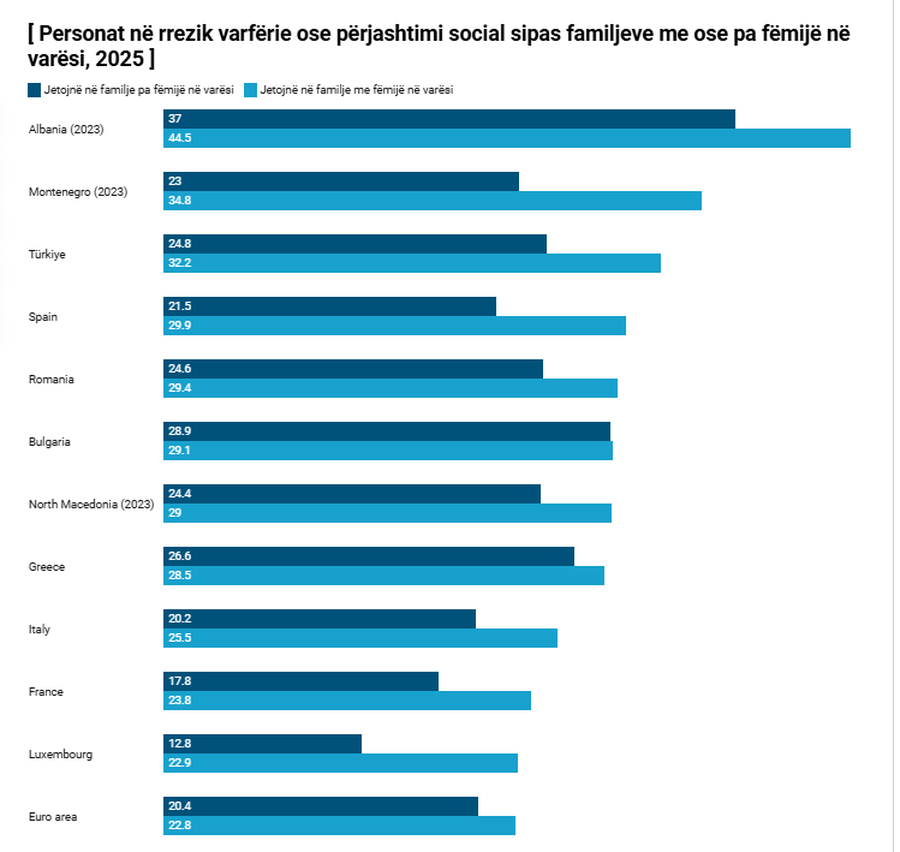


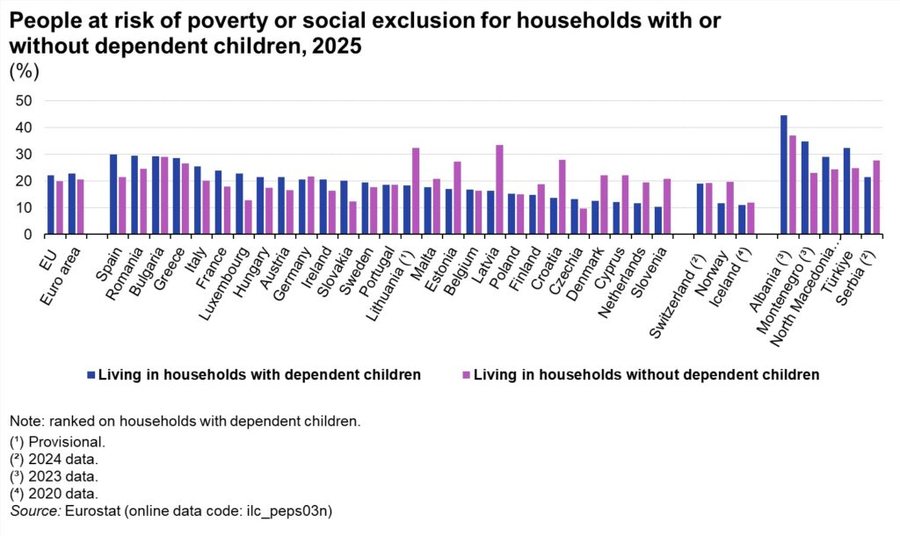
In Albania, 44.5% of families with children and 37% of families without children are considered at risk of poverty or social exclusion, according to data made public by Eurostat, which measures the indicator (AROPE - At risk of poverty or social exclusion).
This means that at least 37% of families in the country were in at least one of three situations: at risk of poverty, facing severe material and social deprivation, or living in a household with very low work intensity.
People are counted only once, even if they are affected by more than one of these conditions. Specifically, in Albania, 44.5% of households in Albania either have an income of 60% of the national median, or cannot pay bills, unexpected expenses, vacations, food, or live in a household where most members work very little, or a combination of some of these conditions.
Albania has this indicator the highest in Europe and well above the European average of 19.8% for families without children and 22.1% for families with children (20.9% average).
Despite the satisfactory economic growth figures and stable macro indicators that the country has had in recent years, the high level of this indicator is a signal that development has not been inclusive, as long as poverty in the country continues to be high.
Albania's per capita income, according to the latest IMF data for 2026, is $12.5 thousand, up from $4.1 thousand in 2010. Albania has surpassed North Macedonia, which has this indicator of about $12 thousand for the same period, while in 2010 it was $4.8 thousand. However, the purchasing power of Albanians remains lower than in Macedonia, despite increased incomes.
Poverty among Albanian families is much higher than in the region. In Montenegro, 23% of families without children and 34.8% of families with children are at risk of poverty. In Serbia, these indicators are 27.6 and 21.4 respectively (the only one in the region where families with children have a lower poverty level than those with children).
Even North Macedonia, which we recently surpassed in per capita income, has 24.4% of families without children in poverty and 29% of those with children. Data for Kosovo and Bosnia are missing.
In terms of per capita income, according to the IMF, Serbia leads ($17.2 thousand), followed by Montenegro ($16.4 thousand). Bosnia and Kosovo rank below Albania, with $10.7 thousand and almost $9 thousand, respectively.
When you are considered at risk of poverty
According to Eurostat, the “at-risk-of-poverty” indicator measures the percentage of people living with an income below a certain threshold in their country. According to Eurostat, a person is considered at risk of poverty if their disposable income (after social transfers) is below 60% of the national median income.
The “Severe Material and Social Deprivation Rate” (SMSD) measures the percentage of the population that cannot afford to meet some basic living needs. According to Eurostat, a person is considered to be in severe material and social deprivation if they cannot afford at least 7 out of 13 basic items, such as paying bills, unexpected expenses, holidays, regular food, internet or participation in social activities.
The Severe Material and Social Deprivation Rate (SMSD) measures the percentage of the population that cannot afford to meet some basic living needs. According to Eurostat, a person is considered to be in severe material and social deprivation if they cannot afford at least 7 out of 13 basic items, such as paying bills, unexpected expenses, holidays, regular food, internet or participation in social activities.
Persons living in households with “very low work intensity” are those living in households where working-age members worked 20% or less of their total work potential during the year.
europe
According to Eurostat, in 2025, around 92.7 million people in the EU were at risk of poverty or social exclusion, equivalent to 20.9% of the total population.
The AROPE rate varied significantly across EU countries. Bulgaria, with 29.0%, Greece, with 27.5%, and Romania, with 27.4%, reported the highest proportions of people at risk of poverty or social exclusion in 2025.
In contrast, the Netherlands, Slovenia, Poland and the Czech Republic had levels lower than 16.0%./Monitor.al/