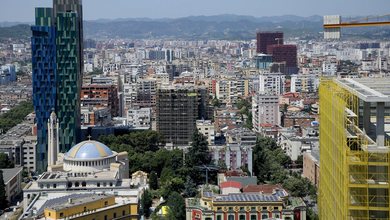


With average apartment prices in the capital exceeding 2,000 euros per square meter and wages growing at a much slower pace, Tirana has caught up with Milan in terms of house prices measured by purchasing power, while becoming among the most expensive capitals in Europe.
According to the latest data from Numbeo, a global data unit that measures the affordability index of real estate purchases, the price-to-income ratio in 2026 has reached 17.6 years. This indicator is calculated as the ratio between the average price of an apartment and a family's disposable income, expressed in years of income.
The price-to-income ratio measures how many years of household income it takes to buy an average apartment. The lower the ratio, the more affordable the apartment is. The calculation is based on net household income, the average apartment size of 90 m², and the average price per square meter in the city center and outside the city center.
Albania ranks as the fourth most expensive capital city in Europe, behind Moscow in Russia, which leads with 22 years, Lisbon in Portugal with 19.2 years and Prague in the Czech Republic with 18.6 years. In Rome, the Italian capital, it takes an average of 14.5 years of work, the same in Vienna, and in Paris 15.4 years. Tirana has also surpassed Belgrade, which until now held the throne as the most expensive capital in the region, according to purchasing power, which has fallen behind the Albanian capital, with 16.4 years.
Interestingly, Tirana has become as expensive as Milan, where residents need 17.7 years to buy an apartment. However, the reasons driving the price increase in Milan are quite different.
In recent years, Milan has become one of the main business and financial centers in Europe, attracting multinational companies, investment funds and regional offices of large corporations. After Brexit, many financial institutions and professional services relocated their activities to cities like Milan, increasing the demand for offices and apartments.
This has been accompanied by the development of new urban areas, such as Porta Nuova or CityLife, which have attracted a new segment of high-income buyers. Despite Milanese residents complaining that living has become more expensive for them, the rise in prices in Milan has ultimately reflected an economy that is expanding its productive base and attracting qualified workers and long-term investment.
The demand for housing in this case is supported by higher wages, the presence of large businesses, and a more developed rental market, where properties are used more efficiently, elements that have also encouraged increased employment and opportunities for locals.
In Tirana, the picture is different. The rise in apartment prices has not been accompanied by a similar increase in incomes or the influx of large foreign investments that would support demand. Unlike Milan, where the real estate market is fueled by an expanding and internationalized economy, in Tirana demand remains more limited and fragile.
Foreigners, who have increased their presence in the Albanian real estate market, mostly prefer coastal areas, where investment is more related to tourism and seasonal use of properties. In the capital, their interest remains more limited.
On the other hand, domestic buyers face a large gap between prices and incomes. A large proportion of families are finding it increasingly difficult to enter the housing market, shifting demand towards rentals or postponing purchases indefinitely.
Large foreign business inflows are lacking. More than a third of foreign direct investment is for real estate purchases, mainly on the coast, not the arrival of real companies, which would increase demand for office space or employees in the capital.
Even Albanian businesses, generally small and with limited capacities, do not create a sustainable demand for the office market. According to other INSTAT data, there are only about two thousand enterprises in the country that have more than 50 employees, out of 132 thousand enterprises in the country.
Under these conditions, the rapid increase in prices in Tirana risks not being supported by real demand, but by the so-called phenomenon of "parking money", or investing money earned from illegal activities, or corruption. Some of the new apartments, especially in the high-end segment, may risk remaining unused, despite the fact that they may have been sold.
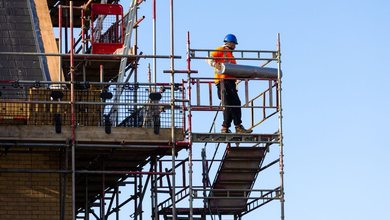
Meanwhile, construction is expected to take on even greater proportions, given the record revenues generated from the issuance of new construction permits in the first two months of this year. According to official data from the Ministry of Finance, revenues from local taxes, represented by the infrastructure impact tax (TNI) for the period January-February 2026, reached a historical record, reaching 11.2 billion lek, a fourfold increase from the previous year.
Based on the amount collected of 11.2 billion lek, and the fact that the infrastructure impact tax is 4-8% of the sales value of buildings, permits have been granted in the country for other constructions worth at least 1.4 billion euros./Monitor