

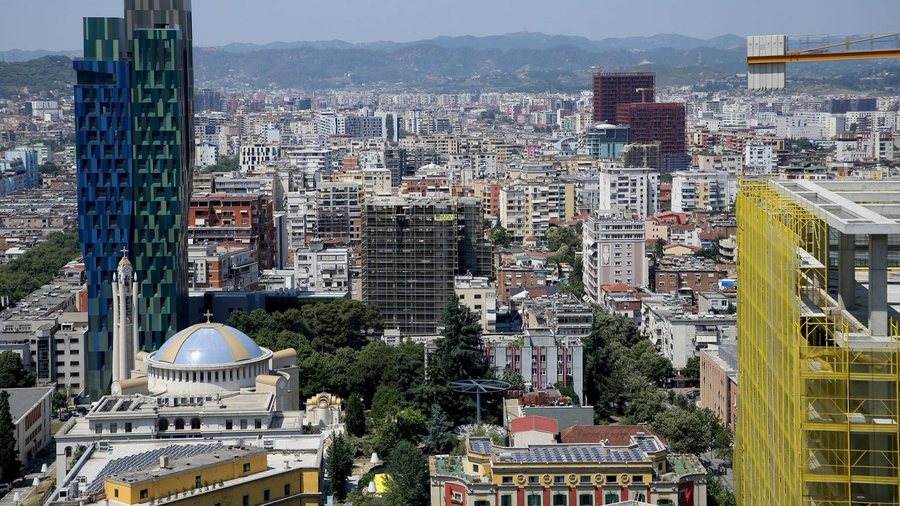
Official data on the real estate market in Albania shows a reality that challenges the basic rules of economics. Transaction figures from the State Cadastre Agency, ASHK, for the period 2021-2025, crossed with demographic changes and INSTAT data on building permits reveal a clear anomaly, where the volume of construction and property prices continue to increase, while the number of sales shrinks.
Data obtained through a right to information request to the Albanian Housing Agency (ASHK) shows that after a boom in 2022, apartment sales in the capital experienced a significant and continuous contraction for two years in a row, before showing stabilization and slight growth during 2025.
In a functioning economy, this should be the moment when basic rules come into play. When demand falls and unsold stock rises, prices should fall to encourage buyers. However, in Tirana, property prices experienced an aggressive increase during 2023-2024, making housing an impossible mission for the middle-class citizen.
This is the essence of what experts consider the “concrete paradox”; where instead of the market self-correcting from the lack of traditional buyers, it is being held hostage by the atypical buyer, who is immune to bank loans and interest.
“The construction sector is used as a conduit for informal and criminal money, reducing the pressure to sell quickly and allowing prices to remain high, regardless of the real income of households,” says Zef Preçi, director of the Albanian Center for Economic Research.
According to him, this informal flow of capital has created a "wall" of prices, which according to experts is deforming the national economy.
Property sales trend
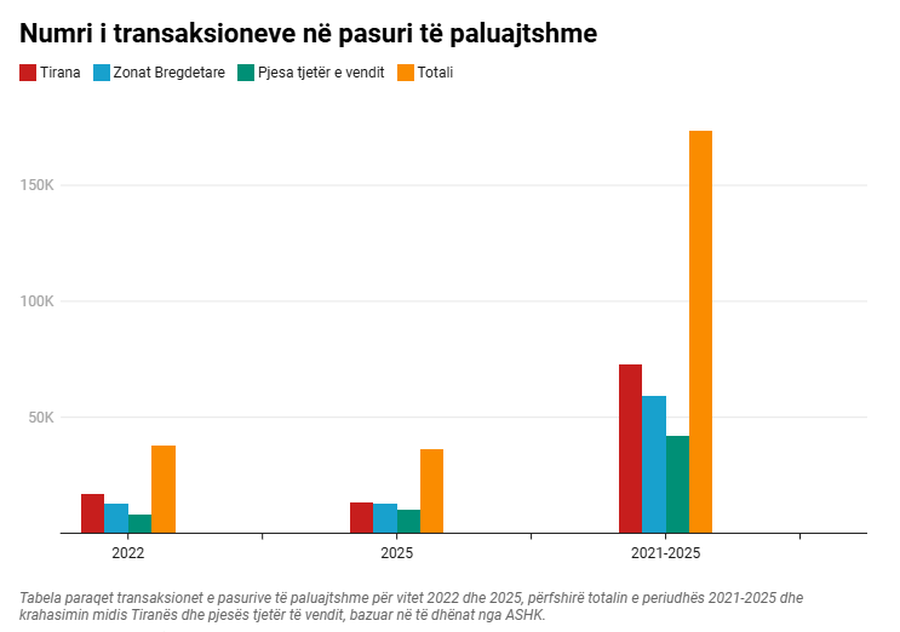
Statistical data from the State Cadastre Agency show that 2022 was the "golden year" after the pandemic for the real estate market, while the following years saw a decline in sales.
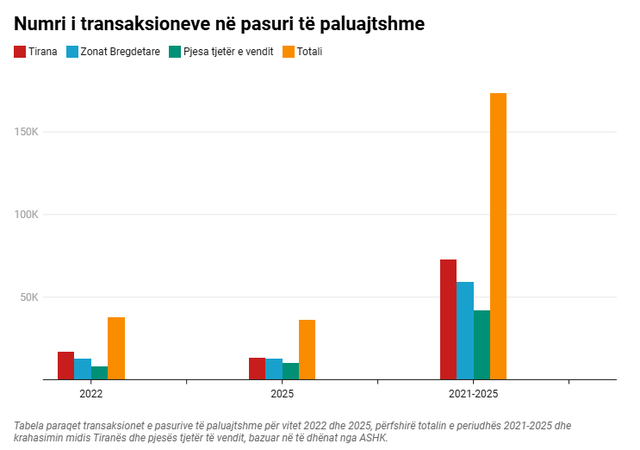
At the national level, the property sales trend reached an absolute peak in 2022 with 37,684 contracts, followed by a substantial contraction of approximately 17.2% by 2024, dropping to 31,199 contracts. The market recorded growth again during 2025, where 36,027 real estate transactions were recorded.
While the number of transactions at the national level improved, Tirana - which holds the main weight with over 41% of transactions in these 5 years, has not yet reached the sales level of 2022. Taken together, the 4 regions of ASHK in Tirana recorded over 17 thousand transactions in 2022, while in 2025 around 13 thousand.
The volume of transactions occurring in the capital, compared to the total nationwide, fell from 45.5% in 2022 to 36.5% in 2025. The data shows that the market shifted to the coastline and other areas of the country, which are also responsible for what appears to be a market recovery over the past year.
For example, in the area covered by the “Tirana North” directorate, which includes some of the most rapidly developing areas, including the New Boulevard, 4,735 sales contracts were registered in 2021 and increased to 6,201 transactions in 2022.
But after that point, the market fell. In 2023, the number of sales fell to 4,729, and in 2024, it hit the bottom of this cycle with just 4,073 contracts, a drastic drop of nearly 35% compared to the boom year.
According to Ylli Sula, director of the company "Çelësi" that compiles the "Keydata" price index, this is the area with the lowest prices in the capital.
"From this relative perspective, this area remains, as before the price jump of 2022, the area with the lowest prices in Tirana," says Sula.
He explains the decline in transactions with the decline in internal migration numbers and the inability of this group moving from the districts to Tirana to buy at current prices.
"As for the decline in the volume of contracts in this area, our interpretation links this phenomenon mainly to the decline in the internal migratory flow towards the capital from the low-income group of buyers that has constituted the main potential for this area over the years, and to the inability of this group to cope with this level of price increase," he said.
A similar trajectory is observed in the area known as “Tirana South”, which includes the center of Tirana and the coveted part around the Artificial Lake park. From 3,960 contracts in 2022, the figure in this area fell to 3,109 in 2024. The south of the capital had a stronger comeback in 2025, but again without reaching the figures of two years ago.
“The inelastic investor”
According to the "KeyData" index of the Çelësi company, property prices in the capital for the last 3 years [2023-2025] have increased between 49.4% in the northern area to 74.9 percent in other areas of Tirana.
For economic expert Zef Preçi, the increase in prices despite the decline in demand has a number of factors, including higher costs, increased local and central taxes, increased reference prices, and a speculative market with a large presence of dirty money.
"There are several indicators where one can reasonably suspect the presence of dirty money in the construction sector, but none of them is 'proof' alone," he says, citing the forms of financing of luxury projects in the capital that are being developed by companies without clear capital.
For him, building large towers without obtaining credit is a clear signal of danger.
"We have construction companies with very low declared turnover over the years, which suddenly receive permits for projects worth tens of millions of euros and do not report the source of capital, or have an ownership structure with a chain of shell companies, often offshore," Preçi emphasizes.
Eduard Gjokutaj, head of the economic research center ALTAX, also explains that price increases are being driven “by selective demand focused on premium segments.” This creates what he calls an “inelastic investor,” a profile that possesses abundant liquidity and does not react to price fluctuations.
For experts, this market dominated by buyers who don't ask about prices is evidence of the informal economy and suspicions of money laundering. Eduard Gjokutaj warns that Tirana's financial landscape cannot be analyzed without taking into account the "red flags" waving over this sector.
“The systematic gap between the prices declared in contracts and the real market value is the first sign of a parallel economy,” he points out. According to him, this phenomenon is easily confirmed by another anomaly: “An extremely low ratio of mortgage loans to total transactions, which suggests that a significant part of real estate is being absorbed by liquidity outside the banking system.”
Also, another alarm signal are the so-called "flip transactions" or the rapid resale of properties: "Without having any real residential or economic function, it indicates a speculative nature of the market," emphasized Gjokutaj.
Dutch Disease
Data from the 2023 Population and Housing Census by INSTAT show that the resident population in Albania has suffered a drastic decline compared to 2011, a phenomenon that affects almost the entire country.
The Tirana region is the only one that still records an increase in population, thanks to continuous urbanization and internal migration to the capital. But despite this population growth, in 2023 there were 52,800 uninhabited apartments in the Municipality of Tirana. Calculated on a conservative average surface area of 80 square meters and the average state reference price in the capital of around 1,290 Euros per square meter, these empty buildings represent nearly 5 billion Euros of “frozen” capital.
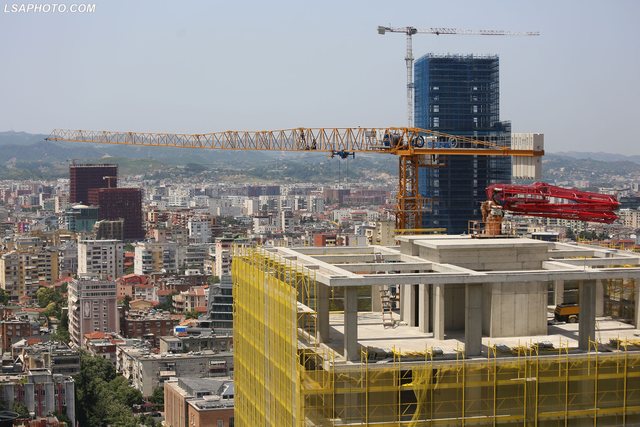
Despite the population decline, INSTAT data shows that permits were issued for 2.4 million square meters of new construction space in 2024. In 2025, the area fell to 1.3 million square meters.
This situation is threatening, according to experts, the country's macroeconomic structure. For Zef Preçi, this is a profound paradox since the current volume of construction is not based on any real macroeconomic projection.
“The IMF and other institutions expect real GDP growth of around 3–4% per year in the next decade… this is not enough to justify construction taking such a large share of total investment, reaching around half of investment in some years,” he explains.
This craze for throwing money into concrete is creating ripple effects. Preçi uses the term “Empty Towers” to describe thousands of unused apartments and offices that hold huge investment values locked up.
“The more capital is held in empty buildings, the less capital is left for sectors that increase productivity and exports, holding back long-term GDP growth,” warns Preçi.
Gjokutaj also emphasizes the same point that construction has abandoned its social function.
“Property is being used as a 'store of value', fueled by inward urbanization towards the capital and diaspora demand,” he said.
According to him, Albania risks falling into what is known in economics as "Dutch Disease", when the strengthening of the local currency due to large inflows of foreign exchange to purchase real estate harms the rest of the economy.
“We are in conditions defined as 'Dutch Disease', where excessive concentration in one sector (construction) 'kills' other competitive sectors by increasing input costs (labor and land),” says Gjokutaj. This situation, according to him, creates an “illusion of wealth,” while leaving productive and innovative sectors underfunded, hitting long-term sustainable development. /BIRN/